
Texas Auto Liability Coverage: What It Pays For and Penalties
Texas auto liability coverage explained: learn what it may pay after a crash, Texas minimum limits, what it excludes, and penalties for driving uninsured.

Texas auto liability coverage explained simply: it pays for covered injuries and property damage you cause in an accident, up to your policy limits. Texas’s minimum is commonly called 30/60/25; according to the Texas Department of Insurance, it includes bodily injury limits of $30,000 per person and $60,000 per accident. Driving without required insurance can also bring fines and other consequences.
For drivers commuting around Austin or traveling between Central Texas communities, understanding Texas auto liability coverage before an accident can help you make more informed choices. Your routine, passengers, and vehicle use can shape the questions to raise during a policy review. This guide explains what liability insurance may pay for, what it does not cover, and the possible consequences of driving uninsured.
Key Takeaways
- Understand which injury and property-damage costs liability coverage may pay when you cause a crash.
- See where liability coverage stops, including expenses for your own injuries or vehicle repairs.
- Learn how driving uninsured can create consequences beyond a fine, including registration and license-related penalties.
- Consider how your policy limits and other available coverages affect your financial exposure after a collision.
What does Texas liability insurance cover?
Texas liability insurance can pay for covered injuries and property damage you cause in an accident, up to your policy limits. Texas’s minimum is commonly called 30/60/25, but those limits can leave costs beyond your coverage.
Texas Minimum Liability Limits
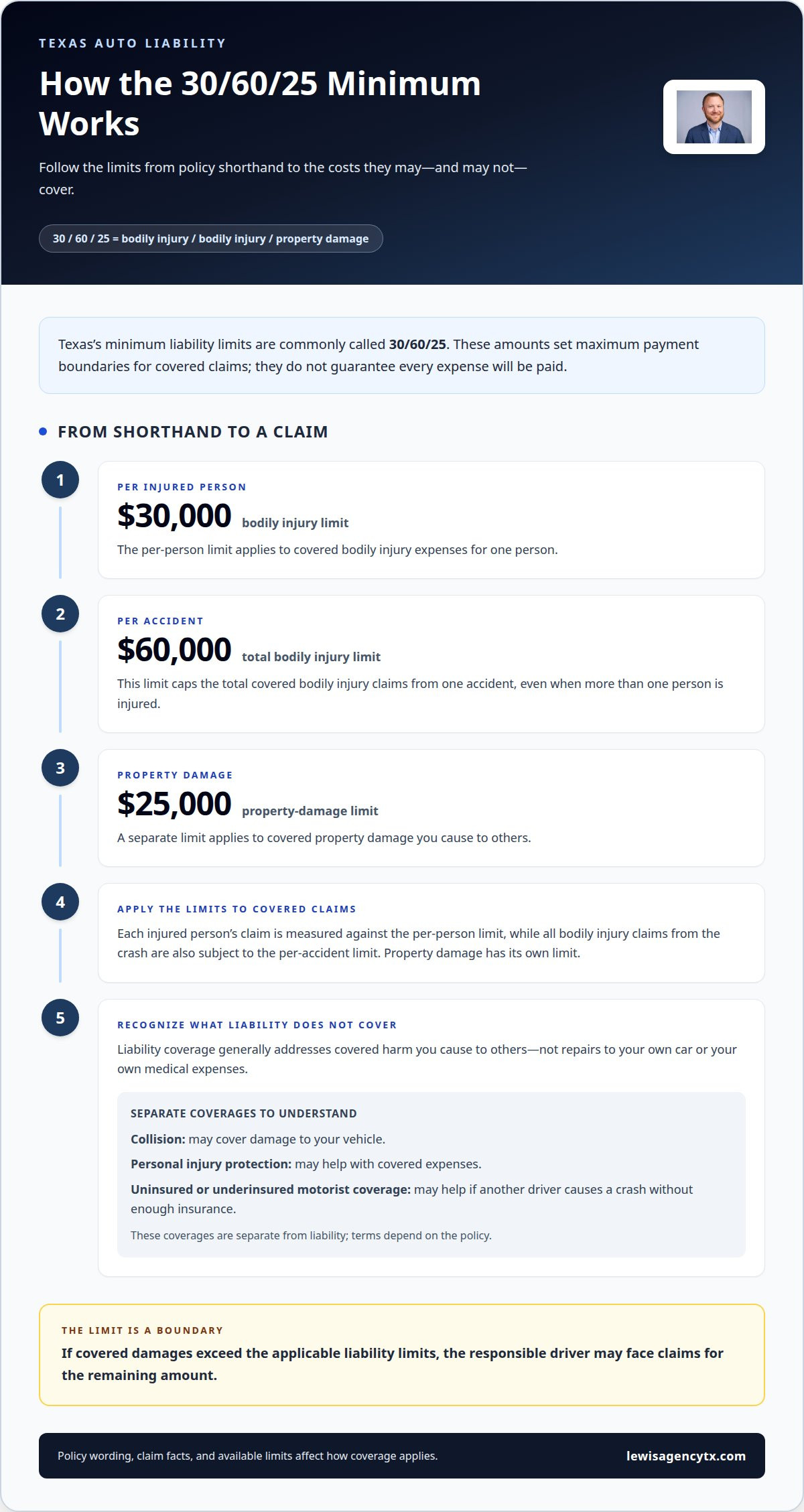
The 30/60/25 shorthand means bodily injury limits of $30,000 per person and $60,000 per accident, plus $25,000 for property damage. According to the Texas Department of Insurance, Texas auto liability insurance must provide at least $30,000 for bodily injury per person. According to the Texas Department of Insurance, it must provide at least $60,000 for bodily injury per accident. The $25,000 property-damage limit completes the minimum. These amounts set the policy’s maximum payment boundaries, not a guarantee that every expense will be paid.
Choosing limits means weighing potential claim costs against your finances. Drivers with savings, property, or substantial income may face greater personal exposure if a claim exceeds their liability limits. Higher limits can provide more coverage for covered claims, but the appropriate amount depends on your circumstances and policy.
Applying Limits to Accident Claims
Liability limits cap what a policy may pay for covered claims arising from an accident. The per-person bodily injury limit applies to one injured person, while the per-accident limit caps the total for bodily injury claims from that crash. Property-damage liability has a separate limit.
For example, if two people have injury claims, each claim is measured against the per-person limit, and their combined covered expenses are also subject to the per-accident limit. If damages exceed the applicable limits, injured people may pursue the responsible driver for the remaining amount. After an accident involving liability claims, notify your insurer and provide the details and records it requests. Keep documentation of expenses and lost wages, as these may be part of an injury claim.
Coverage for Your Car and Injuries
Liability insurance generally pays for covered harm you cause to others, not repairs to your car or your own injuries. If you cause an accident, liability coverage does not pay for damage to your vehicle or your medical expenses. Keep that distinction in mind when deciding whether minimum coverage meets your financial needs.
Texas drivers may consider separate coverage for their own losses, such as collision coverage for vehicle damage or personal injury protection for covered expenses. Uninsured or underinsured motorist coverage may also help if another motorist causes a crash without enough insurance. These coverages are separate from liability insurance, and their terms depend on the policy.
Penalties for driving without insurance
Driving without required insurance in Texas can bring fines and other consequences. A first offense can result in a fine from $175 to $350. A subsequent conviction for driving without insurance or another accepted form of financial responsibility generally carries a fine of $350 to $1,000.
The consequences may extend beyond a court fine. Uninsured driving can lead to vehicle-registration suspension, and repeat offenses can bring higher fines or possible vehicle impoundment. A driver whose license is suspended may need an SR-22 filing to regain driving privileges. For an uninsured driver with a safety responsibility suspension, the surcharge is $250 per year for 3 years from the conviction date. If an uninsured driver causes a collision, they may also face responsibility for medical expenses, property damage, and legal fees.
Hail damage is separate from a citation for driving uninsured. Liability coverage addresses harm a driver causes to others; damage to the driver’s own vehicle requires separate coverage. Before driving into Mexico, review your policy’s territory and coverage terms. These questions concern what a policy covers, not whether you have met Texas financial-responsibility requirements.
Drivers who have difficulty obtaining coverage may have another route: the Texas Automobile Insurance Plan is intended for drivers rejected by at least 2 insurance providers. It is designed for access to required insurance, not as a substitute for understanding policy limits. A conversation about auto coverage options can help clarify the protections in your policy and the questions to consider before driving.
Liability coverage and what it pays for
Homeowners liability coverage may help with certain claims if you’re legally responsible for someone else’s injury or property damage. For example, a guest who is injured at your home might make a claim for covered medical expenses, or someone might seek payment for damaged belongings. The policy’s terms, exclusions, and limits determine whether coverage applies and what the insurer may pay. To understand your homeowners liability coverage, start by identifying who was injured or whose property was damaged.
For example, imagine a visitor trips on a walkway at your home and is injured. The visitor could make a claim for related losses, which would be evaluated under the policy and the circumstances. If the claim is covered, the policy’s available limits may affect payment. Liability coverage does not automatically pay just because someone is injured or property is damaged.
The circumstances matter. A claim involving an injury or damage may be handled differently depending on what happened and the policy language. Homeowners liability coverage is separate from coverage for damage to your own home or belongings, and exclusions or other policy terms may apply. Review your policy to understand how these coverages are described.
The practical takeaway is to consider who experienced the loss and what caused it. Liability coverage may address covered claims by others when you’re responsible; coverage for your own home or belongings is a separate question. Policy wording, claim facts, and available limits all matter. For help understanding your policy, ask Chris about your coverage.
The Lewis Agency: Homeowners Insurance
The Lewis Agency helps Central Texas homeowners understand policy language, deductibles, and how coverage may apply to a claim. Its homeowners insurance offering can be a useful next step if you are reviewing your coverage or have questions about your policy. Coverage and claim decisions depend on the policy and circumstances; the agency can explain policy terms and the claims process.
Bring questions about a specific coverage term or a change to your home. A clear policy review can help you understand what your coverage is intended to address and where you may have questions.
Contact The Lewis Agency to discuss your homeowners coverage questions.
Make Your Next Policy Review Count
With Texas homeowners coverage explained, you can make your next policy review more focused. Consider how your home, belongings, and financial responsibilities fit together. Note any unclear terms, such as how coverage applies to your home or what deductible may apply to a claim. Specific questions make a review more useful than looking at a coverage amount in isolation.
The Lewis Agency helps Central Texas homeowners understand policy language and how coverage works. A conversation can clarify what your current policy says and identify topics to revisit as your needs change. Coverage depends on the policy and circumstances, so focus on the details that apply to you.
Contact The Lewis Agency to talk through your homeowners coverage questions and take a thoughtful next step.
Frequently Asked Questions
What Happens If You Drive Without Insurance?
Driving uninsured in Texas can have legal and financial consequences. If you cause a crash, you may be personally responsible for costs insurance does not cover, including other people’s medical expenses and property damage. A collision can also bring costs beyond immediate repairs. Keep proof of valid coverage available when driving, and do not drive until you have the required financial responsibility in place.
Do I need PIP or uninsured motorist coverage in Texas?
Texas drivers are not required to keep either coverage, but insurers must offer both. Personal injury protection, or PIP, can pay covered expenses regardless of fault. Uninsured and underinsured motorist coverage may help with covered losses if the responsible driver has no insurance or insufficient limits. If you decline either option, the rejection must be in writing under the stated Texas requirements.
How does Texas’ 51% responsibility rule affect a claim?
Under Texas’s proportionate responsibility rule, a person found more than 50% responsible for an accident generally can’t recover damages from the other parties. For example, if a person is found 51% responsible, the rule generally bars recovery from those parties. Responsibility findings affect whether a claim can recover damages, so the assigned share of fault matters alongside the losses documented.
Is PIP required in Texas?
No, Texas law doesn’t require drivers to keep PIP. Insurers must offer at least $2,500 in PIP coverage, and a policyholder may decline it in writing. PIP can cover certain expenses after an accident, including covered medical expenses and lost wages, regardless of who caused the crash. Whether keeping it fits your needs depends on the protections you want in your auto policy.
Is Texas a no-fault state because it offers PIP?
No. Offering PIP does not make Texas a no-fault state. PIP can pay covered expenses regardless of fault, but that is separate from determining who caused a collision. Liability claims still depend on responsibility for the crash, and policy terms and limits affect how claims are handled. PIP is one component of coverage, not a replacement for liability insurance.

Article by
Chris Lewis
Chris Lewis is the owner of The Lewis Agency, an Allstate insurance agency serving Austin and Central Texas. With more than 25 years of insurance experience, Chris focuses on helping Central Texas homeowners better understand their insurance coverage, including deductibles, roofs and hail, severe weather risks, water damage and other important coverage considerations. He created LewisAgencyTX.com to provide practical homeowners insurance education and help homeowners better understand their coverage before they need it.