
Lower Your Texas Homeowners Insurance Premium in 2026
Wondering how to lower homeowners insurance premium Texas 2026 costs? Review deductibles, property updates, and coverage options with this Central Texas guide.

If you searched “how to lower homeowners insurance premium texas 2026,” you’re probably looking for practical ways to manage renewal costs without taking on more risk than you can afford. A lower premium can come with trade-offs, so start by understanding what a proposed change means for your coverage and your costs after a loss.
This guide walks through what to review, from your home’s roof and other property details to your coverage and deductibles. It also explains how to ask about possible discounts without assuming you qualify. Policy terms and pricing vary, so no single change fits every home. Chris Lewis of The Lewis Agency, an Allstate agency serving Austin and Central Texas, brings more than 25 years of insurance experience to helping homeowners understand their coverage. Whether you live in Austin, Leander, Cedar Park, Georgetown, Round Rock or Liberty Hill, use this guide to prepare for a clear, informed policy discussion.
Key Takeaways
- Know the difference between your premium, deductible and claim payment, and understand which details you can review.
- Review coverage before making changes. Lowering limits or adjusting policy terms can affect your financial risk after a loss.
- Compare possible steps by effort, cost and effect on protection. Treat bundling auto and home insurance as a question, not a promised discount.
- Use your declarations page and current policy documents to note home updates and prepare questions for your renewal review.
- Chris Lewis and The Lewis Agency can help explain policy terms and make coverage questions easier to understand.
Start by understanding what drives a Texas homeowners insurance premium
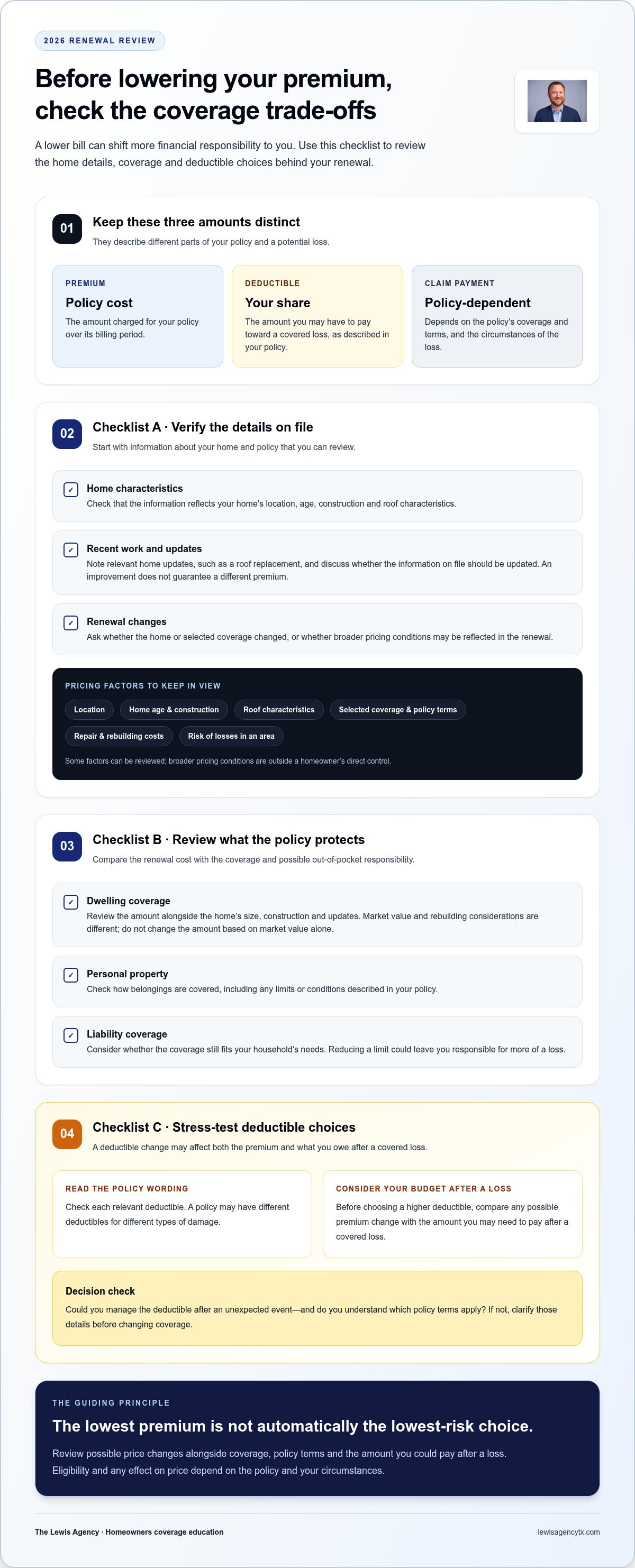
Your premium is the amount charged for your policy over its billing period. It is not the same as your deductible, which is the amount you may have to pay toward a covered loss under your policy. A claim payment depends on the policy’s coverage and terms, as well as the circumstances of the loss. Keep these amounts separate when you compare renewal options.
Some pricing factors relate to your home and coverage choices. Others reflect broader conditions, such as repair and rebuilding costs or the risk of losses in an area. Location, the home’s age and construction, roof characteristics, selected coverage and policy terms may all affect pricing. General information about homeowners insurance can explain a policy’s purpose, but the documents for your policy describe the coverage and exclusions that apply to your home.
No single action guarantees a lower premium. Weigh any potential price change against the coverage and out-of-pocket risk that come with it. To find ways to lower your homeowners insurance premium in Texas in 2026, separate the details you can review from pricing factors you cannot control.
Which parts of a premium can a homeowner influence?
You can review your selected coverage, deductible choices and the property information on file. For example, check that the information about your Central Texas home reflects its current roof and any relevant updates. Consider whether the coverage still fits your home and belongings, and whether you could manage the deductible after a loss. Eligibility and any effect on price depend on the policy and your circumstances.
Imagine a homeowner near Round Rock whose roof was recently replaced. It makes sense to document the work and discuss the updated information during a policy review, but the replacement does not guarantee a different premium. The insurer’s rules, policy terms and other pricing factors still matter. Look at the options together rather than assuming one improvement will produce a particular result.
Why can a Texas premium change at renewal?
A renewal price may reflect policy-specific details, such as updated information about the home, selected coverage or changes in pricing. It may also reflect broader conditions that affect repair and rebuilding costs or the insurer’s assessment of risk. A homeowner cannot directly change those broader factors, even though they may influence the price.
Start by asking whether anything about your home or policy changed, or whether the renewal may reflect broader pricing conditions. That can keep the discussion focused on useful next steps instead of an assumed cause. For more context about factors that may affect costs, see the Texas home insurance rate increases guide. Then review your current policy details before deciding whether to make an adjustment.
Review coverage and deductibles before trying to cut your premium
To assess a renewal, compare the premium with the coverage and the amount you could pay after a loss. Review dwelling coverage for the home, personal property coverage and its terms, liability coverage, and each deductible shown in your policy documents. Changing any of these elements may affect the premium, but it can also shift more financial responsibility to you.
The lowest premium is not automatically the lowest-risk choice. Before changing coverage, consider what the change could mean in a serious loss, not just what it might do to the bill. Make sure you understand both the potential price effect and the coverage trade-off.
Check whether dwelling coverage still reflects your home
Review the dwelling coverage amount alongside your home’s current characteristics, such as its size, construction and updates, and check how the policy describes coverage. Market value and rebuilding considerations are different: a sale price may reflect land and local demand, while rebuilding relates to the work and materials needed to reconstruct the insured home. Valuation methods and policy terms vary, so do not change the amount based on market value alone. The Austin homeowners insurance coverage guide offers more context for reviewing coverage.
Review personal property and liability separately. Check how the policy covers belongings, including any limits or conditions, and consider whether the liability coverage still fits your household’s needs. Reducing a limit is not necessarily a harmless way to lower the premium; it could leave you responsible for more of a loss. The Texas Department of Insurance (TDI) provides consumer information about insurance, while your policy documents explain the terms that apply to your coverage.
Weigh deductible changes against your ability to pay
A deductible is the amount you may pay toward a covered claim, as described in your policy. Changing it may affect both the premium and what you owe after a loss. Deductibles are policy-specific. A policy may have different deductibles for different types of damage, so check the relevant wording rather than assuming one amount applies to every claim. Before making a change, consider whether you could manage the out-of-pocket cost after an unexpected event.
For example, if you are considering a higher deductible to reduce renewal costs, compare the possible premium change with the amount you would need to pay after a covered loss. The Texas homeowners insurance deductibles guide can help you identify what to look for in your policy. You can also have a policy review conversation with The Lewis Agency to understand the terms before deciding what to adjust.
Compare practical premium-saving options without assuming a discount
Possible ways to manage a premium differ in effort, expense and effect on protection. A policy question may take little effort, while a roof project can involve substantial planning and cost. Neither guarantees a lower price. Before taking action, consider the expense, whether the step changes coverage or risk, and what information the insurer needs to determine eligibility.
Use these questions to compare options:
- Policy review: Is there information to correct or clarify, and could a proposed change affect your protection?
- Auto coverage: Is a home and auto option available for your policies, and what eligibility rules apply?
- Property improvements: What maintenance or resilience benefits would the work provide if the premium stays the same?
- Potential discounts: What documentation is required, and how are eligibility and any price effect determined for your policy?
For broader ideas, the Insurance Information Institute discusses ways to lower homeowners insurance costs. Treat general suggestions as questions to explore, not a promise that a particular option applies to your policy. Texas-specific consumer information from the Texas Department of Insurance (TDI) can help you frame questions about policy costs and discounts.
Ask about eligibility for policy discounts
Ask which discounts, if any, may apply to your specific policy. Do not assume you qualify because another homeowner received a discount or a general article mentions one. Eligibility, required documentation and the effect on the premium can vary. Ask what conditions apply and whether a policy change would affect coverage as well as price.
Consider roof and home improvements carefully
Hail is a practical concern for Central Texas homeowners, but replacing a roof or adding a safety feature does not guarantee a lower premium. Weigh the project’s maintenance and resilience benefits on their own, then ask whether the insurer considers the improvement and what documentation may be needed. That way, you are not taking on an expense solely because you expect insurance savings.
A measured review can help you distinguish a useful option from one that costs more or shifts risk without a clear benefit. The Lewis Agency can help you understand your policy terms and available choices through a homeowners coverage review.
Use a step-by-step review before your 2026 renewal
Preparing for a renewal can make the discussion more useful and less rushed. Start with your declarations page and current policy documents. Note what has changed and what you need explained. This keeps the focus on understanding your coverage and the options available under it, rather than treating a lower quoted price as the only goal.
Prepare documents and note changes to the home
Gather your renewal notice, declarations page and current policy documents. Make a short record of relevant changes since the last review, such as roof work, updates to major home systems, a change in occupancy or a shift in household circumstances. These details help you discuss whether the information on file is current. An update does not automatically qualify the home for a discount or change the premium.
Work through the review in order:
- Gather documents. Keep the renewal notice, declarations page and policy wording together so you can refer to the same information during the discussion.
- Inspect changes. Note work completed on the home and any changes in how it is used. For roof work, record what was done and when, along with any available documentation.
- List questions. Identify unfamiliar terms, a premium change you want explained or coverage details you would like to understand. Put the most important questions first.
- Review options. Discuss the current policy and any proposed adjustments one at a time. Consider how each could affect coverage, deductibles, exclusions or out-of-pocket costs, as well as the premium.
Ask focused questions about premium and protection
Ask what changed at renewal, which policy terms influence the premium and whether updated home information was considered. If an option involves changing coverage, ask how it could affect limits, exclusions, deductibles or the amount you might need to pay after a loss. The answers depend on your policy and circumstances.
Write down the explanation and any follow-up items. If a term is unclear, ask for a plain-language explanation and, when helpful, where it appears in the policy documents. You will have something concrete to review afterward instead of relying on memory.
If you are looking for ways to lower your homeowners insurance premium in Texas in 2026, a prepared policy review can help you evaluate changes without losing sight of protection. Review your homeowners policy with The Lewis Agency to discuss its terms and your renewal questions.
Get help understanding your Texas homeowners policy
A renewal conversation can help turn policy language into clear questions and choices. Chris Lewis has more than 25 years of insurance experience, and The Lewis Agency is an Allstate agency serving Austin and Central Texas, including Leander, Cedar Park, Georgetown, Round Rock and Liberty Hill. The agency can help homeowners understand policy terms and the claims process. Rates, underwriting, renewal, coverage and claim-payment decisions are made by the insurer, not the agency.
A discussion can clarify what your documents say and what questions to raise, but it cannot promise a particular premium or claim outcome. The goal is to help you understand your current policy so you can consider possible changes carefully.
What a policy discussion can help clarify
Bring your renewal notice, declarations page and any policy wording you are unsure about. A discussion can help explain how coverage terms, deductibles and other policy details fit together, as well as how the claims process generally works under your policy. If a term is unclear, ask where it appears in the documents and what it means for your circumstances.
Keep the conversation grounded in the actual policy. Coverage and exclusions vary, so a general explanation is not a substitute for the wording that applies to your home. You can ask how a proposed change might affect protection or costs after a covered loss, then consider the trade-off before deciding.
Choose a useful next step
For Austin and Central Texas homeowners, a useful first step is to raise renewal questions before making changes. Note what you want to understand, whether it is a premium change, a deductible or a particular coverage term. This keeps the discussion focused on your policy instead of assuming a change will produce a specific result.
If you are considering how to lower your homeowners insurance premium in Texas in 2026, use the conversation to understand possible effects on both price and protection. Ask for unfamiliar language to be explained plainly, and make sure you are comfortable with any change before moving ahead. You may decide an adjustment makes sense, or that your current terms better fit your needs.
There is no need to make a change simply because renewal is approaching. If you would like to talk through your current policy and questions, talk with The Lewis Agency.
Make your next renewal decision with confidence
A renewal review does not need to end with an immediate change. Take time to consider what you learned, revisit any policy language that remains unclear and decide which trade-offs fit your household’s needs. A premium adjustment is useful only if you understand what changes along with it.
If you are exploring ways to lower your homeowners insurance premium in Texas in 2026, bring specific questions to a policy discussion. Ask how each option you are considering could affect your coverage or out-of-pocket costs. You do not have to choose an adjustment simply because it is available; keeping your current terms may also be the right decision for your needs.
If you would like help working through your renewal questions, review your homeowners policy questions with The Lewis Agency. A thoughtful conversation can help you understand your choices and the protection you keep.
Frequently Asked Questions
Can bundling homeowners and auto insurance lower my premium?
It may affect the price, but whether a home and auto option applies and what it changes depends on the insurer, policies and household details. Ask for the home and auto costs separately and together, then compare the combined price alongside coverage and deductibles. For example, a lower homeowners premium alone may not make the combined option less expensive if the auto policy cost changes. Do not assume a discount is available or guaranteed.
Will replacing my roof lower my Texas homeowners insurance premium?
A new roof may affect how the insurer evaluates the home, but it does not guarantee a lower premium. Before starting a project mainly for insurance reasons, ask how the proposed work would be considered under your policy. Keep records such as invoices, permits if applicable, and details about materials or installation. Also weigh the roof’s condition, maintenance needs and resilience benefits separately from any possible insurance effect.
Does homeowners insurance in Texas cover flood damage?
Do not assume your homeowners policy covers flooding. The policy wording determines how water damage is treated, and coverage for a plumbing leak may differ from damage caused by rising water. Check the definitions, exclusions and any endorsements in your documents, then ask about your specific situation. If flood risk is a concern, consult consumer guidance from the Texas Department of Insurance or FEMA about coverage options rather than relying on a general assumption.
Can filing a small homeowners insurance claim affect my premium?
The effect depends on the insurer, policy, claim details and underwriting circumstances, so there is no universal outcome to rely on. Before deciding whether to file, compare the known damage with the applicable deductible and review how the claims process works. The agency can explain policy language and the process, but it does not determine claim decisions, premium changes or renewal outcomes. Keep records of damage and communications related to the loss.
Do home security devices qualify for a homeowners insurance discount?
Some insurers may recognize certain security features, but eligible equipment and any premium effect vary by policy. Before buying a device mainly for possible savings, ask whether the specific equipment is considered and what documentation may be needed. Keep its model information and installation records. Then weigh any potential insurance benefit against the device’s separate value for household safety and property protection, even if the premium does not change.
Can I lower my premium by changing my homeowners insurance deductible?
A deductible change may affect both the premium and what you pay toward a covered loss, depending on the policy. Before choosing a different amount, consider whether you could manage that expense if a claim occurred alongside other household costs. Check the declarations page and policy wording for applicable deductibles, including whether different types of loss have different terms. Understand the out-of-pocket trade-off before making a change.

Article by
Chris Lewis
Chris Lewis is the owner of The Lewis Agency, an Allstate insurance agency serving Austin and Central Texas. With more than 25 years of insurance experience, Chris focuses on helping Central Texas homeowners better understand their insurance coverage, including deductibles, roofs and hail, severe weather risks, water damage and other important coverage considerations. He created LewisAgencyTX.com to provide practical homeowners insurance education and help homeowners better understand their coverage before they need it.