
Texas Homeowners Insurance Renewal Notice: Check Premium Changes
Texas homeowners insurance renewal notice: review premium, coverage, deductibles, policy dates, and any non-renewal explanation before your current term ends.

A Texas homeowners insurance renewal notice shows your next term’s premium and coverage details, or explains that your insurer will not renew your policy. For homeowners in Austin and across Central Texas, including Leander, Cedar Park, Georgetown, Round Rock, and Liberty Hill, reviewing the notice helps you understand what is changing before making coverage decisions. A higher premium alone does not mean your policy is ending.
It is natural to focus first on the new price, especially when your household budget is already set. But coverage, deductibles, policy dates, and any explanation of non-renewal also deserve attention. This article explains what to review, why an insurer may decline to renew a policy, and how non-renewal differs from cancellation, so you can understand the notice and consider your next steps.
Key Takeaways
- Compare the renewal premium with the policy dates, coverage amounts, deductibles, and endorsements to see what changed.
- A non-renewal notice means the policy is set to end at expiration; cancellation ends coverage earlier and follows different notice rules.
- Look for the insurer’s stated reason and any risk factors or requested repairs that may affect your next steps.
- A careful policy review can help you identify coverage questions and plan for a renewal or replacement policy before the current term ends.
Reviewing changes to coverage and premiums
Compare your renewal notice with your current declarations page. Check the premium, dwelling limit, personal property coverage, liability amount, endorsements, and each deductible. A lower premium may come with different coverage or cost-sharing terms, so compare the policy details, not just the total. The Texas Department of Insurance explains that replacement cost coverage pays to repair or rebuild based on current costs, while actual cash value accounts for the home’s age and condition. Consider whether renovations and belongings still match the listed amounts.
When shopping for renewal coverage, compare premiums alongside dwelling coverage, exclusions, deductibles, and wind and hail terms. Texas policies can differ, so examine the specific coverage and deductible wording in the policy documents. Ask the insurer to explain unfamiliar changes. If you need replacement coverage, aim to bind it 3 to 5 days before your current policy expires. Renewed coverage takes effect on the old policy’s expiration date once premiums are paid.
Use the renewal notice to identify the increase, then ask the insurer what changed and what information it used. Check property and roof details, along with your selected coverage, against your records. Keep the notice and the insurer’s response together for reference.
If two companies have refused coverage, the Texas FAIR Plan Association is the state’s provider of last resort. It offers limited coverage for one- and two-family homes, townhouses, and condominiums. Before considering it as a replacement, compare its limits and covered risks with your home’s needs.
What a home insurance renewal notice contains
A renewal notice usually arrives before your current policy expires. Check the new term dates, premium, coverage summary, deductibles, and any revised endorsements. Compare the property details with your home, including its occupancy and roof information. The notice shows the premium for the upcoming term, so review it alongside any changes to coverage and policy details.
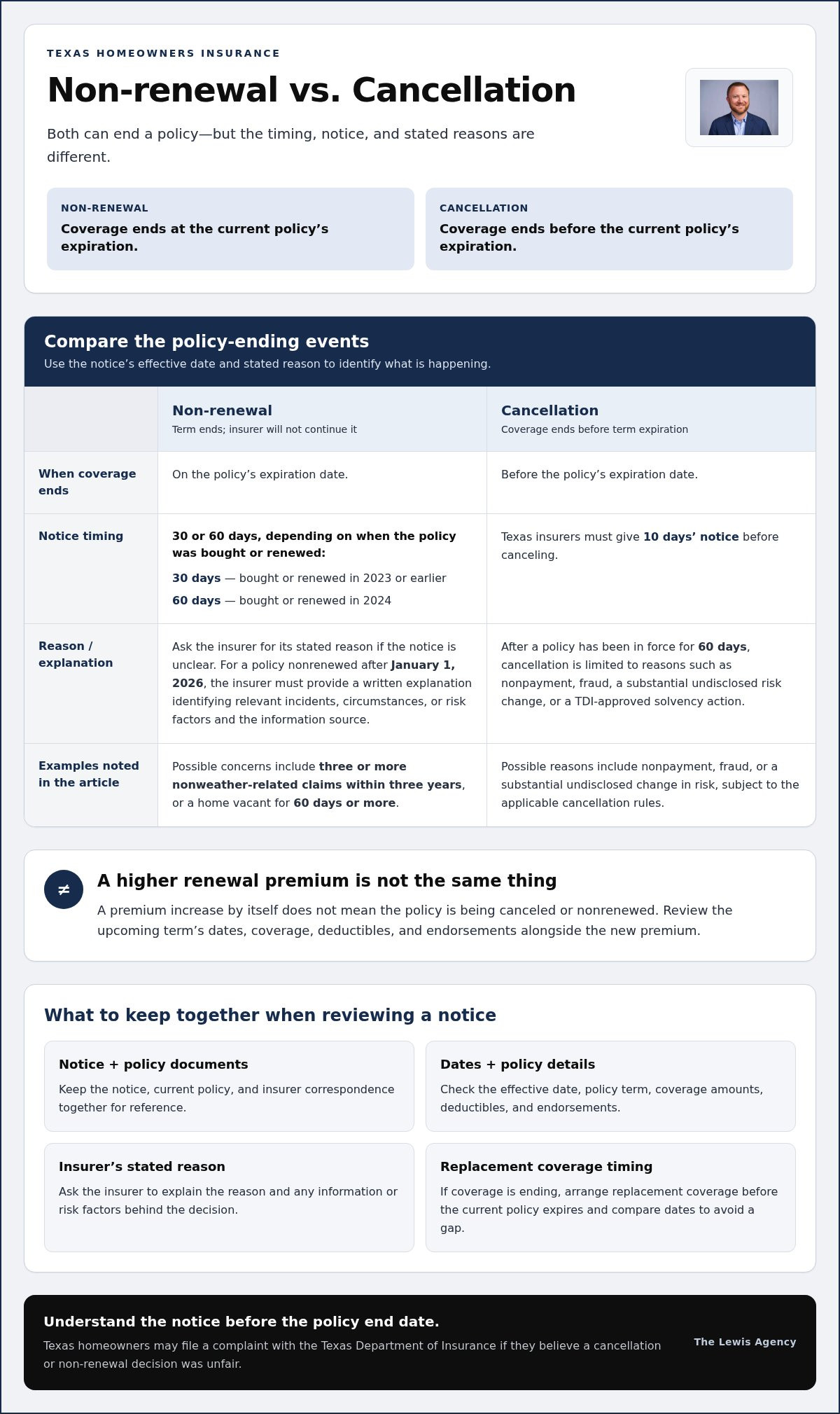
Texas nonrenewal notice periods depend on when the policy was bought or renewed. A policy bought or renewed in 2023 or earlier required 30 days’ notice; one bought or renewed in 2024 required 60 days’ notice. For a homeowners policy declined, canceled, or nonrenewed after January 1, 2026, the insurer must provide a written explanation. That explanation must identify the relevant incident, circumstance, or risk factors and the information source.
Reasons for nonrenewal may include three or more nonweather-related claims within three years, or a home vacant for 60 days or more. Cancellation is different. After a policy has been in force for 60 days, cancellation is limited to reasons such as nonpayment, fraud, a substantial undisclosed risk change, or a TDI-approved solvency action.
If your insurer sends a nonrenewal notice, ask for its reason and arrange replacement coverage before your current policy expires. Compare the new policy’s dates and terms to avoid a gap. If you believe the decision was unfair, you may file a complaint with the Texas Department of Insurance. The homeowners resource center can help you prepare questions for a renewal review.
Texas homeowners insurance non-renewal versus cancellation
Non-renewal and cancellation describe different ways a Texas policy can end. Non-renewal means the insurer won’t continue coverage after the current term’s expiration date. Cancellation ends coverage before that date. Check the notice’s effective date first; it clarifies whether you have time to arrange replacement coverage before the policy ends. A renewal premium increase, by itself, is not the same as either action.
For a homeowners policy bought or renewed in 2023 or earlier, Texas required 30 days’ notice of non-renewal. For one bought or renewed in 2024, the requirement was 60 days. Cancellation has a different timeline: Texas insurers must give 10 days’ notice before canceling. After a policy has been in force for 60 days, cancellation is limited to narrow reasons, including nonpayment, fraud, or a substantial undisclosed change in risk.
A written non-renewal explanation for a policy nonrenewed after January 1, 2026, must identify applicable incidents, circumstances, or risk factors, plus the information source. Examples of possible non-renewal concerns include three or more nonweather-related claims within three years, or a home vacant for 60 days or more. Ask the insurer for its reason if the notice leaves you unclear.
For help with an unfair cancellation or non-renewal, Texas homeowners may file a complaint with the Texas Department of Insurance. Keep the notice, policy documents, and insurer correspondence together so you can describe the decision clearly. If you’re sorting through what the notice means, you can ask a renewal notice question.
The Lewis Agency: Homeowners Insurance Policies
The Lewis Agency can help you review an Allstate homeowners policy and understand how its coverage, deductibles, and renewal terms fit your home. If your notice changes the premium or coverage, an agent can explain the policy language and help you identify questions to raise. The agency doesn’t control insurer rates, underwriting, or renewal decisions, and it doesn’t shop policies across multiple carriers.
A review can also help you organize details to compare when considering replacement coverage, such as policy dates, limits, exclusions, and deductibles. Keep your renewal notice and current policy documents together so you can focus on the changes that matter to your household.
Contact The Lewis Agency to discuss your homeowners insurance renewal.
Make Your Next Renewal Review More Useful
A Texas homeowners insurance renewal notice is a chance to connect your policy details with changes in your household. Keep a simple record of renovations, major purchases, changes in occupancy, and other updates to your home. This information gives your next policy review a clearer starting point and helps you identify questions before the renewal deadline.
You don’t need to sort through unfamiliar policy language alone. The Lewis Agency can help explain your Allstate homeowners policy and discuss the details that matter to your home. For a calm conversation about your coverage, contact The Lewis Agency. A little preparation can make your next insurance decision feel more manageable.
Frequently Asked Questions
Why would a company not renew my policy?
An insurer may decide not to renew after reviewing claims, property condition, or other risk factors. For example, a Texas homeowners insurance renewal notice may cite repeated non-weather-related claims or vacancy as concerns. Read the explanation and check whether it points to a specific property detail or event. This can help you understand the stated reason and prepare accurate information when seeking replacement coverage.
What do “nonrenewal” and “cancellation” mean?
Nonrenewal ends coverage at the policy’s scheduled expiration, while cancellation ends it earlier. That distinction matters because cancellation can leave less time to arrange replacement coverage. Texas insurers must give 10 days’ notice before cancellation. After a policy has been in force for 60 days, cancellation is limited to narrow reasons, including nonpayment, fraud, or a substantial undisclosed change in risk.
How much advance notice must Texas insurers give before nonrenewing a homeowners policy?
For a Texas homeowners policy bought or renewed in 2023 or earlier, the required notice was 30 days. For a policy bought or renewed in 2024, the required notice was 60 days. For policies nonrenewed after January 1, 2026, the insurer must also provide a written explanation identifying relevant risk factors and the information source relied upon.
What deadlines and delivery methods apply to Texas homeowners insurance renewal notices?
A Texas homeowners insurance renewal notice generally arrives before your current policy expires, but the applicable non-renewal deadline depends on when the policy was bought or renewed. Compare the notice date with your policy’s expiration date. Keep a copy of the notice and related messages, whether they arrived by mail or electronically, so you can refer to the dates and terms when contacting the insurer.
What happens to coverage if a Texas homeowners policy expires before replacement coverage starts?
There may be a gap in homeowners coverage between the old policy’s expiration and the replacement policy’s effective date. A loss during that gap may leave you responsible for damage. If you have a mortgage, the lender may force-place a bare-bones policy that protects only the mortgage amount, with its cost added to your mortgage payment.

Article by
Chris Lewis
Chris Lewis is the owner of The Lewis Agency, an Allstate insurance agency serving Austin and Central Texas. With more than 25 years of insurance experience, Chris focuses on helping Central Texas homeowners better understand their insurance coverage, including deductibles, roofs and hail, severe weather risks, water damage and other important coverage considerations. He created LewisAgencyTX.com to provide practical homeowners insurance education and help homeowners better understand their coverage before they need it.