
Texas homeowners insurance costs and why rates are rising
Learn why Texas homeowners insurance costs increase, how severe weather and rebuilding costs affect premiums, and what to review in your policy and budget.

A rising premium is only part of the affordability picture. Understanding why Texas homeowners insurance costs increase starts with severe weather losses and the cost of repairing or rebuilding damaged homes, which can put pressure on premiums. The increase also matters in the context of mortgage payments, property taxes, and other costs of owning a home.
If your renewal is becoming harder to fit into the household budget, that concern is understandable. This article explains why Texas homeowners insurance costs increase, including how storms can affect premiums and why insurance has become a larger part of homeownership expenses. It also covers factors that may affect your individual policy, helping you understand its price and coverage.
Key Takeaways
- Understand how Texas insurance regulation works and what it can tell you about market stability.
- See how repeated severe-weather losses can put upward pressure on homeowners insurance rates.
- Put insurance premiums in context alongside the other costs of owning a Texas home.
- Learn which policy details to review so you can better understand your coverage and household budget.
Is Texas experiencing a home insurance crisis?
Texas homeowners are facing rising premiums, but an increase by itself does not prove there is a market crisis. The figures help explain why affordability matters to households balancing mortgage payments and other homeownership costs.
Texas regulates insurance rates through the Texas Department of Insurance. Insurers can apply rate changes before official approval, subject to standards and possible disapproval by the insurance commissioner. A Texas Senate bill passed in 2025 would have required regulators to approve rate increases above 10% before insurers implemented them. The proposal addressed prior review of larger increases, not a promise of lower premiums.
How much have Texas homeowners insurance rates increased in recent years? These annual figures show a rising trend, although individual renewals can differ.
A home’s value, age, roof condition, and construction materials help insurers assess its condition and potential rebuilding needs. These details may inform underwriting, but their effect depends on the insurer and policy.
How do insurers use claims history, credit-based insurance scores, and deductibles to set rates? The treatment of claims history and credit-based scores varies by insurer. Deductibles can affect premiums: according to the Texas Department of Insurance, higher deductibles mean lower premiums but more out-of-pocket expense after a claim. Your quote depends on your home, its condition, location, and policy details; the exact figure is provided in a quote for your case.
Severe weather losses and insurance costs
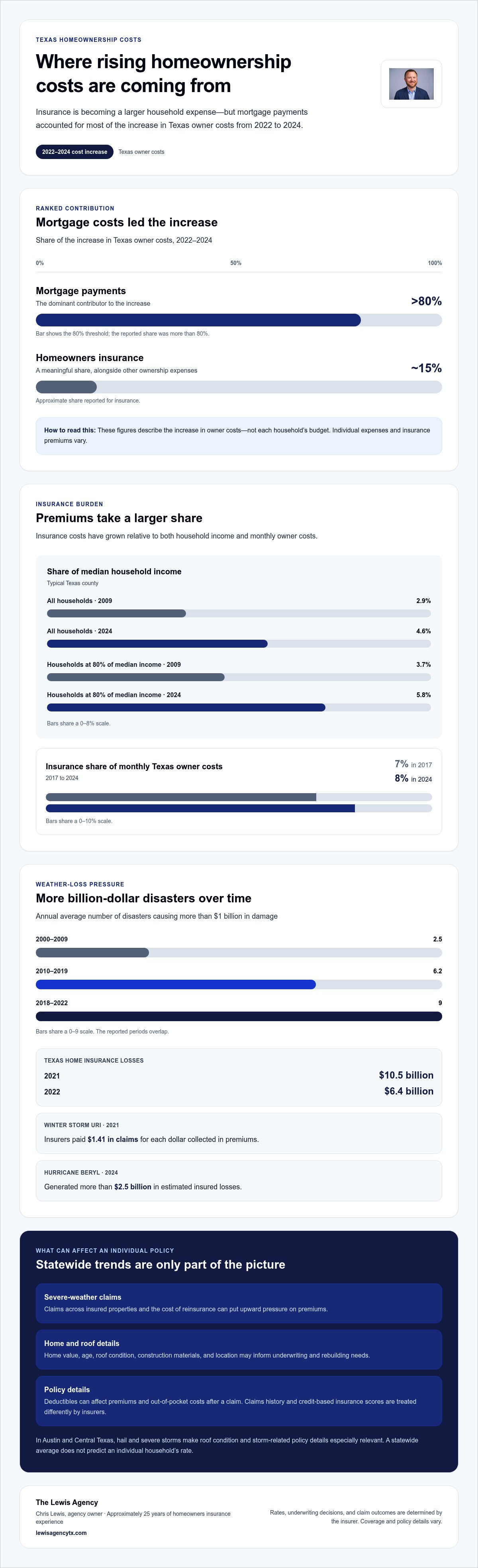
Texas weather losses can affect insurance premiums beyond the homes directly damaged. The state averaged 2.5 disasters causing more than a billion dollars in damage annually from 2000 to 2009. That average rose to 6.2 during 2010 to 2019, then 9 from 2018 to 2022. These trends help explain why Texas homeowners insurance costs increase: insurers account for claims across the properties they insure, not only damage to one home.
The losses can be substantial. Texas home insurance losses totaled $10.5 billion in 2021 and $6.4 billion in 2022. Winter Storm Uri added strain: in 2021, insurers paid $1.41 in claims for each dollar collected in premiums. In 2024, Hurricane Beryl generated more than $2.5 billion in estimated insured losses. These events show how severe weather can affect claim payments and future pricing. They also help explain why Texas homeowners insurance costs increase even for households without a recent claim.
Reinsurance is another cost factor. Insurers may buy it to help manage large losses, and its cost can influence the rates they seek. Storm claims and reinsurance costs can both put pressure on premiums, although each homeowner’s renewal also depends on the property and policy. In Austin and Central Texas, hail and severe storms make roof condition and policy details especially relevant when assessing a home’s exposure.
For a practical review, note your roof’s age, any storm repairs, and the deductible shown in your policy. The Homeowners Resource Center can help you prepare questions about storm damage and coverage. Understanding how a policy addresses losses helps connect statewide weather trends with the protection your household has chosen.
Texas homeowners insurance costs as a share of ownership expenses
Insurance premiums take a larger share of household income than they did in 2009. In a typical Texas county, premiums consumed 4.6% of median household income in 2024, compared with 2.9% in 2009. For households earning 80% of median income, the share rose from 3.7% to 5.8%. These comparisons show how premiums can tighten an already stretched housing budget, even when other expenses remain unchanged.
Insurance is one part of ownership costs, not the whole increase. It represented around 8% of monthly Texas owner costs in 2024, up from 7% in 2017. From 2022 to 2024, insurance accounted for roughly 15% of the increase in owner costs, while mortgage payments accounted for more than 80%. That context helps households assess premiums alongside their mortgage and other regular expenses.
Which Texas cities and regions have the highest homeowners insurance costs, and why? Costs vary by county, reflecting differences in properties and risks. In Austin and nearby Central Texas communities, a home’s location, construction, and coverage details can affect its premium. Statewide averages do not predict an individual household’s rate.
To manage costs, review your home details and compare quotes using similar coverage limits, exclusions, and deductibles. The Texas Department of Insurance explains that higher deductibles lower premiums but increase what you pay out of pocket after a claim. Check whether dwelling coverage reflects rebuilding needs, then weigh deductible costs against your budget. A homeowners policy review can help you identify details to discuss and compare.
The Lewis Agency: Homeowners Insurance Policies
The Lewis Agency helps Central Texas homeowners understand their homeowners policies, including how coverage, exclusions, and deductibles relate to their homes and budgets. The agency provides plain-English guidance on policy language, coverage, and the claims process. Rates, underwriting decisions, and claim outcomes are determined by the insurer.
Consider reviewing your policy after a renewal change, roof update, or home renovation. Have your declarations page handy and note questions about dwelling coverage, storm-related deductibles, and household expenses. A review can clarify your current policy and help you identify details to consider when requesting a quote.
For questions about your homeowners coverage, contact The Lewis Agency.
Make your next policy review more useful
Understanding why Texas homeowners insurance costs increase can help you approach your next renewal with clearer questions. Before reviewing your policy, note changes to your home, recent repairs, and your household budget. Then consider whether the coverage details and deductibles still suit your circumstances.
The Lewis Agency offers Homeowners Insurance Policies, Auto Insurance, and Landlords Insurance. You can ask questions about policy language and discuss how your coverage fits your needs. A thoughtful review won’t control rates or claim decisions, but it can help you understand what your policy says and what to consider next.
Contact The Lewis Agency to discuss your homeowners coverage. Taking time to understand your policy is a practical step toward making informed decisions about your home.
Frequently Asked Questions
What factors are driving homeowners insurance costs up in Texas?
An individual household’s premium reflects details about the property and the policy selected. To understand a change, compare your renewal with the prior policy: check the home information, coverage amounts, deductibles, endorsements, and exclusions. Updating outdated property details and identifying what changed can make a renewal easier to evaluate.
How do hail, hurricanes, tornadoes, and severe storms affect Texas insurance premiums?
Storms can damage different parts of a home, so review the policy language for wind, hail, and water damage. Check whether it lists a separate deductible or excludes a particular cause of loss. After a storm, document visible damage and keep repair records to support a claim discussion under your policy.
How have rising construction and labor costs changed Texas homeowners insurance prices?
Higher material and labor costs can make an older reconstruction estimate less useful when planning for repairs after a major loss. Keep records of renovations, additions, and major material changes, then review whether your dwelling coverage reflects the home’s current rebuilding needs. Market value and rebuilding cost are different measures, so one should not automatically stand in for the other.
What role do reinsurance costs and insurer losses play in Texas premium increases?
Reinsurance is insurance that an insurance company purchases to help manage its exposure to large losses. Its cost and the insurer’s loss experience can inform broader pricing decisions, but neither determines one household’s premium by itself. For your renewal, focus on the terms and property details in your documents rather than assuming a statewide trend explains every change.
What rules does the Texas Department of Insurance have for rate increases and policyholder notices?
The Texas Department of Insurance reviews rate filings under state standards. Texas permits insurers to apply rate changes before official approval, subject to possible disapproval by the insurance commissioner. For your renewal, read the insurer’s notice for the new premium, effective date, and policy changes. Ask the insurer to clarify anything the notice does not explain.

Article by
Chris Lewis
Chris Lewis is the owner of The Lewis Agency, an Allstate insurance agency serving Austin and Central Texas. With more than 25 years of insurance experience, Chris focuses on helping Central Texas homeowners better understand their insurance coverage, including deductibles, roofs and hail, severe weather risks, water damage and other important coverage considerations. He created LewisAgencyTX.com to provide practical homeowners insurance education and help homeowners better understand their coverage before they need it.