
Texas homeowners insurance costs and why rates are rising
Learn why Texas homeowners insurance costs increase, how severe weather and rebuilding costs affect premiums, and what to review in your policy and budget.

A rising premium is only part of the affordability picture. Understanding why Texas homeowners insurance costs increase starts with severe weather losses and the cost of repairing or rebuilding damaged homes, which can put pressure on premiums. The increase also matters in the context of mortgage payments, property taxes, and other costs of owning a home.
If your renewal is becoming harder to fit into the household budget, that concern is understandable. This article explains why Texas homeowners insurance costs increase, including how storms can affect premiums and why insurance has become a larger part of homeownership expenses. It also covers factors that may affect your individual policy, helping you understand its price and coverage.
Key Takeaways
- Understand how Texas insurance regulation works and what it can tell you about market stability.
- See how repeated severe-weather losses can put upward pressure on homeowners insurance rates.
- Put insurance premiums in context alongside the other costs of owning a Texas home.
- Learn which policy details to review so you can better understand your coverage and household budget.
Is Texas experiencing a home insurance crisis?
Texas homeowners are facing rising premiums, but an increase by itself does not prove there is a market crisis. The figures help explain why affordability matters to households balancing mortgage payments and other homeownership costs.
Texas regulates insurance rates through the Texas Department of Insurance. Insurers can apply rate changes before official approval, subject to standards and possible disapproval by the insurance commissioner. A Texas Senate bill passed in 2025 would have required regulators to approve rate increases above 10% before insurers implemented them. The proposal addressed prior review of larger increases, not a promise of lower premiums.
How much have Texas homeowners insurance rates increased in recent years? These annual figures show a rising trend, although individual renewals can differ.
A home’s value, age, roof condition, and construction materials help insurers assess its condition and potential rebuilding needs. These details may inform underwriting, but their effect depends on the insurer and policy.
How do insurers use claims history, credit-based insurance scores, and deductibles to set rates? The treatment of claims history and credit-based scores varies by insurer. Deductibles can affect premiums: according to the Texas Department of Insurance, higher deductibles mean lower premiums but more out-of-pocket expense after a claim. Your quote depends on your home, its condition, location, and policy details; the exact figure is provided in a quote for your case.
Severe weather losses and insurance costs
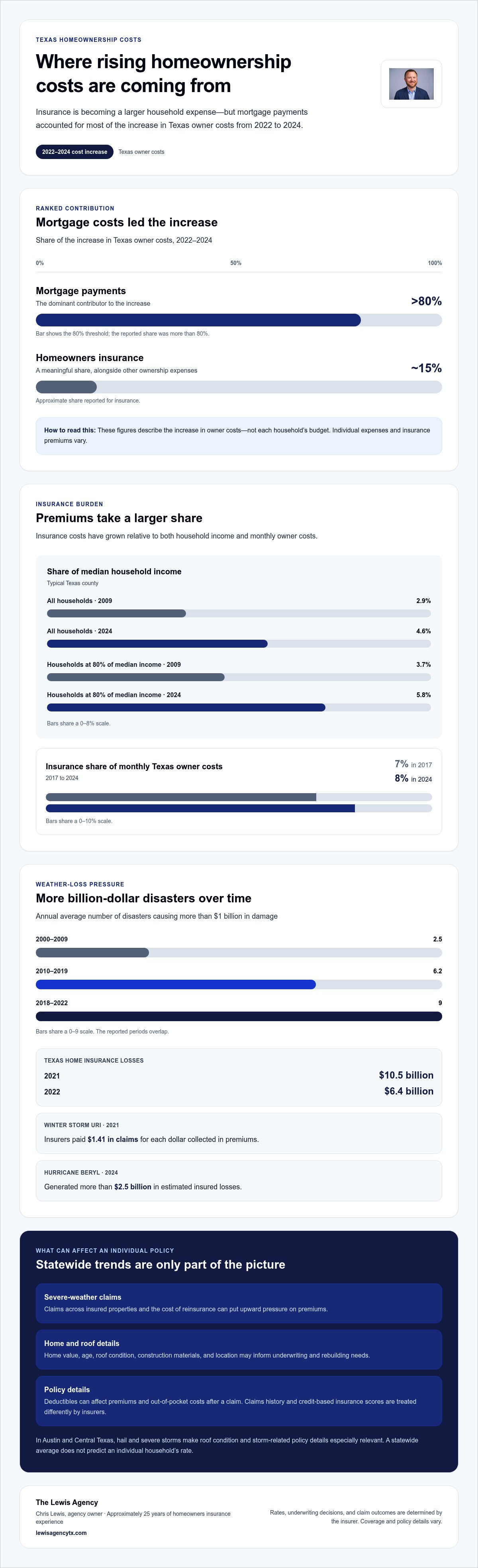
Texas weather losses can affect insurance premiums beyond the homes directly damaged. The state averaged 2.5 disasters causing more than a billion dollars in damage annually from 2000 to 2009. That average rose to 6.2 during 2010 to 2019, then 9 from 2018 to 2022. These trends help explain why Texas homeowners insurance costs increase: insurers account for claims across the properties they insure, not only damage to one home.
The losses can be substantial. Texas home insurance losses totaled $10.5 billion in 2021 and $6.4 billion in 2022. Winter Storm Uri added strain: in 2021, insurers paid $1.41 in claims for each dollar collected in premiums. In 2024, Hurricane Beryl generated more than $2.5 billion in estimated insured losses. These events show how severe weather can affect claim payments and future pricing. They also help explain why Texas homeowners insurance costs increase even for households without a recent claim.
Reinsurance is another cost factor. Insurers may buy it to help manage large losses, and its cost can influence the rates they seek. Storm claims and reinsurance costs can both put pressure on premiums, although each homeowner’s renewal also depends on the property and policy. In Austin and Central Texas, hail and severe storms make roof condition and policy details especially relevant when assessing a home’s exposure.
For a practical review, note your roof’s age, any storm repairs, and the deductible shown in your policy. The Homeowners Resource Center can help you prepare questions about storm damage and coverage. Understanding how a policy addresses losses helps connect statewide weather trends with the protection your household has chosen.
Texas homeowners insurance costs as a share of ownership expenses
Insurance premiums take a larger share of household income than they did in 2009. In a typical Texas county, premiums consumed 4.6% of median household income in 2024, compared with 2.9% in 2009. For households earning 80% of median income, the share rose from 3.7% to 5.8%. These comparisons show how premiums can tighten an already stretched housing budget, even when other expenses remain unchanged.
Insurance is one part of ownership costs, not the whole increase. It represented around 8% of monthly Texas owner costs in 2024, up from 7% in 2017. From 2022 to 2024, insurance accounted for roughly 15% of the increase in owner costs, while mortgage payments accounted for more than 80%. That context helps households assess premiums alongside their mortgage and other regular expenses.
Which Texas cities and regions have the highest homeowners insurance costs, and why? Costs vary by county, reflecting differences in properties and risks. In Austin and nearby Central Texas communities, a home’s location, construction, and coverage details can affect its premium. Statewide averages do not predict an individual household’s rate.
To manage costs, review your home details and compare quotes using similar coverage limits, exclusions, and deductibles. The Texas Department of Insurance explains that higher deductibles lower premiums but increase what you pay out of pocket after a claim. Check whether dwelling coverage reflects rebuilding needs, then weigh deductible costs against your budget. A homeowners policy review can help you identify details to discuss and compare.
The Lewis Agency: Homeowners Insurance Policies
The Lewis Agency helps Central Texas homeowners understand their homeowners policies, including how coverage, exclusions, and deductibles relate to their homes and budgets. The agency provides plain-English guidance on policy language, coverage, and the claims process. Rates, underwriting decisions, and claim outcomes are determined by the insurer.
Consider reviewing your policy after a renewal change, roof update, or home renovation. Have your declarations page handy and note questions about dwelling coverage, storm-related deductibles, and household expenses. A review can clarify your current policy and help you identify details to consider when requesting a quote.
For questions about your homeowners coverage, contact The Lewis Agency.
Make your next policy review more useful
Understanding why Texas homeowners insurance costs increase can help you approach your next renewal with clearer questions. Before reviewing your policy, note changes to your home, recent repairs, and your household budget. Then consider whether the coverage details and deductibles still suit your circumstances.
The Lewis Agency offers Homeowners Insurance Policies, Auto Insurance, and Landlords Insurance. You can ask questions about policy language and discuss how your coverage fits your needs. A thoughtful review won’t control rates or claim decisions, but it can help you understand what your policy says and what to consider next.
Contact The Lewis Agency to discuss your homeowners coverage. Taking time to understand your policy is a practical step toward making informed decisions about your home.
Frequently Asked Questions
What factors are driving homeowners insurance costs up in Texas?
An individual household’s premium reflects details about the property and the policy selected. To understand a change, compare your renewal with the prior policy: check the home information, coverage amounts, deductibles, endorsements, and exclusions. Updating outdated property details and identifying what changed can make a renewal easier to evaluate.
How do hail, hurricanes, tornadoes, and severe storms affect Texas insurance premiums?
Storms can damage different parts of a home, so review the policy language for wind, hail, and water damage. Check whether it lists a separate deductible or excludes a particular cause of loss. After a storm, document visible damage and keep repair records to support a claim discussion under your policy.
How have rising construction and labor costs changed Texas homeowners insurance prices?
Higher material and labor costs can make an older reconstruction estimate less useful when planning for repairs after a major loss. Keep records of renovations, additions, and major material changes, then review whether your dwelling coverage reflects the home’s current rebuilding needs. Market value and rebuilding cost are different measures, so one should not automatically stand in for the other.
What role do reinsurance costs and insurer losses play in Texas premium increases?
Reinsurance is insurance that an insurance company purchases to help manage its exposure to large losses. Its cost and the insurer’s loss experience can inform broader pricing decisions, but neither determines one household’s premium by itself. For your renewal, focus on the terms and property details in your documents rather than assuming a statewide trend explains every change.
What rules does the Texas Department of Insurance have for rate increases and policyholder notices?
The Texas Department of Insurance reviews rate filings under state standards. Texas permits insurers to apply rate changes before official approval, subject to possible disapproval by the insurance commissioner. For your renewal, read the insurer’s notice for the new premium, effective date, and policy changes. Ask the insurer to clarify anything the notice does not explain.

Article by
Chris Lewis
Chris Lewis is the owner of The Lewis Agency, an Allstate insurance agency serving Austin and Central Texas. With more than 25 years of insurance experience, Chris focuses on helping Central Texas homeowners better understand their insurance coverage, including deductibles, roofs and hail, severe weather risks, water damage and other important coverage considerations. He created LewisAgencyTX.com to provide practical homeowners insurance education and help homeowners better understand their coverage before they need it.

Homeowners Insurance in Cedar Park, TX: Coverage and Costs
Learn what homeowners insurance Cedar Park TX may cover, what can affect premiums, and why rebuilding costs, roof condition, and water exclusions matter.

A home policy can cover more than the structure itself. Homeowners insurance in Cedar Park, TX may help protect your home and belongings, provide personal liability coverage, and help with certain additional living expenses after a covered loss. The details depend on the policy, including its exclusions and limits.
It’s understandable to want a clear picture of what protection you’re paying for and what could affect the premium. The home’s rebuilding needs, features, and policy coverage choices all matter, so a general estimate may not tell the whole story.
This article explains common homeowners coverage, factors that influence costs, and how to think about protecting a Cedar Park home. It also covers why details such as roof condition, water-related exclusions, and rebuilding costs deserve careful attention when choosing or reviewing a policy.
Key Takeaways
- Review how your policy may protect the home, belongings, and personal liability, including the limits and exclusions that shape each type of coverage.
- Understand which home and coverage details can influence premiums so you can make informed choices when reviewing a policy.
- Set dwelling coverage with the cost to rebuild in mind, and pay close attention to how the policy treats flood and sewer-related damage.
- Use a policy review to clarify how coverage applies to your Cedar Park home before you need to rely on it.
What can home insurance provide coverage for?
Home insurance can combine protection for a dwelling, personal belongings, and personal liability. These coverages work differently, so review their limits and terms separately.
Does homeowners insurance in Cedar Park cover hail, wind, and tornado damage? These losses may be covered, depending on the policy, exclusions, and applicable deductibles.
Liability Coverage
Liability coverage may help if you’re legally responsible for another person’s injury or property damage. For example, a visitor could be hurt at your home, or you could accidentally damage someone else’s belongings. Depending on policy terms, protection may extend beyond your property, including while traveling. Review who qualifies as an insured, the liability limit, exclusions, and how the policy addresses legal defense costs.
Home and Belongings in Standard Packages
A homeowners policy may cover the dwelling and personal property, but covered causes of loss and settlement terms vary. Dwelling coverage applies to the home itself; personal property coverage may apply to furniture, clothing, and appliances. Check whether belongings are settled at replacement value or actual cash value. Some coverage options may also include identity recovery support, subject to the policy’s terms.
Personal Property Away From Home
Personal property coverage may apply to belongings temporarily away from your Cedar Park residence, such as a laptop taken on a trip or sports equipment stored elsewhere. Review the policy’s terms, including limits and exclusions for property away from home. Valuables such as jewelry or collectibles may be treated differently from everyday household items, so check whether they need separate coverage attention.
Choosing Dwelling Coverage
How much dwelling coverage should Cedar Park homeowners choose? Base the amount on the estimated cost to rebuild the home, not its sale price or land value. Consider the home’s size, materials, and features when reviewing the estimate. Update the details after a renovation or room addition, then compare the estimate with the dwelling limit shown in the policy.
Factors that affect home insurance premiums
A Cedar Park premium reflects the home, selected protections, and the insurer’s underwriting. Roof condition, construction, rebuilding needs, and coverage choices can all shape a quote.
Policy Options and Discounts
How can homeowners compare quotes and choose an insurer in Cedar Park, Texas? Compare matching coverage limits, deductibles, exclusions, and policy terms, then consider how each insurer handles questions and claims. Allstate is one insurer represented in Cedar Park through The Lewis Agency. Discounts vary by insurer and eligibility, so ask which options apply before counting them as potential savings.
What discounts are available for Cedar Park homeowners insurance? There is no single discount list that applies across insurers. Ask about eligibility for available discounts and compare the resulting policy details, not just the premium. An agent can explain the terms of the policy being offered, while the insurer sets underwriting, rates, and coverage decisions.
Flood Insurance Considerations
Flood damage is excluded from most homeowners policies, so consider flood exposure separately. Whether flood insurance is required depends on the property and its financing circumstances. Cedar Park homeowners can weigh their location’s flood exposure and review any applicable lender requirements when deciding whether to seek separate coverage.
After storm damage, report the loss to the insurer and follow its claim instructions. Photograph affected areas, keep receipts for temporary measures, and organize estimates and claim correspondence. These records can help you describe the damage and track the claim process. The homeowners insurance resource center offers guidance for preparing policy and claims questions.
Homeowners insurance in Cedar Park
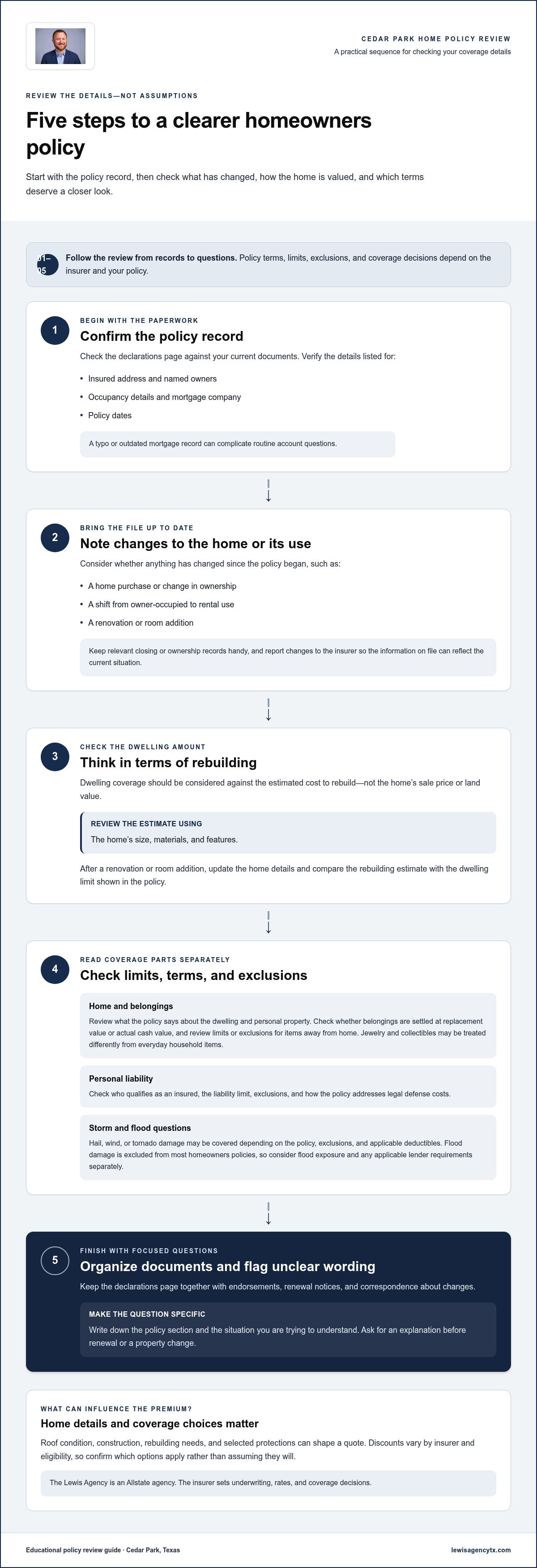
A useful Cedar Park policy review starts with the paperwork, not assumptions about what a neighbor’s home needs. Check the declarations page for the insured address, named owners, occupancy details, mortgage company, and policy dates. A typo or outdated mortgage record can complicate routine account questions, so compare these entries with current documents.
Next, note any changes since the policy began. A home purchase, change in ownership, or shift from owner-occupied to rental use can make the information on file outdated. Keep closing or ownership records handy and report changes to the insurer so the policy reflects the current situation.
Keep policy documents together. Save the declarations page with endorsements, renewal notices, and correspondence about changes. If a term is unclear, write down the section name and the situation you’re trying to understand. That makes a coverage conversation more focused than asking generally whether the home is protected.
For example, a Cedar Park homeowner preparing for a move can review the effective dates, occupancy information, and mortgage details together. A homeowner staying put can use the renewal notice as a prompt to check that the listed information remains accurate. These administrative checks help keep policy records aligned with current circumstances.
If a policy term is unclear, note the exact wording and ask for an explanation before renewal or a property change. Raising a specific homeowners insurance question can make your review more useful.
The Lewis Agency: Homeowners Insurance Policies
The Lewis Agency helps Cedar Park homeowners understand their homeowners insurance policy and consider coverage for their needs. As an Allstate agency, it can explain policy language, answer coverage questions, and help customers understand the claims process, while claim and coverage decisions remain with the insurer.
Turn to the agency when you’re reviewing a policy, considering a home update, or want to clarify how terms apply to your situation. Chris Lewis, the agency owner, has approximately 25 years of homeowners insurance experience and focuses on helping Central Texas homeowners understand their coverage. The agency also offers Auto Insurance, Landlords Insurance, and Condo Insurance for related household needs.
For a conversation about your Cedar Park home coverage, contact The Lewis Agency.
Make Your Next Policy Review More Useful
A policy review works best when it reflects how you live in your home now, not just when you first bought coverage. For homeowners insurance in Cedar Park, TX, keep a simple record of major home changes, new belongings, and questions that arise during the year. This gives you a practical starting point for discussing whether your policy still fits.
Before reaching out, gather your current declarations page and note any changes you want to discuss. You can also ask how a policy term applies to a specific concern, such as a home improvement or a possible claim. Coverage and outcomes depend on the policy and circumstances, so a conversation can help clarify what your documents say.
When you’re ready to talk through your coverage, contact The Lewis Agency. A clear question is a good place to start.
Frequently Asked Questions
How Much Does Texas Home Insurance Cost?
Texas home insurance premiums are shaped by the home’s rebuilding needs, location, condition, and selected policy terms. A newer roof and an older roof can affect how an insurer evaluates a property. The dwelling limit, personal property protection, liability coverage, and deductible choices also influence the premium. Compare quotes using the same home details and coverage selections.
What is the Difference Between Homeowners Insurance and Home Insurance?
Homeowners insurance and home insurance usually refer to coverage for an owner-occupied home, but the terms alone don’t describe a policy’s exact protections. A policy may cover the dwelling and personal belongings while also including liability protection. Check the declarations page and policy wording for the insured property, listed limits, covered causes of loss, and exclusions.
What is the average cost of homeowners insurance in Cedar Park, TX?
There isn’t one premium that represents every Cedar Park home. The amount depends on the property’s rebuilding characteristics, roof condition, selected limits, deductible choices, and policy terms. A home with a detached structure or recent renovation may have different coverage needs from a similar home without those features. A quote based on the specific address and property details is more useful than a broad average.
How do Cedar Park homeowners insurance rates compare with Austin and the Texas average?
Rates can’t be compared reliably without matching the homes and policy details behind each quote. A Cedar Park home and an Austin home may differ in age, roof condition, construction, and coverage selections. Statewide averages also combine different properties and locations. For a meaningful comparison, use the same dwelling limit, personal property coverage, liability limit, and deductible when reviewing each price.
What coverage does a standard homeowners insurance policy include in Texas?
A homeowners policy commonly combines dwelling, other structures, personal property, personal liability, and additional living expense coverage. For example, other structures coverage may apply to a detached garage, while additional living expense coverage may help with temporary housing after a covered loss. Exact protections, exclusions, and limits depend on the policy. Flood damage is excluded from most homeowners policies, so review that exposure separately.
Article by
Chris Lewis
Chris Lewis is the owner of The Lewis Agency, an Allstate insurance agency serving Austin and Central Texas. With more than 25 years of insurance experience, Chris focuses on helping Central Texas homeowners better understand their insurance coverage, including deductibles, roofs and hail, severe weather risks, water damage and other important coverage considerations. He created LewisAgencyTX.com to provide practical homeowners insurance education and help homeowners better understand their coverage before they need it.

How to Read an Insurance Declarations Page (Dec Sheet)
Learn how to read an insurance declarations page dec sheet. Understand listed coverage limits, deductibles, endorsements, and what to verify before renewing.

Could your homeowners insurance summary answer some questions while leaving the most important ones open? That’s common: unfamiliar terms, coverage amounts, and deductibles can make a declarations page feel harder to understand than it should. Learning how to read an insurance declarations page dec sheet starts with treating it as a snapshot of your policy, not the full policy itself.
This guide explains how to identify the policy, insured home, and coverage dates, then make sense of the listed limits, premium, deductibles, and endorsements. Those figures tell you what’s recorded, but they don’t guarantee how a future claim will be handled. The policy itself contains the terms, conditions, and exclusions that shape coverage. Before renewal, check whether the home details and listed coverage still reflect your circumstances. With more than 25 years of insurance experience, Chris Lewis helps Central Texas homeowners understand policy language. We’ll walk through what the dec sheet can tell you, what it can’t, and how to prepare useful questions for a review.
Key Takeaways
- Follow a clear sequence to learn how to read an insurance declarations page dec sheet, starting with the policy details and moving through the property and listed coverages.
- Compare limits, deductibles, and premiums by what each figure represents, without treating them as a promise about how a claim will be handled.
- Review the address, named insureds, mortgage information, and home characteristics for changes before renewal.
- Mark unclear entries, look for related wording in the policy, and prepare focused questions for a policy review.
What an Insurance Declarations Page Shows, and What It Leaves Out
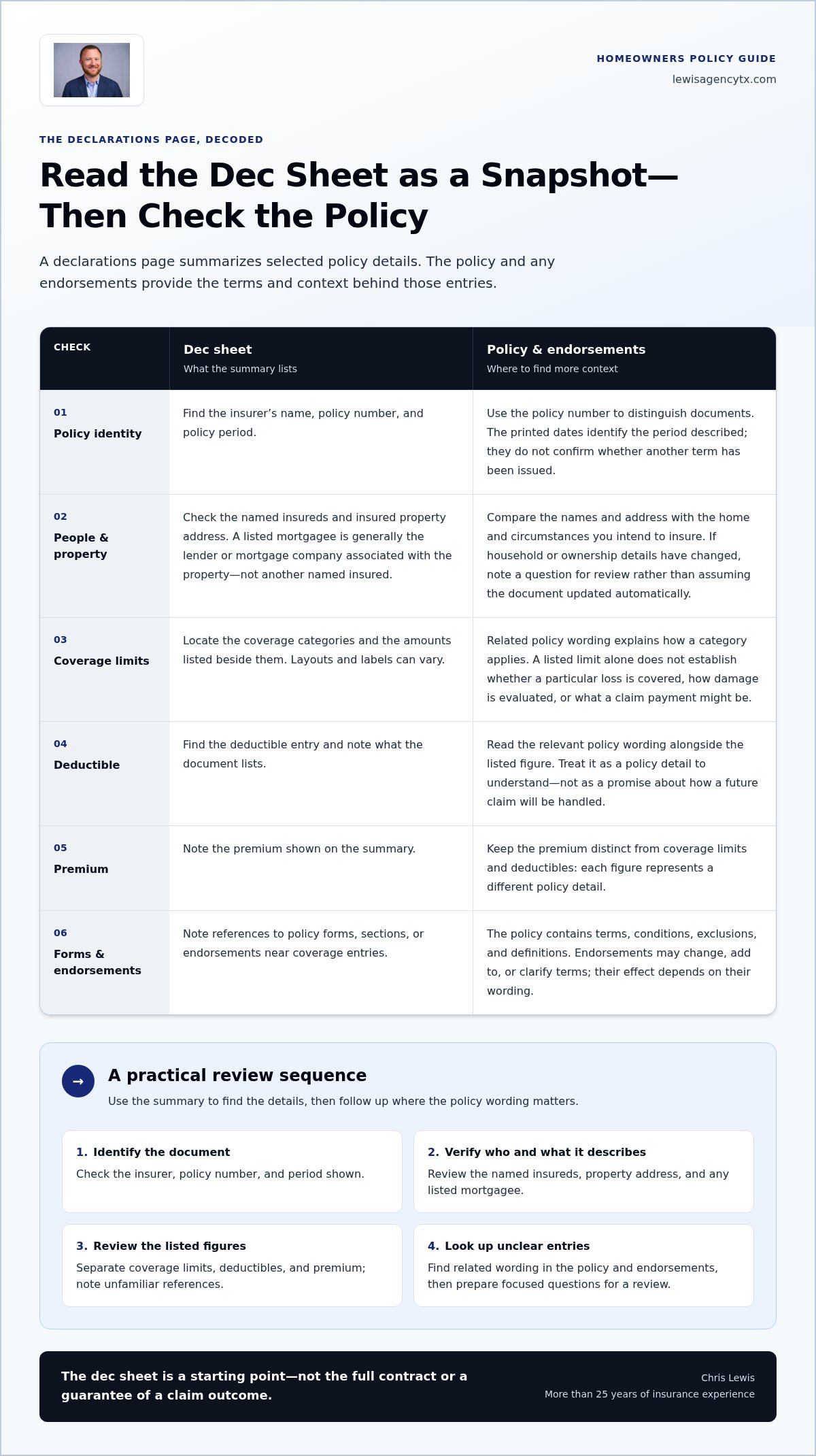
A homeowners insurance declarations page, often called a dec sheet, is a short summary of selected details about your policy. It can help you identify the insured home, policy period, and listed coverages, but it isn’t the full contract. A useful way to think about it is this: A dec sheet is a snapshot of selected policy details, not a promise that a particular claim will be paid.
If you’re learning how to read an insurance declarations page dec sheet, keep that distinction in mind. The summary points you toward key information; the full policy and any endorsements explain the terms that apply. Endorsements are documents that may change, add to, or clarify policy terms. Their effect depends on the wording in your documents.
Why homeowners receive a dec sheet
The summary gives you a practical way to identify your homeowners policy and review details without searching through every page first. You might consult it when policy documents arrive, when you’re preparing for renewal, or when you want to check the information associated with your home. It’s a starting point for review, not a substitute for reading the policy.
For example, a homeowner in Central Texas might use the page to locate the listed dwelling coverage and deductible before reviewing the related policy wording. That helps focus questions, especially before renewal, when home details or household circumstances may have changed.
What the dec sheet cannot tell you on its own
A summary has limits. Exclusions, conditions, and definitions that affect coverage may appear in the policy or an endorsement rather than on the dec sheet. Those sections explain how the policy applies, including requirements or restrictions that may matter in a particular situation. Coverage depends on the actual policy, its endorsements, and the circumstances of a loss.
A listed coverage limit tells you the amount shown for that part of the policy. By itself, it doesn’t establish whether a specific loss is covered, how damage will be evaluated, or what a claim payment might be. For instance, a listed dwelling limit alone can’t answer whether a particular roof loss is covered or how the policy would apply. Those questions depend on the policy language and the facts of the claim, and the insurer makes the claim determination.
- The dec sheet: A quick reference for selected policy details.
- The policy: The terms, conditions, exclusions, and definitions that provide context.
- Endorsements: Additional documents that may alter or clarify terms, depending on their wording.
Read the summary as a guide to where to look next. If an entry raises a question, find the related wording in the policy and review both documents together. This keeps a listed figure in perspective and gives you a clearer basis for asking informed questions.
How to Read the Policy, Property, and Coverage Details on a Dec Sheet
Start with the identifying details before looking at coverage amounts. This helps confirm which policy document you’re reading and which home it refers to. When learning how to read an insurance declarations page dec sheet, connect each listed detail to the right property and policy period, then note anything that needs a closer look.
Start with the people, property, and policy dates
Find the policy number, named insureds, insured location, and policy period. These details help distinguish one document from another, especially if you have copies from different dates. The policy number is the insurer’s reference for the policy. Named insureds are the people identified on it. The insured location is the home the document describes. Check the dates printed for the policy period rather than assuming a document is current because you recently received it.
- Identify the policy. Locate the policy number and the insurer’s name. Use the number to distinguish this document from other policy paperwork.
- Check the named insureds. Review the names as printed. If a household or ownership change has occurred, note it as a question for your policy review rather than assuming the document updated automatically.
- Verify the insured property address. Compare the listed location with the home you intend to insure. The property address identifies which home the policy details refer to. For example, a homeowner in Round Rock should check that the page names the intended Round Rock property, not a previous residence.
- Read the policy period. Note the start and end dates shown. These dates help you compare documents and identify the period each one describes; they don’t, by themselves, confirm whether another term has been issued.
Locate the listed coverages and policy references
After checking the identifying details, look for the coverage section. It may appear as a table or schedule, with coverage categories alongside listed amounts. Labels and categories can vary, so read your own document rather than expecting every Texas policy to use the same layout. The mortgagee, if listed, is generally the lender or mortgage company associated with the property, not another named insured.
Note any references to policy forms, sections, or endorsements near the coverage entries. These references point to wording that explains how a category applies or whether an endorsement changes the terms. Don’t assume a coverage label alone answers questions about a specific loss. Keep a short list of unfamiliar references so you can find them in the accompanying policy documents.
For instance, a hypothetical homeowner in Cedar Park might find the correct address and policy dates, then see a coverage label followed by a form reference. The useful next step is to record that reference and locate its wording, not to draw a conclusion from the label alone. If you’d like help understanding your policy documents, you can discuss your homeowners policy with The Lewis Agency.
How to Understand Home Insurance Limits, Deductibles, and Premiums
Coverage amounts, deductibles, and premium may sit close together on a declarations page, but they describe different parts of the policy. To understand how to read an insurance declarations page dec sheet, consider each figure separately, then check how the policy wording connects it to a particular coverage or loss.
Read coverage limits as listed amounts, not claim promises
A limit is the amount shown for a particular coverage category. Your dec sheet may display several categories and their amounts in a table or schedule. Labels and layout vary by policy, so don’t assume every homeowners policy uses the same categories or structure. A listed limit helps you understand what the document states, but it doesn’t independently determine whether a specific loss is covered or how a claim will be settled.
Policy wording, exclusions, endorsements, and the facts of a loss all matter. A listed dwelling limit, for example, doesn’t by itself explain how the policy would respond to damage from a particular event. For roof questions, check how the policy describes settlement and which roof coverage applies. The distinctions in actual cash value versus replacement cost for a Texas roof can help you identify what wording to look for.
Check deductibles and premium without assuming why they changed
A deductible is the amount or share you’re responsible for under the policy when a covered loss applies. The premium is the amount charged for the policy period shown in the documents. Neither figure has one universally suitable value. Review what your own documents say, and don’t infer the reason for a premium change from the declarations page alone.
Pay attention to the deductible’s label and which coverage it applies to. A policy may list more than one deductible, with different terms or applications. If a deductible is shown as a percentage, check the policy wording to understand what it is calculated against rather than assuming the percentage applies to the cost of repairs. Don’t assume one listed amount applies to every kind of loss. If the wording or calculation is unclear, note the question and locate the relevant policy language.
| Figure | What it represents | What it doesn’t establish by itself |
|---|---|---|
| Coverage limit | The amount shown for a coverage category | Whether a particular loss is covered or what a claim will pay |
| Deductible | Your stated share or amount under applicable policy terms | Which deductible applies without checking its label and wording |
| Premium | The policy charge for the stated period | Why the price is at that level or how it may change later |
If the premium differs from an earlier document, compare the policy periods and listed details before drawing conclusions. A rate change can have several possible explanations, and the dec sheet alone may not explain them. For broader renewal context, see Texas home insurance rate increases in 2026. Use the figures as prompts for review, then consult the policy wording for the terms that govern your coverage.
How to Review a Dec Sheet for Home Details, Changes, and Questions
A policy review is a chance to check whether the information on your declarations page still reflects your home and household. Keep the current page beside an earlier one, if you have it, and list anything that looks different or unclear. Learning how to read an insurance declarations page dec sheet also means knowing when a detail deserves a follow-up question instead of guessing what it means.
Check whether the listed information still matches your home
Compare the page with your current circumstances. Pay attention to the insured address, named insureds, mortgage information, and property characteristics shown on the document. Details such as construction or roof information may appear, depending on the policy documents. If something seems outdated or inaccurate, write it down for a policy discussion. Don’t assume that changing a detail will necessarily change coverage or premium.
- Address: Does the insured location match the home you’re reviewing?
- Named insureds: Are the listed names consistent with the current household and policy documents?
- Mortgage information: Is the mortgage company information shown, if applicable, consistent with your records?
- Property details: Do listed characteristics appear to match the home as you understand it?
Use the checklist to identify questions, not to decide whether a claim would be covered. For example, imagine a homeowner in Georgetown notices hail damage to a roof and sees a roof-related entry on the dec sheet. The summary may help identify a coverage label or endorsement to look up, but it can’t answer on its own how the policy applies to that damage. The policy wording and circumstances of the loss matter. Broader policy topics are covered in this Austin homeowners insurance coverage guide.
Compare the current page with prior policy documents
Look for changes in the policy dates, listed amounts, deductibles, or endorsements. Mark each difference and note what you want clarified. A changed entry is a reason to investigate, not proof of why it changed or what effect it has. If the premium is different, keep that question separate from the other entries; the declarations page may not explain the reason.
Before a review, gather relevant records, such as an updated mortgage statement or information about changes to the home. Keep your questions specific: “What does this listed property detail refer to?” or “Where can I find the wording for this endorsement?” Focused questions make it easier to connect a summary entry with the policy language that explains it.
If several entries have changed, review them one at a time rather than trying to infer a single cause. The Lewis Agency can help explain homeowners policy documents and clarify questions about listed information. Reviewing the details calmly before renewal gives you time to understand what the documents say and identify anything that needs attention. This review approach applies whether your home is in Austin, Leander, Cedar Park, Georgetown, Round Rock, or Liberty Hill.
What to Do After Reading Your Home Insurance Dec Sheet
Once you’ve reviewed the summary, turn anything unclear into a specific question. Mark the entry, find the related wording in your policy documents, and ask for help understanding how the documents fit together. Knowing how to read an insurance declarations page dec sheet means knowing when to look beyond the summary, too.
Prepare focused questions about unclear entries
Keep your questions neutral and tied to the wording you see. Instead of asking whether a loss is covered based only on a label, ask what that term or figure refers to in your specific policy and where its full explanation appears. That keeps the discussion grounded in your documents, rather than assumptions about what the policy might say.
- Mark the entry. Note the label, amount, date, or reference that prompted your question.
- Find related wording. Check the policy sections or endorsements connected to the entry. Look for relevant definitions, exclusions, and conditions.
- Ask a focused question. For example: “Where does the policy explain this term?” or “What wording applies to this listed coverage?”
If two documents seem to use different terms, bring both into the review and ask how they relate. If a deductible or coverage entry is unclear, ask what the specific wording says about when it applies. These questions don’t assume a particular answer or claim outcome. They help you understand which policy language is relevant.
Use a policy review to clarify next steps
A policy review can help you make sense of the documents, identify details you may want to discuss, and understand what to read next. An insurance agent can explain policy language and help you follow the claims process, but doesn’t decide whether a claim is covered or control coverage terms. Coverage interpretations and claim decisions depend on the policy and the circumstances involved.
Chris Lewis has more than 25 years of insurance experience and helps Central Texas homeowners better understand coverage and policy language. A conversation can clarify what a listed entry means and where to find its context, without treating the summary as a decision about a future claim.
Bring the declarations page and related policy documents, along with the questions you marked. You don’t need to resolve every detail at once. Start with the entries that matter most to your understanding of the home’s policy, then work through the related wording one question at a time. That steady approach can make a policy review more useful and help you know what follow-up, if any, makes sense.
If you’d like to talk through questions about your homeowners policy, you can ask The Lewis Agency about your homeowners policy.
Make Your Next Policy Review More Useful
Set aside time before renewal to make policy review a regular part of caring for your home. A brief note of questions as they arise can help you approach that review with a clearer sense of what you want to understand. Knowing how to read an insurance declarations page dec sheet isn’t about finding every answer on one page. It’s about being ready to follow up thoughtfully.
Keep your policy documents together in a place you can find them, and note when you last reviewed them. If your circumstances change, add that to your list for the next review. Small habits like these can make it easier to stay engaged with your coverage over time.
Take the process one question at a time. Understanding your policy is ongoing, and steady attention can help you feel more prepared for future decisions.
Frequently Asked Questions
What is an insurance declarations page, or dec sheet?
It’s the declarations page, a document homeowners can use to identify which contract and policy period they’re looking at. A practical way to learn how to read an insurance declarations page dec sheet is to compare its dates and policy number with the paperwork you’re reviewing. That check can help prevent mixing up current documents with older copies when you organize records or prepare questions.
Is a declarations page the same as an insurance policy?
No. Think of the declarations page as one document within the broader set of policy materials, not a replacement for them. If you’re trying to understand a particular term, note any section or form references near it and use those as clues for where to look next. Keeping the related pages together can make it easier to follow how the documents connect.
Can a declarations page prove that my home is insured?
It can provide policy information, but the organization requesting proof decides what documentation it will accept. If a mortgage lender asks for evidence, clarify whether it needs a declarations page or another document, and whether it requires a specific policy period or delivery method. Then provide the current paperwork that matches the request. This avoids assuming that one document will meet every organization’s requirements.
What should I do if my homeowners declarations page has incorrect information?
Describe the issue clearly when you contact your insurance agency or insurer. For example, identify the exact field and explain what you believe it should say, using relevant records if helpful. Ask how the discrepancy should be handled and whether updated documentation will be provided if a change is made. Keep any response with your policy records so you can refer to it during a later review.
How often should I review my insurance declarations page?
Review it when you receive new policy documents and when a change in your household or home prompts a question. Keep dated copies together and make a brief note of changes you want to discuss. That record can help you track what you noticed and when, without relying on memory at renewal. The right review timing depends on your circumstances and policy documents.
Where can I get a copy of my homeowners dec sheet?
Look through the documents provided by your insurer or its customer account tools, if available. If you can’t find the page, contact your insurance agency or insurer and specify the policy period you need. Save the copy with your other homeowners records and label it by date. That makes it easier to distinguish the current document from earlier versions when you’re discussing your policy.
Does a dec sheet show whether hail damage to my roof is covered?
It can help you identify which roof-related terms to ask about, but don’t use it alone to predict a claim result. For a Central Texas hail concern, note the deductible label and look for any roof settlement wording or related endorsement in the policy documents. An insurance professional can explain where those terms appear and how to read them; claim decisions depend on the policy and loss circumstances.
Article by
Chris Lewis
Chris Lewis is the owner of The Lewis Agency, an Allstate insurance agency serving Austin and Central Texas. With more than 25 years of insurance experience, Chris focuses on helping Central Texas homeowners better understand their insurance coverage, including deductibles, roofs and hail, severe weather risks, water damage and other important coverage considerations. He created LewisAgencyTX.com to provide practical homeowners insurance education and help homeowners better understand their coverage before they need it.

Lower Your Texas Homeowners Insurance Premium in 2026
Wondering how to lower homeowners insurance premium Texas 2026 costs? Review deductibles, property updates, and coverage options with this Central Texas guide.

If you searched “how to lower homeowners insurance premium texas 2026,” you’re probably looking for practical ways to manage renewal costs without taking on more risk than you can afford. A lower premium can come with trade-offs, so start by understanding what a proposed change means for your coverage and your costs after a loss.
This guide walks through what to review, from your home’s roof and other property details to your coverage and deductibles. It also explains how to ask about possible discounts without assuming you qualify. Policy terms and pricing vary, so no single change fits every home. Chris Lewis of The Lewis Agency, an Allstate agency serving Austin and Central Texas, brings more than 25 years of insurance experience to helping homeowners understand their coverage. Whether you live in Austin, Leander, Cedar Park, Georgetown, Round Rock or Liberty Hill, use this guide to prepare for a clear, informed policy discussion.
Key Takeaways
- Know the difference between your premium, deductible and claim payment, and understand which details you can review.
- Review coverage before making changes. Lowering limits or adjusting policy terms can affect your financial risk after a loss.
- Compare possible steps by effort, cost and effect on protection. Treat bundling auto and home insurance as a question, not a promised discount.
- Use your declarations page and current policy documents to note home updates and prepare questions for your renewal review.
- Chris Lewis and The Lewis Agency can help explain policy terms and make coverage questions easier to understand.
Start by understanding what drives a Texas homeowners insurance premium
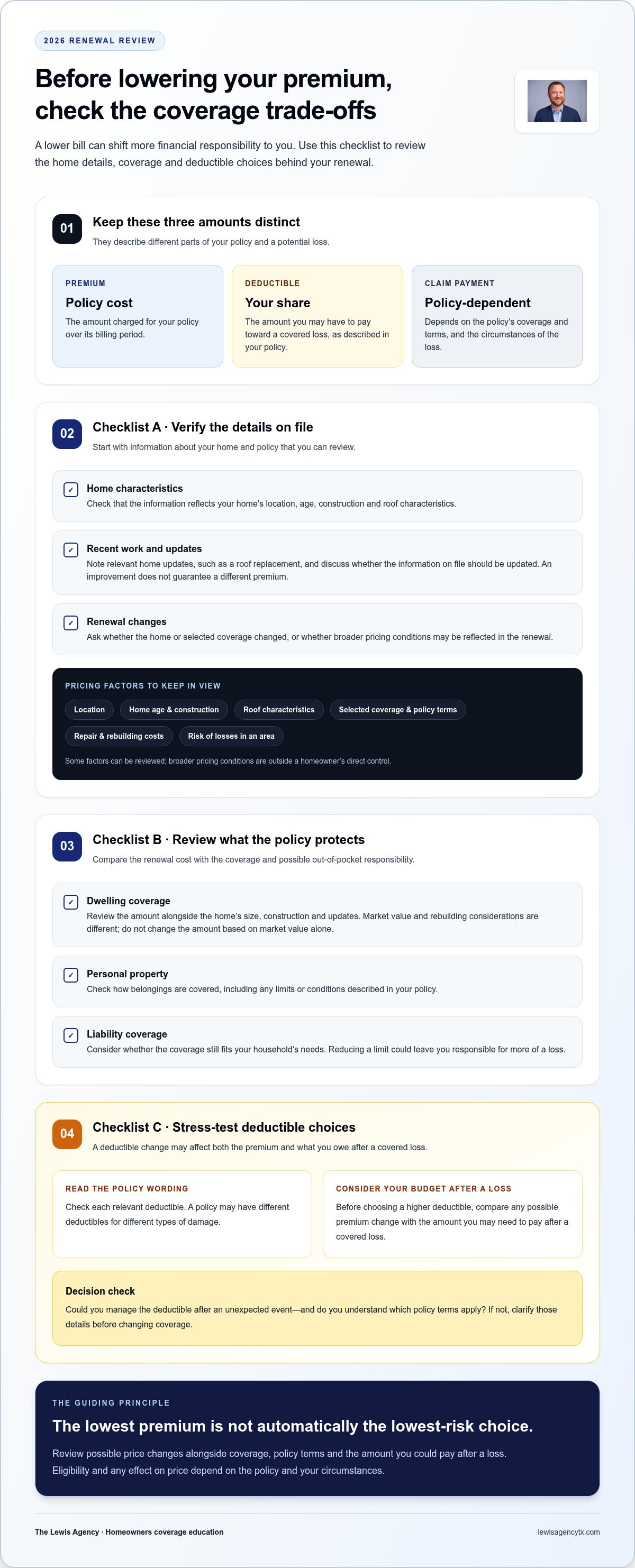
Your premium is the amount charged for your policy over its billing period. It is not the same as your deductible, which is the amount you may have to pay toward a covered loss under your policy. A claim payment depends on the policy’s coverage and terms, as well as the circumstances of the loss. Keep these amounts separate when you compare renewal options.
Some pricing factors relate to your home and coverage choices. Others reflect broader conditions, such as repair and rebuilding costs or the risk of losses in an area. Location, the home’s age and construction, roof characteristics, selected coverage and policy terms may all affect pricing. General information about homeowners insurance can explain a policy’s purpose, but the documents for your policy describe the coverage and exclusions that apply to your home.
No single action guarantees a lower premium. Weigh any potential price change against the coverage and out-of-pocket risk that come with it. To find ways to lower your homeowners insurance premium in Texas in 2026, separate the details you can review from pricing factors you cannot control.
Which parts of a premium can a homeowner influence?
You can review your selected coverage, deductible choices and the property information on file. For example, check that the information about your Central Texas home reflects its current roof and any relevant updates. Consider whether the coverage still fits your home and belongings, and whether you could manage the deductible after a loss. Eligibility and any effect on price depend on the policy and your circumstances.
Imagine a homeowner near Round Rock whose roof was recently replaced. It makes sense to document the work and discuss the updated information during a policy review, but the replacement does not guarantee a different premium. The insurer’s rules, policy terms and other pricing factors still matter. Look at the options together rather than assuming one improvement will produce a particular result.
Why can a Texas premium change at renewal?
A renewal price may reflect policy-specific details, such as updated information about the home, selected coverage or changes in pricing. It may also reflect broader conditions that affect repair and rebuilding costs or the insurer’s assessment of risk. A homeowner cannot directly change those broader factors, even though they may influence the price.
Start by asking whether anything about your home or policy changed, or whether the renewal may reflect broader pricing conditions. That can keep the discussion focused on useful next steps instead of an assumed cause. For more context about factors that may affect costs, see the Texas home insurance rate increases guide. Then review your current policy details before deciding whether to make an adjustment.
Review coverage and deductibles before trying to cut your premium
To assess a renewal, compare the premium with the coverage and the amount you could pay after a loss. Review dwelling coverage for the home, personal property coverage and its terms, liability coverage, and each deductible shown in your policy documents. Changing any of these elements may affect the premium, but it can also shift more financial responsibility to you.
The lowest premium is not automatically the lowest-risk choice. Before changing coverage, consider what the change could mean in a serious loss, not just what it might do to the bill. Make sure you understand both the potential price effect and the coverage trade-off.
Check whether dwelling coverage still reflects your home
Review the dwelling coverage amount alongside your home’s current characteristics, such as its size, construction and updates, and check how the policy describes coverage. Market value and rebuilding considerations are different: a sale price may reflect land and local demand, while rebuilding relates to the work and materials needed to reconstruct the insured home. Valuation methods and policy terms vary, so do not change the amount based on market value alone. The Austin homeowners insurance coverage guide offers more context for reviewing coverage.
Review personal property and liability separately. Check how the policy covers belongings, including any limits or conditions, and consider whether the liability coverage still fits your household’s needs. Reducing a limit is not necessarily a harmless way to lower the premium; it could leave you responsible for more of a loss. The Texas Department of Insurance (TDI) provides consumer information about insurance, while your policy documents explain the terms that apply to your coverage.
Weigh deductible changes against your ability to pay
A deductible is the amount you may pay toward a covered claim, as described in your policy. Changing it may affect both the premium and what you owe after a loss. Deductibles are policy-specific. A policy may have different deductibles for different types of damage, so check the relevant wording rather than assuming one amount applies to every claim. Before making a change, consider whether you could manage the out-of-pocket cost after an unexpected event.
For example, if you are considering a higher deductible to reduce renewal costs, compare the possible premium change with the amount you would need to pay after a covered loss. The Texas homeowners insurance deductibles guide can help you identify what to look for in your policy. You can also have a policy review conversation with The Lewis Agency to understand the terms before deciding what to adjust.
Compare practical premium-saving options without assuming a discount
Possible ways to manage a premium differ in effort, expense and effect on protection. A policy question may take little effort, while a roof project can involve substantial planning and cost. Neither guarantees a lower price. Before taking action, consider the expense, whether the step changes coverage or risk, and what information the insurer needs to determine eligibility.
Use these questions to compare options:
- Policy review: Is there information to correct or clarify, and could a proposed change affect your protection?
- Auto coverage: Is a home and auto option available for your policies, and what eligibility rules apply?
- Property improvements: What maintenance or resilience benefits would the work provide if the premium stays the same?
- Potential discounts: What documentation is required, and how are eligibility and any price effect determined for your policy?
For broader ideas, the Insurance Information Institute discusses ways to lower homeowners insurance costs. Treat general suggestions as questions to explore, not a promise that a particular option applies to your policy. Texas-specific consumer information from the Texas Department of Insurance (TDI) can help you frame questions about policy costs and discounts.
Ask about eligibility for policy discounts
Ask which discounts, if any, may apply to your specific policy. Do not assume you qualify because another homeowner received a discount or a general article mentions one. Eligibility, required documentation and the effect on the premium can vary. Ask what conditions apply and whether a policy change would affect coverage as well as price.
Consider roof and home improvements carefully
Hail is a practical concern for Central Texas homeowners, but replacing a roof or adding a safety feature does not guarantee a lower premium. Weigh the project’s maintenance and resilience benefits on their own, then ask whether the insurer considers the improvement and what documentation may be needed. That way, you are not taking on an expense solely because you expect insurance savings.
A measured review can help you distinguish a useful option from one that costs more or shifts risk without a clear benefit. The Lewis Agency can help you understand your policy terms and available choices through a homeowners coverage review.
Use a step-by-step review before your 2026 renewal
Preparing for a renewal can make the discussion more useful and less rushed. Start with your declarations page and current policy documents. Note what has changed and what you need explained. This keeps the focus on understanding your coverage and the options available under it, rather than treating a lower quoted price as the only goal.
Prepare documents and note changes to the home
Gather your renewal notice, declarations page and current policy documents. Make a short record of relevant changes since the last review, such as roof work, updates to major home systems, a change in occupancy or a shift in household circumstances. These details help you discuss whether the information on file is current. An update does not automatically qualify the home for a discount or change the premium.
Work through the review in order:
- Gather documents. Keep the renewal notice, declarations page and policy wording together so you can refer to the same information during the discussion.
- Inspect changes. Note work completed on the home and any changes in how it is used. For roof work, record what was done and when, along with any available documentation.
- List questions. Identify unfamiliar terms, a premium change you want explained or coverage details you would like to understand. Put the most important questions first.
- Review options. Discuss the current policy and any proposed adjustments one at a time. Consider how each could affect coverage, deductibles, exclusions or out-of-pocket costs, as well as the premium.
Ask focused questions about premium and protection
Ask what changed at renewal, which policy terms influence the premium and whether updated home information was considered. If an option involves changing coverage, ask how it could affect limits, exclusions, deductibles or the amount you might need to pay after a loss. The answers depend on your policy and circumstances.
Write down the explanation and any follow-up items. If a term is unclear, ask for a plain-language explanation and, when helpful, where it appears in the policy documents. You will have something concrete to review afterward instead of relying on memory.
If you are looking for ways to lower your homeowners insurance premium in Texas in 2026, a prepared policy review can help you evaluate changes without losing sight of protection. Review your homeowners policy with The Lewis Agency to discuss its terms and your renewal questions.
Get help understanding your Texas homeowners policy
A renewal conversation can help turn policy language into clear questions and choices. Chris Lewis has more than 25 years of insurance experience, and The Lewis Agency is an Allstate agency serving Austin and Central Texas, including Leander, Cedar Park, Georgetown, Round Rock and Liberty Hill. The agency can help homeowners understand policy terms and the claims process. Rates, underwriting, renewal, coverage and claim-payment decisions are made by the insurer, not the agency.
A discussion can clarify what your documents say and what questions to raise, but it cannot promise a particular premium or claim outcome. The goal is to help you understand your current policy so you can consider possible changes carefully.
What a policy discussion can help clarify
Bring your renewal notice, declarations page and any policy wording you are unsure about. A discussion can help explain how coverage terms, deductibles and other policy details fit together, as well as how the claims process generally works under your policy. If a term is unclear, ask where it appears in the documents and what it means for your circumstances.
Keep the conversation grounded in the actual policy. Coverage and exclusions vary, so a general explanation is not a substitute for the wording that applies to your home. You can ask how a proposed change might affect protection or costs after a covered loss, then consider the trade-off before deciding.
Choose a useful next step
For Austin and Central Texas homeowners, a useful first step is to raise renewal questions before making changes. Note what you want to understand, whether it is a premium change, a deductible or a particular coverage term. This keeps the discussion focused on your policy instead of assuming a change will produce a specific result.
If you are considering how to lower your homeowners insurance premium in Texas in 2026, use the conversation to understand possible effects on both price and protection. Ask for unfamiliar language to be explained plainly, and make sure you are comfortable with any change before moving ahead. You may decide an adjustment makes sense, or that your current terms better fit your needs.
There is no need to make a change simply because renewal is approaching. If you would like to talk through your current policy and questions, talk with The Lewis Agency.
Make your next renewal decision with confidence
A renewal review does not need to end with an immediate change. Take time to consider what you learned, revisit any policy language that remains unclear and decide which trade-offs fit your household’s needs. A premium adjustment is useful only if you understand what changes along with it.
If you are exploring ways to lower your homeowners insurance premium in Texas in 2026, bring specific questions to a policy discussion. Ask how each option you are considering could affect your coverage or out-of-pocket costs. You do not have to choose an adjustment simply because it is available; keeping your current terms may also be the right decision for your needs.
If you would like help working through your renewal questions, review your homeowners policy questions with The Lewis Agency. A thoughtful conversation can help you understand your choices and the protection you keep.
Frequently Asked Questions
Can bundling homeowners and auto insurance lower my premium?
It may affect the price, but whether a home and auto option applies and what it changes depends on the insurer, policies and household details. Ask for the home and auto costs separately and together, then compare the combined price alongside coverage and deductibles. For example, a lower homeowners premium alone may not make the combined option less expensive if the auto policy cost changes. Do not assume a discount is available or guaranteed.
Will replacing my roof lower my Texas homeowners insurance premium?
A new roof may affect how the insurer evaluates the home, but it does not guarantee a lower premium. Before starting a project mainly for insurance reasons, ask how the proposed work would be considered under your policy. Keep records such as invoices, permits if applicable, and details about materials or installation. Also weigh the roof’s condition, maintenance needs and resilience benefits separately from any possible insurance effect.
Does homeowners insurance in Texas cover flood damage?
Do not assume your homeowners policy covers flooding. The policy wording determines how water damage is treated, and coverage for a plumbing leak may differ from damage caused by rising water. Check the definitions, exclusions and any endorsements in your documents, then ask about your specific situation. If flood risk is a concern, consult consumer guidance from the Texas Department of Insurance or FEMA about coverage options rather than relying on a general assumption.
Can filing a small homeowners insurance claim affect my premium?
The effect depends on the insurer, policy, claim details and underwriting circumstances, so there is no universal outcome to rely on. Before deciding whether to file, compare the known damage with the applicable deductible and review how the claims process works. The agency can explain policy language and the process, but it does not determine claim decisions, premium changes or renewal outcomes. Keep records of damage and communications related to the loss.
Do home security devices qualify for a homeowners insurance discount?
Some insurers may recognize certain security features, but eligible equipment and any premium effect vary by policy. Before buying a device mainly for possible savings, ask whether the specific equipment is considered and what documentation may be needed. Keep its model information and installation records. Then weigh any potential insurance benefit against the device’s separate value for household safety and property protection, even if the premium does not change.
Can I lower my premium by changing my homeowners insurance deductible?
A deductible change may affect both the premium and what you pay toward a covered loss, depending on the policy. Before choosing a different amount, consider whether you could manage that expense if a claim occurred alongside other household costs. Check the declarations page and policy wording for applicable deductibles, including whether different types of loss have different terms. Understand the out-of-pocket trade-off before making a change.
Article by
Chris Lewis
Chris Lewis is the owner of The Lewis Agency, an Allstate insurance agency serving Austin and Central Texas. With more than 25 years of insurance experience, Chris focuses on helping Central Texas homeowners better understand their insurance coverage, including deductibles, roofs and hail, severe weather risks, water damage and other important coverage considerations. He created LewisAgencyTX.com to provide practical homeowners insurance education and help homeowners better understand their coverage before they need it.