
Dwelling Coverage Homeowners Insurance Texas: Complete Policy Guide (2026)
Learn how dwelling coverage homeowners insurance Texas policies protect your home. Understand rebuild costs, hail deductibles, and policy limits with confide...

One of the most important numbers on a Texas homeowners insurance policy is the dwelling coverage limit—but it's also one of the easiest to misunderstand. Your home's insured value isn't necessarily the same as its market value, tax appraisal or purchase price.
In reality, market values and physical construction expenses are entirely different calculations. You don't want to pay high premiums for bloated protection, but you also cannot afford an unexpected shortfall when severe hailstorms strike. In this guide, you'll learn how Coverage A protects your home's structure, why rebuild expenses differ from market valuations, and how to establish accurate policy limits. We'll examine how replacement cost mechanics work, unpack percentage-based hail deductibles, and help you evaluate your coverage options with total confidence.
Key Takeaways
- Learn how dwelling coverage homeowners insurance Texas policies provide essential structural protection for your foundation, framing, and roof system after covered losses.
- Discover why real estate market value and property tax appraisals differ significantly from the actual labor and material costs required to reconstruct your home.
- Understand the vital financial distinctions between replacement cost settlements and actual cash value claim payouts, particularly for aging roof systems.
- Find out how evolving municipal building codes across Central Texas impact your repair requirements and why regular limit reviews prevent costly out-of-pocket shortfalls.
What Is Dwelling Coverage in Texas Homeowners Insurance?
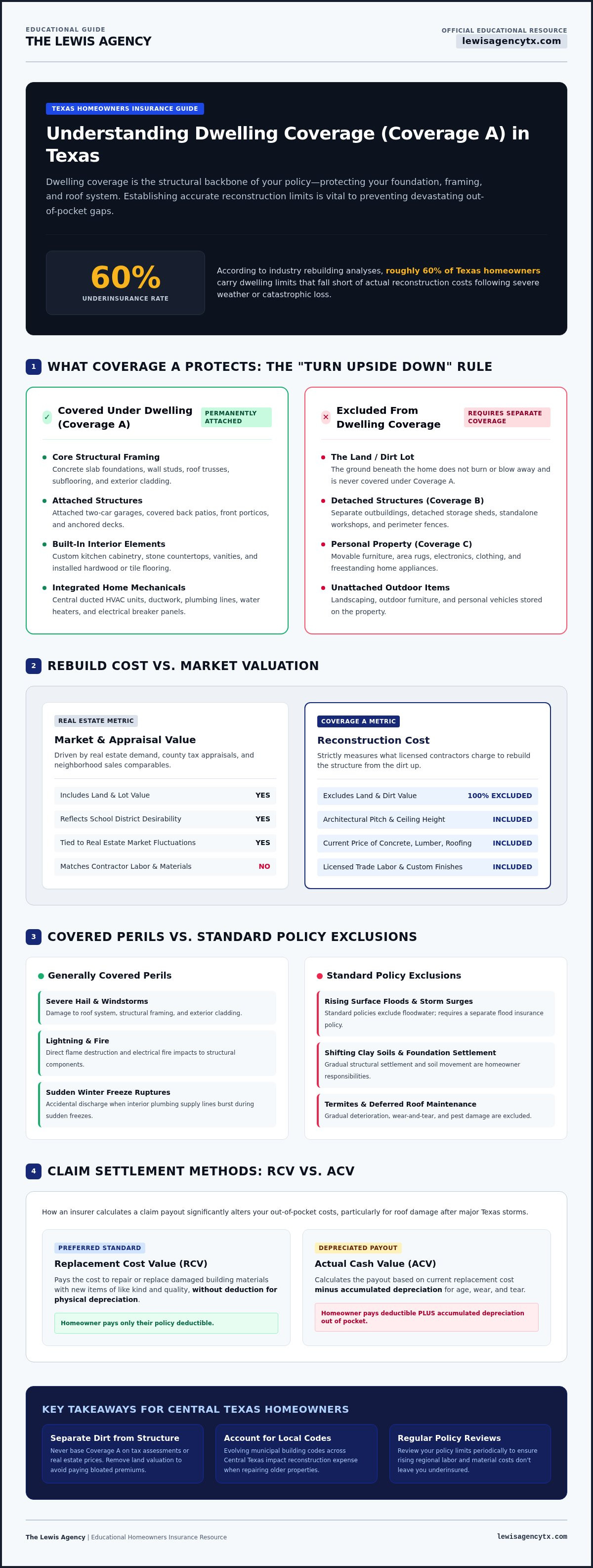
Dwelling coverage, officially designated as Coverage A, forms the structural backbone of your policy. It pays to repair or rebuild the physical structure of your primary residence if damaged or destroyed by a covered loss. Rather than protecting the land beneath your feet or the furniture inside your rooms, this specific coverage focuses entirely on the bricks, mortar, and framing that keep a roof over your head.
In standard homeowners insurance policies, the dwelling limit serves as the baseline for the rest of your protection. The dollar amount you select for Coverage A directly dictates the formulaic limits available for other structures, personal property, and temporary living expenses. That makes setting an accurate limit for your dwelling coverage homeowners insurance Texas policy one of the most critical decisions you will make as a homeowner.
What Dwelling Coverage Protects Inside and Outside
Coverage A extends beyond the exterior siding to include permanently installed fixtures that make the house functional. If you could turn the house upside down, anything that stays attached typically falls under dwelling protection:
- Core structural framing: Concrete slab foundations, wall studs, roof trusses, subflooring, and exterior cladding.
- Attached structures: Attached two-car garages, covered back patios, front porticos, and permanently anchored decks.
- Built-in interior elements: Custom kitchen cabinetry, stone countertops, vanities, and installed hardwood or tile flooring.
- Integrated home mechanicals: Central ducted HVAC units, ductwork, plumbing lines, water heaters, and electrical breaker panels.
Items not permanently joined to the structure fall outside this protection. Separate outbuildings like detached storage sheds, standalone workshops, and perimeter fences require separate other structures coverage, while furniture and rugs belong to personal property.
Common Covered Perils vs. Standard Policy Exclusions
Texas weather presents substantial hazards to residential framing and roofs. Understanding how your dwelling coverage homeowners insurance Texas policy responds to sudden regional weather events ensures you know where policy boundaries lie.
Most standard policies cover perils like lightning, fire, high winds, and severe hail damage. They also generally cover sudden, accidental water discharge, such as an interior supply line that ruptures during an unexpected winter freeze. However, standard policies carry strict exclusions. Rising surface floodwaters, river overflows, and storm surges are excluded, requiring separate flood insurance policies. Similarly, gradual structural issues, such as foundation cracks caused by shifting clay soils, termite damage, or deferred roof maintenance, remain the homeowner's responsibility.
Dwelling Rebuild Value vs. Market Value in Texas
One common mistake homeowners make is assuming market value equals reconstruction cost. When your county appraisal district sends its annual property valuation, that total reflects buyer demand, school district boundaries, and neighborhood appeal. Your policy's Coverage A limit, however, exists strictly to purchase physical materials and hire licensed trades to reconstruct your home from the dirt up. As highlighted in the Texas Department of Insurance Home insurance guide, your structural limits need to reflect true replacement expense rather than real estate transactions or outstanding mortgage balances.
Why Real Estate Market Valuations Mislead Homeowners
Real estate appraisals bundle the value of your physical home together with the raw land it occupies. When a total catastrophe strikes, the lot beneath your home does not burn away. Factoring land value into your dwelling limits results in purchasing unnecessary coverage and paying inflated premiums for dirt that cannot be destroyed. Conversely, if local property sales cool down, the price of concrete, roofing, and skilled trade labor does not suddenly drop alongside home prices.
Key Factors Driving Texas Reconstruction Expenses
Calculating accurate replacement limits requires looking directly at physical construction variables rather than neighborhood sales comparables. Several regional elements determine what contractors charge to restore a damaged property:
- Architectural complexity: Steep roof pitches, custom masonry, high ceilings, and non-standard floor plans require specialized installation labor.
- Interior finish tiers: Rebuilding basic builder-grade trim involves different material expenses than replicating custom hardwood cabinetry, imported tile, and solid stone surfaces.
- Suburban trade demand: Fast-growing Central Texas communities like Leander, Liberty Hill, and Pflugerville experience high competition for subcontracting crews, which directly affects local labor rates.
- Demolition and debris haul-away: Before a builder pours fresh concrete, heavy equipment must break down damaged structures, clear hazardous rubble, and haul away debris to designated landfills.
If you aren't sure whether your current policy accounts for these regional construction realities, sitting down with The Lewis Agency can help you evaluate your property's specific characteristics and verify your numbers against local building trends.
Replacement Cost vs. Actual Cash Value on Texas Homes
Setting an accurate limit is only half the equation; the claim settlement method written into your contract determines how disbursements are calculated after a loss. When damage occurs, insurance carriers settle structural claims under either Actual Cash Value (ACV) or Replacement Cost Value (RCV). Knowing which provision applies to your structure protects your household from unexpected out-of-pocket bills.
Industry guidance on calculating your home's replacement cost emphasizes meeting your insurer's coinsurance requirements. According to the Texas Department of Insurance, most insurers require homeowners to maintain coverage equal to at least 80% of the home's total replacement cost. Falling short of this threshold can trigger coinsurance penalties, meaning the carrier reduces claim payouts on partial losses proportionally, leaving you responsible for the remaining balance.
Comparing Actual Cash Value and Replacement Cost
Actual cash value subtracts physical depreciation, factoring in the age and prior condition of your building materials before issuing payment. If an older roof sustains severe damage under an ACV provision, the insurer subtracts years of normal wear, paying only its current value. Replacement cost coverage pays to rebuild or replace damaged property with new materials of like kind and quality, without deductions for deterioration. Because of this added financial security, mortgage lenders routinely require replacement cost coverage on residential loans.
Extended Replacement Cost and Inflation Guard Endorsements
Severe storm outbreaks frequently generate localized shortages of building materials and trade labor. When widespread hail damages hundreds of homes in a single community, local construction costs can surge overnight, occasionally exceeding initial estimates.
Adding an extended replacement cost endorsement gives your dwelling coverage homeowners insurance Texas policy an extra safety buffer. Depending on policy terms, this endorsement provides an additional percentage of structural coverage above your stated Coverage A limit if localized demand drives up reconstruction expenses. Pairing this buffer with an inflation guard endorsement helps ensure your base limits steadily adjust over time, preserving your financial protection against ongoing price increases.
Tailoring Dwelling Coverage to Texas Perils and Local Codes
Every region presents its own set of environmental threats, but the Lone Star State is notorious for volatile weather patterns. From severe straight-line winds and tornadoes to spring hail swarms and bitter winter freezes, your home's structural framing and roof endure extraordinary strain. Structuring your dwelling coverage homeowners insurance Texas policy requires tailoring your protections to these specific regional realities rather than settling for a generic policy template.
Managing Hail Risks and Percentage Deductibles
Severe convective storms, hail, and high winds generate over 60% of all Texas homeowners insurance losses. Because hail risk is so high across the state, Texas insurers commonly write separate wind and hail deductibles structured as a percentage rather than a flat dollar amount. Crucially, this percentage applies directly to your Coverage A dwelling limit, not the total amount of storm damage.
For example, if your dwelling limit sits at $400,000 and your policy includes a 2% wind and hail deductible, your out-of-pocket obligation is $8,000 before insurance proceeds cover a single dollar of roof repairs. Under Texas Business & Commerce Code § 27.02, it is illegal for roofing contractors to absorb, rebate, or waive this deductible, meaning policyholders must pay this amount themselves. Keeping your baseline dwelling limit accurate prevents your percentage deductible from inflating unnecessarily while still ensuring adequate reconstruction funds.
The Role of Ordinance or Law Coverage in Growing Communities
Standard home policies agree to rebuild damaged structures back to their original specifications. However, fast-growing municipalities across Travis and Williamson counties regularly update local building standards. Cities like Cedar Park, Buda, and Round Rock frequently adopt newer revisions of the International Residential Code (IRC) along with stricter energy conservation mandates.
If extensive repairs require upgraded electrical panels, modified roof decking fasteners, or modern plumbing pipe configurations, standard policies typically provide little or no funding for those mandatory improvements. Adding an Ordinance or Law endorsement bridges this financial gap, providing dedicated funds to cover the code-mandated upgrades required by municipal inspectors during reconstruction.
Taking time to review your policy details can save your family thousands of dollars after a storm. If you want a clear, personalized assessment of your structural limits and roof deductibles, contact The Lewis Agency to walk through your current homeowners coverage.
How to Review and Adjust Your Texas Dwelling Coverage Limits
Homes evolve over time, and regional construction expenses shift alongside them. Leaving a policy on autopilot for years creates a dangerous gap between your coverage limits and actual local building expenses. Maintaining the right dwelling coverage homeowners insurance Texas policy requires ongoing attention rather than a one-time estimate. Instead of relying on rough square-footage guesses, accurate structural evaluations utilize comprehensive replacement cost estimators that account for your home's unique layout, foundation, and interior craftsmanship.
Triggers That Require Adjusting Your Coverage A Limits
Everyday improvements and market shifts alter your replacement needs. You should reach out to adjust your Coverage A baseline whenever you experience one of these key milestones:
- Interior remodeling: Upgrading to custom solid wood cabinetry, luxury bathroom fixtures, or high-end stone countertops increases the physical cost required to restore damaged rooms.
- Added square footage: Finishing a bonus room over your garage, enclosing a back patio, or constructing an attached guest suite expands your total rebuild footprint.
- Mechanical installations: Adding permanent infrastructure like whole-home standby generators, multi-stage HVAC systems, or built-in water filtration systems adds substantial replacement value.
- Regional cost shifts: General changes in subcontractor availability and supply chain pricing across Williamson and Travis counties can quietly leave older policy limits behind.
Working with The Lewis Agency on Your Coverage
Having experienced local guidance makes evaluating structural protection straightforward and stress-free. As a dedicated Allstate agency serving Central Texas communities like Austin, Round Rock, Cedar Park, Leander, and Pflugerville, The Lewis Agency understands how regional weather exposures and municipal building standards affect your home.
Agent Chris Lewis takes the time to sit down with you, examine your home's specific building features, and ensure your structural limits and deductibles work together effectively. When you want clear answers and personalized attention, schedule a consultation with The Lewis Agency to review your Texas homeowners policy and ensure your coverage matches your family's needs.
Protect Your Central Texas Home with the Right Structural Limits
Securing adequate dwelling coverage homeowners insurance Texas policies offer isn't about matching your neighbor's policy or relying on county tax appraisals. It's about making sure your Coverage A limit realistically reflects the current materials, specialized labor, and building codes required to restore your home after an unexpected catastrophe. Balancing replacement cost provisions with manageable percentage deductibles ensures you aren't caught off guard when severe weather rolls across the state.
You don't have to decipher these complex structural details by yourself. As a dedicated local Allstate agency serving Austin, Round Rock, Cedar Park, Leander, and Pflugerville, The Lewis Agency provides personalized coverage reviews tailored to regional construction trends. Agent Chris Lewis brings experienced, neighborly guidance to every conversation, helping you evaluate your property's specific rebuild requirements with total clarity.
Take the uncertainty out of your homeowners policy. Review your Texas homeowners coverage with The Lewis Agency today, and enjoy the lasting confidence that comes from knowing your home is thoroughly protected.
Frequently Asked Questions
How do I know if my Texas dwelling coverage limit is high enough?
Your limit is high enough if it matches a professional replacement cost calculation rather than your home's purchase price. A detailed replacement cost estimate examines your square footage, roof pitch, custom finishes, and local trade wages across Central Texas cities like Round Rock and Leander. Annual reviews ensure your dwelling coverage homeowners insurance Texas policy limit keeps pace with shifts in material costs and regional building expenses.
Is dwelling coverage based on the county property tax appraisal value in Texas?
No, dwelling coverage is never based on county property tax appraisal numbers. County appraisals evaluate the market value of your property, which includes both the physical house and the underlying parcel of land. Rebuild insurance strictly covers the labor, equipment, and building materials needed to reconstruct the structural dwelling. Because your land doesn't disappear during a loss, tying your policy limit to tax records results in inaccurate coverage.
What happens if my home costs more to rebuild than my dwelling coverage limit?
If rebuild expenses exceed your limit, you must pay the remaining balance out of pocket. Standard policies pay claims only up to the stated Coverage A limit on your declarations page. However, adding an extended replacement cost endorsement provides an additional percentage buffer above your base limit if localized disasters cause sudden surges in labor and lumber costs. Reviewing your policy prevents catastrophic out-of-pocket shortfalls during major community rebuilding phases.
Does dwelling insurance cover roof damage caused by severe Texas hailstorms?
Yes, standard policies generally cover hail damage to roofs, but specific settlement terms depend on your policy language. Hail is typically a covered peril, but your claim payout depends on whether your policy pays replacement cost or actual cash value based on roof age. Texas policies also apply separate wind and hail deductibles, which require an out-of-pocket percentage payment based on your total dwelling limit before claim funds are released.
Can I lower my dwelling coverage to reduce my homeowners insurance premium?
You shouldn't artificially lower your Coverage A limit simply to reduce your premium. Insurers generally require coverage equal to at least 80% of replacement costs to avoid coinsurance penalties on partial claims. Dropping your structural limit below true rebuild expenses exposes your family to major out-of-pocket liabilities. Instead of cutting essential dwelling protection, explore adjusting your policy deductibles or reviewing eligible policy credits with your local agent.
Does dwelling insurance cover foundation damage caused by shifting Texas soil?
Standard policies exclude foundation damage caused by normal soil expansion, contraction, or settling. The expansive clay soils common across Austin, Pflugerville, and Williamson County frequently cause ground movement, but standard Texas home policies treat this as gradual wear. However, if foundation cracking results directly from an accidental, sudden plumbing freeze or interior pipe rupture, limited coverage may apply depending on your specific policy endorsements and water damage riders.
What is the difference between dwelling coverage and other structures coverage?
Dwelling coverage protects your primary residence and permanently attached features, while other structures coverage protects unattached outbuildings. Your dwelling limit pays for repairs to your house, roof, foundation, and attached garage. Other structures coverage, known as Coverage B, specifically covers separate physical assets on your property grounds, such as detached storage sheds, standalone workshops, gazebos, and perimeter fencing, typically set as a default percentage of your dwelling limit.

Article by
Chris Lewis
Chris Lewis is the owner of The Lewis Agency, an Allstate insurance agency serving Austin and Central Texas. With more than 25 years of insurance experience, Chris focuses on helping Central Texas homeowners better understand their insurance coverage, including deductibles, roofs and hail, severe weather risks, water damage and other important coverage considerations. He created LewisAgencyTX.com to provide practical homeowners insurance education and help homeowners better understand their coverage before they need it.
Austin Homeowners Insurance: Complete 2026 Coverage Guide
Need reliable homeowners insurance Austin coverage? Explore 2026 policy insights on hail deductibles, roof schedules, and protecting your Central Texas home.
What if the deductible on your policy doesn't work the way you expected when a severe hailstorm hits your neighborhood? For many Central Texas residents, shopping for reliable homeowners insurance austin coverage through generic national websites often creates more questions than answers. Online algorithms routinely overlook regional realities, leaving homeowners to untangle separate percentage-based storm deductibles, unexpected roof depreciation schedules, and confusing rules around freeze damage on their own.
It can feel overwhelming to sort through policy fine print, but protecting your biggest investment shouldn't involve guesswork. You can protect your Central Texas home against hail, storms, and local property risks with tailored homeowners coverage designed for our specific climate. In this guide, we'll walk through how local reconstruction expenses shape your dwelling limits, how wind and water claims are handled under Texas guidelines, and the key coverage details you should review to keep your household secure.
Key Takeaways
- Understand what standard policies protect and identify the common Central Texas weather perils that require closer policy attention.
- Learn how regional storm patterns influence homeowners insurance austin coverage, particularly regarding roof settlement terms and depreciation schedules.
- Demystify percentage-based wind and hail deductibles so you clearly understand your out-of-pocket responsibilities before severe weather strikes.
- Establish an accurate dwelling coverage limit based on local reconstruction expenses rather than fluctuating real estate market values.
- Discover how tailored guidance from a dedicated local Allstate agent helps you safeguard your home without the guesswork of generic quote tools.
What Does Homeowners Insurance in Austin Actually Cover?
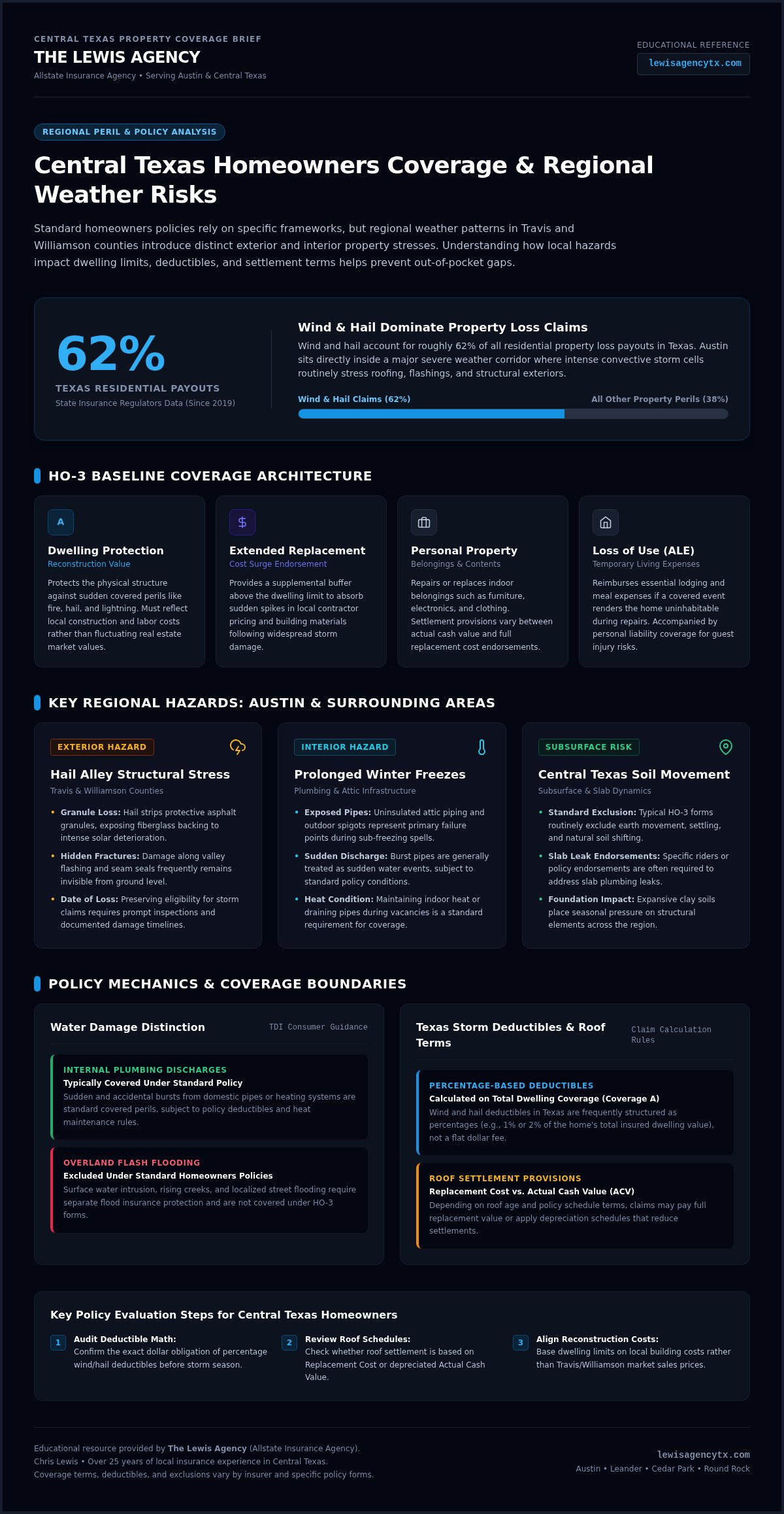
Most single-family homes across Central Texas rely on an HO-3 special form policy. Under the standard homeowners insurance policy structure, coverage splits into distinct categories for your physical structure, personal belongings, liability risks, and living disruptions. Choosing the right homeowners insurance austin policy requires understanding where baseline protections end and where local regional conditions demand closer attention. A baseline policy provides essential safeguards, but it works best when tailored to the specific risks of your property.
Dwelling Protection and Extended Replacement Cost
Coverage A dwelling protection covers the physical structure of your house after sudden, covered events like fire, hail, or lightning. Detached fences, sheds, and detached garages fall under separate other structures coverage. Your dwelling limit must reflect regional labor and rebuilding expenses rather than local real estate market valuations.
Central Texas soils present unique structural challenges. Standard policies routinely exclude earth movement and settling, meaning slab leaks and foundation shifts often require specific policy endorsements. Adding an extended replacement cost endorsement gives your dwelling limit an extra buffer, helping absorb sudden surges in local contractor pricing and materials following widespread severe weather.
Personal Property, Liability, and Additional Living Expenses
Inside your home, personal property coverage helps repair or replace belongings like furniture, clothing, and electronics damaged by covered perils. Policy terms determine whether these items are settled at actual cash value or full replacement cost, with specialty endorsements available for high-value items.
Personal liability coverage safeguards your family's financial assets if a visitor is injured on your property or if you accidentally cause damage to someone else's property. If a covered peril renders your home uninhabitable, loss of use coverage, also known as Additional Living Expenses, reimburses temporary lodging and meal expenses while repairs take place. Because policy forms and endorsements vary between carriers, reviewing these limits carefully ensures your family avoids unexpected out-of-pocket gaps.
Central Texas Weather Hazards: Hail, Freezes, and Severe Storms
Austin sits directly inside a major severe storm corridor where spring cold fronts regularly trigger heavy convective cells. According to data tracked by state insurance regulators, wind and hail events account for roughly 62% of all residential property loss payouts in Texas since 2019. Securing reliable homeowners insurance austin coverage means preparing your household for rapid weather shifts that can batter your exterior or disrupt indoor plumbing within hours.
Hail Alley Activity and Structural Roof Stress
Hail represents the primary exterior threat across Travis and Williamson counties. Large hail bruises asphalt shingles, strips away protective granules, and leaves the fiberglass mat exposed to the intense Texas sun. Metal roofing panels can suffer denting that compromises seam integrity or seam seals over time.
Many roof fractures remain invisible from your driveway. Impact marks often hide beneath tile overlaps or along vulnerable valley flashing. Because storm claims depend on establishing an accurate date of loss, tracking local hail occurrences and arranging regular inspections helps preserve timely filing eligibility. If you want a clear picture of how regional storm risks affect your current policy structure, a quick consultation with The Lewis Agency can help you identify potential coverage gaps before storm season begins.
Winter Freeze Damage and Critical Flood Exclusions
While hail impacts the exterior, Central Texas winter freezes threaten the inside of your home. Hard freezes routinely cause exterior spigots and uninsulated attic pipes to burst once temperatures drop below freezing for extended stretches. Standard policies generally treat burst pipes as sudden and accidental water discharges, provided the homeowner maintained heat in the home or properly drained the plumbing lines before an absence.
The Texas Department of Insurance Home Insurance Guide emphasizes a vital distinction between interior pipe bursts and surface water intrusion. Key coverage boundaries include:
- Sudden internal plumbing breaks: Typically covered under standard property policies, subject to regular policy deductibles and heat maintenance conditions.
- Overland flash flooding: Excluded entirely under standard homeowners policies, whether water flows from a swollen creek or pools in your yard.
- Sewer and drain backups: Excluded by baseline forms unless you add a specific water backup endorsement.
Austin features significant micro-risks near waterways like Shoal Creek, Onion Creek, and the Colorado River. Because standard homeowners policies never cover rising outdoor water, securing separate flood insurance remains necessary for homes near low-lying terrain.
Deciphering Texas Deductibles: Hail Percentages and Roof Terms
Many homeowners assume a storm deductible works like a standard flat-dollar charge. In Central Texas, property policies handle severe weather very differently. According to Insurance Information Institute hail loss data, Texas consistently leads the country in severe hail events. Because storm frequency is elevated here, carriers separate wind and hail deductibles from other property perils, making deductible structure a vital consideration for your homeowners insurance austin coverage.
How Wind and Hail Percentage Deductibles Function
Rather than a fixed dollar fee, wind and hail deductibles are typically structured as a percentage, commonly 1% or 2%. This percentage applies directly to your total dwelling coverage limit, not the specific repair estimate. For example, a 2% deductible on a home with a $400,000 dwelling limit requires an $8,000 out-of-pocket responsibility before policy benefits disburse. Under Texas law, contractors cannot legally waive, absorb, or rebate your deductible, making it essential to keep an accessible emergency fund matched to your chosen tier.
Replacement Cost Value vs. Actual Cash Value Roof Terms
How an insurer calculates roof damage determines how much you pay out of pocket after a severe storm. Replacement Cost Value (RCV) pays to replace damaged roofing materials with new equivalents at current market labor rates, minus your deductible. In contrast, Actual Cash Value (ACV) subtracts depreciation based on the age and condition of your roof before issuing payment.
Many carriers add endorsements that shift roofs older than 10 to 15 years onto ACV depreciation schedules. Homeowners with metal roofing should also review whether their policy includes a cosmetic damage waiver, which restricts claims if hail dents metal panels without causing structural water penetration.
Water Backup and Foundation Endorsement Options
Central Texas expansive clay soils expand during wet seasons and shrink during summer droughts. This movement puts continuous pressure on concrete slabs and sub-surface pipes. Because standard policies exclude foundation settling and backed-up sewer lines, you should consider optional endorsements:
- Water backup endorsements: Cover interior damage caused by backed-up drains or failed sump pumps.
- Foundation and slab leak riders: Help pay the tear-out and repair expenses required to fix sub-surface plumbing pipes under the foundation.
Aligning these optional protections with your core homeowners insurance austin policy ensures you are prepared for both regional weather hazards and local soil conditions.
Evaluating Your Coverage Needs: A Practical Austin Buying Framework
Setting up proper coverage requires moving past automated online calculators. National quote engines often base recommendations on broad national metrics, leaving homeowners vulnerable when severe regional weather strikes. Building a dependable homeowners insurance austin policy begins with an honest evaluation of your specific structure, local construction realities, and personal property requirements.
Calculating Reconstruction Costs Versus Real Estate Market Value
Real estate market value is not the same as reconstruction cost. In Austin, a significant portion of your home's sales price reflects the underlying land and neighborhood demand. You don't insure dirt. Dwelling coverage must strictly reflect the actual expense of clearing debris, purchasing materials, and hiring licensed local trades to rebuild from the slab up.
Local construction expenses can surge quickly, especially after widespread storms strain trade availability. Rebuilding also triggers modern municipal building codes. If your home was built decades ago, full reconstruction may require updated wiring, enhanced insulation, or new plumbing standards. Setting your coverage limit solely to match a purchase price or mortgage balance can leave you underinsured during a total loss.
Reviewing Policy Endorsements and Risk-Mitigation Discounts
Auditing the physical details of your home helps uncover hidden coverage gaps before you sign a contract. Older homes in central neighborhoods often feature legacy plumbing materials that warrant closer attention, while newer builds in growing suburbs demand clear terms around roof wear and hail exposure. Tailoring endorsements to these realities keeps your coverage grounded in how you actually live.
You can also offset your overall insurance costs through practical risk-reduction steps. Insurers routinely offer premium credits for proactive safeguards, including:
- Bundling your homeowners insurance policy with auto insurance under one carrier.
- Installing monitored burglar and fire alarm systems.
- Adding automatic water shutoff valves to prevent catastrophic plumbing leaks.
- Installing qualified impact-resistant roofing shingles.
Partnering with a knowledgeable local advisor helps you identify these opportunities while structuring your coverage limits properly. Rather than leaving your structural protection to an impersonal national website, reach out to The Lewis Agency to schedule a policy review and secure peace of mind for your Central Texas household.
Navigating Homeowners Insurance with The Lewis Agency in Central Texas
When severe weather strikes, having a direct line to someone who knows your neighborhood makes a tremendous difference. Automated chat portals and out-of-state call centers treat your home as a collection of generic data points. Securing the right homeowners insurance austin coverage works best when you collaborate with a professional who lives and works right here in Central Texas.
The Value of a Dedicated Local Allstate Agency
The Lewis Agency is a dedicated Allstate agency led by Chris Lewis. Instead of leaving you to navigate complex policy forms alone, Chris serves as an approachable neighborhood advisor focused on protecting what you've built. Working with a dedicated agency allows you to structure proven Allstate insurance products around your property's specific physical needs.
Distant phone representatives rarely understand how local hail corridors, regional roof repair challenges, and soil shifts influence your coverage requirements. Having an accessible advisor means you can discuss your questions directly across a desk. When property damage happens, you have a steady, dependable resource in your corner to guide you through the initial steps of the claims process with clarity and patience.
Proactive Policy Reviews for Austin and Surrounding Communities
Property values, local rebuilding costs, and household situations evolve constantly across Central Texas. Whether your home is located in Austin, Cedar Park, Leander, Round Rock, Pflugerville, Buda, or Kyle, an unexamined policy can slowly fall behind reality over time. Regular policy audits help identify coverage shortfalls before severe convective storm seasons arrive.
A comprehensive review examines your current dwelling limits against local construction trends, confirms your storm deductibles align with your household budget, and checks that your personal property safeguards remain sufficient. It also provides an opportunity to evaluate related protections, such as auto insurance or landlords insurance, ensuring seamless coverage across all your assets.
Protecting your household begins with a straightforward, informative conversation. Connect with The Lewis Agency to schedule your personalized homeowners coverage review and ensure your Central Texas home has the reliable protection it deserves.
Protecting Your Central Texas Home with Confidence
Securing dependable homeowners insurance austin coverage comes down to understanding your specific property risks. When you base your dwelling limits on regional reconstruction costs rather than real estate market swings, you avoid serious shortfalls after a loss. Knowing how your wind and hail percentage deductibles function also ensures you aren't caught off guard when spring hailstorms roll across Travis or Williamson County.
You don't have to decipher policy provisions or roof settlement schedules alone. As a dedicated local Allstate agency, Chris Lewis and the team bring deep familiarity with Central Texas weather patterns and structural challenges. Whether your home is located in Austin, Cedar Park, or Round Rock, we are here to provide steady, plainspoken guidance. Connect with The Lewis Agency for a personalized Austin homeowners policy review, and ensure your home has the dependable protection your family deserves.
Frequently Asked Questions
How much dwelling coverage do I need for my home in Austin?
Your dwelling coverage limit should reflect the full estimated cost to rebuild your home's physical structure from the slab up, separate from your land value or market selling price. Local construction expenses, architectural materials, square footage, and regional trade labor rates determine this figure. Establishing an accurate limit ensures your policy absorbs local rebuilding costs and municipal building code requirements rather than fluctuating real estate values.
How does a percentage hail deductible work on a Texas home insurance policy?
A percentage hail deductible calculates your out-of-pocket cost as a fixed percentage of your home's total Coverage A dwelling limit, not the total repair estimate. For example, a two percent deductible on a four hundred thousand dollar dwelling limit requires an eight thousand dollar out-of-pocket responsibility. Under Texas law, contractors cannot legally waive, rebate, or absorb this deductible on your behalf.
Does standard Austin homeowners insurance cover flood and water backup damage?
Standard homeowners policies exclude damage caused by rising surface water, flash flooding, and backed-up municipal drains or sewers. Sudden and accidental internal plumbing line bursts, such as those caused by hard winter freezes, are typically covered under baseline terms. Protecting your home from rising creek water or sewer lines requires separate protection through a dedicated flood policy and an optional water backup endorsement.
How does the age and condition of my roof affect coverage terms?
As your roof ages, carriers often adjust coverage terms to account for wear and tear. Roofs older than ten to fifteen years may trigger mandatory roof inspections, underwriting restrictions, or policy endorsements that transition storm settlements from full replacement cost to an actual cash value schedule. Maintaining documentation and addressing minor wear promptly helps preserve broader settlement terms on your homeowners insurance austin policy.
What is the difference between replacement cost and actual cash value on roofs?
Replacement cost coverage pays the necessary amount to repair or replace damaged roofing materials with new equivalents at current market labor rates, minus your deductible. Actual cash value, however, deducts physical depreciation based on the roof's age and preexisting condition before issuing payment. This depreciation deduction can leave property owners facing substantial out-of-pocket expenses during storm claim repairs if their roof is settled on cash value terms.
Can bundling my auto and home insurance policies help lower overall costs?
Bundling your homeowners insurance policy with auto insurance under a single carrier is one of the most practical ways to lower your overall insurance expenses. Carriers frequently provide multi-policy premium credits for households that combine personal coverages. Beyond financial savings, keeping policies with a dedicated agency like The Lewis Agency simplifies account management, streamlines billing, and ensures you have a single point of local contact.
Why do homeowners insurance premiums fluctuate across Central Texas?
Regional premium adjustments reflect changing claim volumes from severe convective storms, rising labor and construction materials expenses, and localized environmental risks. In high-growth communities like Austin, Round Rock, and Cedar Park, frequent hailstorms and regional contractor demand heavily influence market-wide claims payouts. Evaluating your homeowners insurance austin policy annually ensures your coverage limits remain aligned with actual regional reconstruction expenses without unexpected gaps.