
Homeowners Insurance in Cedar Park, TX: Coverage and Costs
Learn what homeowners insurance Cedar Park TX may cover, what can affect premiums, and why rebuilding costs, roof condition, and water exclusions matter.

A home policy can cover more than the structure itself. Homeowners insurance in Cedar Park, TX may help protect your home and belongings, provide personal liability coverage, and help with certain additional living expenses after a covered loss. The details depend on the policy, including its exclusions and limits.
It’s understandable to want a clear picture of what protection you’re paying for and what could affect the premium. The home’s rebuilding needs, features, and policy coverage choices all matter, so a general estimate may not tell the whole story.
This article explains common homeowners coverage, factors that influence costs, and how to think about protecting a Cedar Park home. It also covers why details such as roof condition, water-related exclusions, and rebuilding costs deserve careful attention when choosing or reviewing a policy.
Key Takeaways
- Review how your policy may protect the home, belongings, and personal liability, including the limits and exclusions that shape each type of coverage.
- Understand which home and coverage details can influence premiums so you can make informed choices when reviewing a policy.
- Set dwelling coverage with the cost to rebuild in mind, and pay close attention to how the policy treats flood and sewer-related damage.
- Use a policy review to clarify how coverage applies to your Cedar Park home before you need to rely on it.
What can home insurance provide coverage for?
Home insurance can combine protection for a dwelling, personal belongings, and personal liability. These coverages work differently, so review their limits and terms separately.
Does homeowners insurance in Cedar Park cover hail, wind, and tornado damage? These losses may be covered, depending on the policy, exclusions, and applicable deductibles.
Liability Coverage
Liability coverage may help if you’re legally responsible for another person’s injury or property damage. For example, a visitor could be hurt at your home, or you could accidentally damage someone else’s belongings. Depending on policy terms, protection may extend beyond your property, including while traveling. Review who qualifies as an insured, the liability limit, exclusions, and how the policy addresses legal defense costs.
Home and Belongings in Standard Packages
A homeowners policy may cover the dwelling and personal property, but covered causes of loss and settlement terms vary. Dwelling coverage applies to the home itself; personal property coverage may apply to furniture, clothing, and appliances. Check whether belongings are settled at replacement value or actual cash value. Some coverage options may also include identity recovery support, subject to the policy’s terms.
Personal Property Away From Home
Personal property coverage may apply to belongings temporarily away from your Cedar Park residence, such as a laptop taken on a trip or sports equipment stored elsewhere. Review the policy’s terms, including limits and exclusions for property away from home. Valuables such as jewelry or collectibles may be treated differently from everyday household items, so check whether they need separate coverage attention.
Choosing Dwelling Coverage
How much dwelling coverage should Cedar Park homeowners choose? Base the amount on the estimated cost to rebuild the home, not its sale price or land value. Consider the home’s size, materials, and features when reviewing the estimate. Update the details after a renovation or room addition, then compare the estimate with the dwelling limit shown in the policy.
Factors that affect home insurance premiums
A Cedar Park premium reflects the home, selected protections, and the insurer’s underwriting. Roof condition, construction, rebuilding needs, and coverage choices can all shape a quote.
Policy Options and Discounts
How can homeowners compare quotes and choose an insurer in Cedar Park, Texas? Compare matching coverage limits, deductibles, exclusions, and policy terms, then consider how each insurer handles questions and claims. Allstate is one insurer represented in Cedar Park through The Lewis Agency. Discounts vary by insurer and eligibility, so ask which options apply before counting them as potential savings.
What discounts are available for Cedar Park homeowners insurance? There is no single discount list that applies across insurers. Ask about eligibility for available discounts and compare the resulting policy details, not just the premium. An agent can explain the terms of the policy being offered, while the insurer sets underwriting, rates, and coverage decisions.
Flood Insurance Considerations
Flood damage is excluded from most homeowners policies, so consider flood exposure separately. Whether flood insurance is required depends on the property and its financing circumstances. Cedar Park homeowners can weigh their location’s flood exposure and review any applicable lender requirements when deciding whether to seek separate coverage.
After storm damage, report the loss to the insurer and follow its claim instructions. Photograph affected areas, keep receipts for temporary measures, and organize estimates and claim correspondence. These records can help you describe the damage and track the claim process. The homeowners insurance resource center offers guidance for preparing policy and claims questions.
Homeowners insurance in Cedar Park
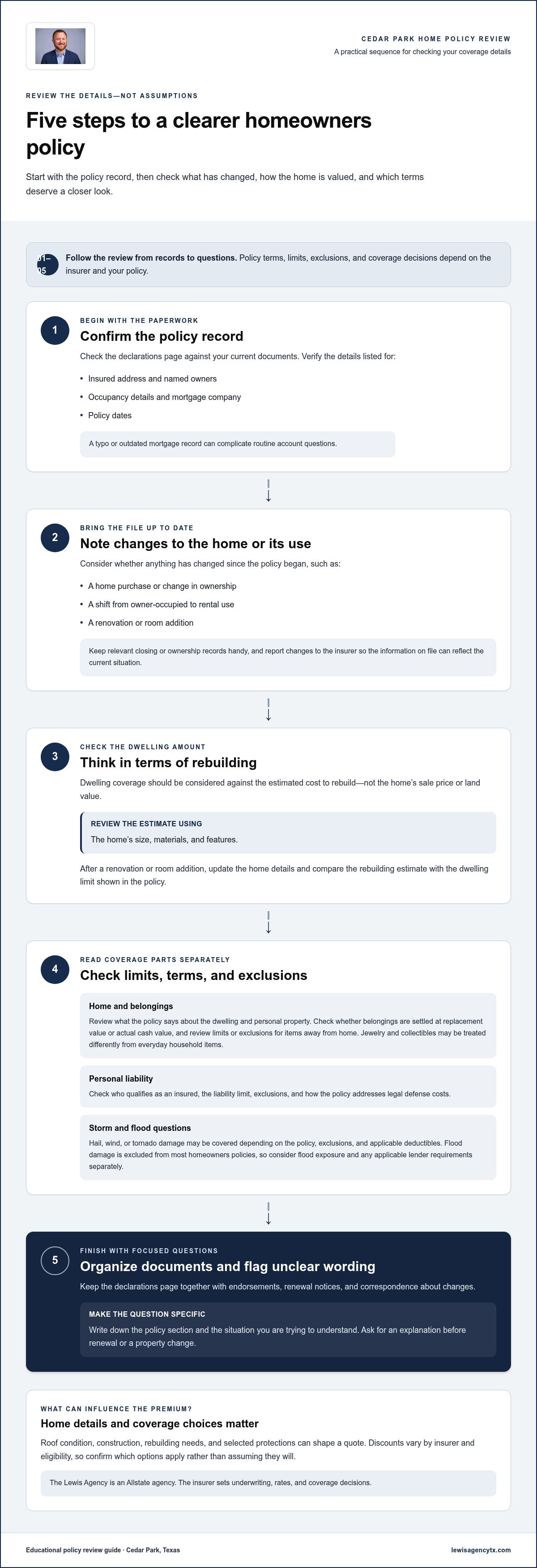
A useful Cedar Park policy review starts with the paperwork, not assumptions about what a neighbor’s home needs. Check the declarations page for the insured address, named owners, occupancy details, mortgage company, and policy dates. A typo or outdated mortgage record can complicate routine account questions, so compare these entries with current documents.
Next, note any changes since the policy began. A home purchase, change in ownership, or shift from owner-occupied to rental use can make the information on file outdated. Keep closing or ownership records handy and report changes to the insurer so the policy reflects the current situation.
Keep policy documents together. Save the declarations page with endorsements, renewal notices, and correspondence about changes. If a term is unclear, write down the section name and the situation you’re trying to understand. That makes a coverage conversation more focused than asking generally whether the home is protected.
For example, a Cedar Park homeowner preparing for a move can review the effective dates, occupancy information, and mortgage details together. A homeowner staying put can use the renewal notice as a prompt to check that the listed information remains accurate. These administrative checks help keep policy records aligned with current circumstances.
If a policy term is unclear, note the exact wording and ask for an explanation before renewal or a property change. Raising a specific homeowners insurance question can make your review more useful.
The Lewis Agency: Homeowners Insurance Policies
The Lewis Agency helps Cedar Park homeowners understand their homeowners insurance policy and consider coverage for their needs. As an Allstate agency, it can explain policy language, answer coverage questions, and help customers understand the claims process, while claim and coverage decisions remain with the insurer.
Turn to the agency when you’re reviewing a policy, considering a home update, or want to clarify how terms apply to your situation. Chris Lewis, the agency owner, has approximately 25 years of homeowners insurance experience and focuses on helping Central Texas homeowners understand their coverage. The agency also offers Auto Insurance, Landlords Insurance, and Condo Insurance for related household needs.
For a conversation about your Cedar Park home coverage, contact The Lewis Agency.
Make Your Next Policy Review More Useful
A policy review works best when it reflects how you live in your home now, not just when you first bought coverage. For homeowners insurance in Cedar Park, TX, keep a simple record of major home changes, new belongings, and questions that arise during the year. This gives you a practical starting point for discussing whether your policy still fits.
Before reaching out, gather your current declarations page and note any changes you want to discuss. You can also ask how a policy term applies to a specific concern, such as a home improvement or a possible claim. Coverage and outcomes depend on the policy and circumstances, so a conversation can help clarify what your documents say.
When you’re ready to talk through your coverage, contact The Lewis Agency. A clear question is a good place to start.
Frequently Asked Questions
How Much Does Texas Home Insurance Cost?
Texas home insurance premiums are shaped by the home’s rebuilding needs, location, condition, and selected policy terms. A newer roof and an older roof can affect how an insurer evaluates a property. The dwelling limit, personal property protection, liability coverage, and deductible choices also influence the premium. Compare quotes using the same home details and coverage selections.
What is the Difference Between Homeowners Insurance and Home Insurance?
Homeowners insurance and home insurance usually refer to coverage for an owner-occupied home, but the terms alone don’t describe a policy’s exact protections. A policy may cover the dwelling and personal belongings while also including liability protection. Check the declarations page and policy wording for the insured property, listed limits, covered causes of loss, and exclusions.
What is the average cost of homeowners insurance in Cedar Park, TX?
There isn’t one premium that represents every Cedar Park home. The amount depends on the property’s rebuilding characteristics, roof condition, selected limits, deductible choices, and policy terms. A home with a detached structure or recent renovation may have different coverage needs from a similar home without those features. A quote based on the specific address and property details is more useful than a broad average.
How do Cedar Park homeowners insurance rates compare with Austin and the Texas average?
Rates can’t be compared reliably without matching the homes and policy details behind each quote. A Cedar Park home and an Austin home may differ in age, roof condition, construction, and coverage selections. Statewide averages also combine different properties and locations. For a meaningful comparison, use the same dwelling limit, personal property coverage, liability limit, and deductible when reviewing each price.
What coverage does a standard homeowners insurance policy include in Texas?
A homeowners policy commonly combines dwelling, other structures, personal property, personal liability, and additional living expense coverage. For example, other structures coverage may apply to a detached garage, while additional living expense coverage may help with temporary housing after a covered loss. Exact protections, exclusions, and limits depend on the policy. Flood damage is excluded from most homeowners policies, so review that exposure separately.

Article by
Chris Lewis
Chris Lewis is the owner of The Lewis Agency, an Allstate insurance agency serving Austin and Central Texas. With more than 25 years of insurance experience, Chris focuses on helping Central Texas homeowners better understand their insurance coverage, including deductibles, roofs and hail, severe weather risks, water damage and other important coverage considerations. He created LewisAgencyTX.com to provide practical homeowners insurance education and help homeowners better understand their coverage before they need it.

Homeowners Insurance Quotes and Costs in Round Rock, Texas
Explore what shapes a homeowners insurance quote Round Rock TX, how Texas and Austin costs compare, and what details to prepare for an online estimate.

A Texas cost average can provide context, but it can’t tell you what a homeowners insurance quote in Round Rock, TX, will cost. Your estimate depends on the home’s features, its location, and the coverage you choose. Statewide and Austin figures are reference points, not substitutes for a quote based on your property.
It’s reasonable to want a clear number before making a decision. But homes in the same area can have different insurance needs and rating factors, including roof age, construction, and policy details. A local estimate is more useful when it reflects the home you’re actually insuring.
This article explains what Texas and Austin cost comparisons can indicate, which details may affect rates in Round Rock, and how to get an online estimate. It also covers coverage choices to understand as you compare an estimate with your home’s needs, helping you make an informed decision without treating a broad average as a personal quote.
Key Takeaways
- Use Texas and Austin cost comparisons as context, not as a prediction of what your home will cost to insure.
- Prepare details about your home, roof, and desired coverage to make an online estimate more relevant.
- Consider how construction, roof condition, and local storm exposure may influence a Round Rock rate.
- Review what a policy says about property damage, belongings, temporary living expenses, and liability before choosing coverage.
- Ask questions about the estimate and policy details so you can make an informed decision about your home’s protection.
How Much Does Texas Home Insurance Cost?
A Texas average offers context, but it doesn’t predict the cost for a particular Round Rock home. A quote reflects the property details provided, the coverage selected, and the insurer’s underwriting.
Premium Factors
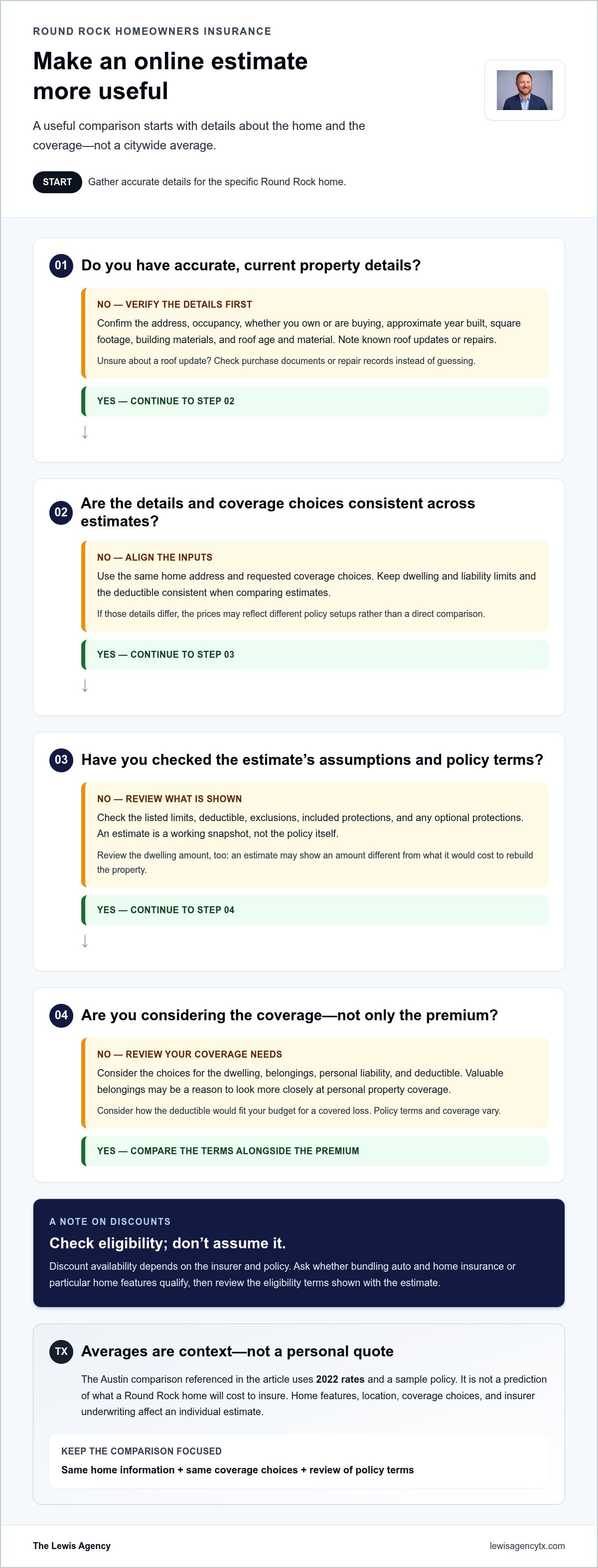
When preparing an estimate, gather accurate details about the home’s age, construction, roof condition, and address. This information describes the property being insured, though its effect on the premium depends on the insurer’s underwriting. Coverage choices matter, too, including dwelling and liability limits and the deductible.
Review those details before submitting a request. For example, note a roof replacement or major home update so the estimate reflects the property as it is now. Then check that the coverage choices reflect what you want insured, rather than choosing options based on premium alone.
Insurer Rate Comparisons
Comparing insurance estimates is most useful when each uses the same home information and coverage choices. If deductibles, limits, or selected protections differ, the prices may reflect different policy setups rather than a direct comparison.
Read the policy terms alongside the premium. Check limits, deductibles, exclusions, and included options. “Home insurance” and “homeowners insurance” are commonly used for owner-occupied homes, but the policy wording determines the coverage.
ZIP Code Rate Differences
Use the Round Rock home’s actual address when requesting an estimate. A nearby ZIP code can’t substitute for the property’s details, and estimates for different addresses may not be directly comparable.
For a useful review, keep the address and requested coverage choices consistent across estimates. This makes it easier to identify differences in quoted terms without assuming that a citywide or ZIP-code average predicts an individual premium.
Discounts and Policy Rules
What discounts can Round Rock homeowners get on insurance? Discount availability depends on the insurer and policy. Ask whether bundling auto and home insurance or particular home features qualify, then review the eligibility terms shown with the estimate.
A deductible is the amount the policyholder pays under the applicable terms for a covered claim. The declarations page lists the deductible, while exclusions describe losses or circumstances the policy doesn’t cover. Claims procedures explain steps such as reporting a loss and providing information. Read these terms together because coverage and claims rules vary by policy.
Online homeowners insurance estimates
An online estimate is a starting point for understanding coverage and price. For a Round Rock property, gather its address, construction details, roof information, and preferred coverage before you begin.
Online Estimate Details
An online estimate uses the information you enter to outline possible home insurance coverage and pricing. It may also show choices for protecting the dwelling, belongings, and personal liability. Read the assumptions carefully: incorrect details may make the estimate inaccurate for the home you intend to insure.
Think of the result as a working snapshot, not the policy itself. For example, an estimate may use a dwelling amount that differs from what it would cost to rebuild the property. Review the displayed coverage choices and note questions about limits, deductibles, exclusions, or optional protections.
Some online forms also ask whether you want to include auto insurance. That information can help assess a home-and-auto request, but bundle terms depend on the insurer and eligibility. Compare the home coverage details separately rather than focusing only on a combined estimate.
Information for a Quote
What information do I need to get a homeowners insurance quote in Round Rock, TX? Start with the property address and details about the home’s age, size, construction, and roof. You’ll also need to consider the coverage you want for the dwelling, belongings, liability, and deductible.
Before opening an online form, collect details that describe the specific house. Useful information includes:
- Property: street address, occupancy, and whether you own or are buying the home.
- Construction: approximate year built, square footage, and primary building materials.
- Roof: age, material, and any known updates or repairs.
- Protection: desired dwelling and belongings coverage, plus liability preferences.
- Insurance history: current insurer details and information requested about prior claims.
Enter each answer consistently. If you’re unsure when the roof was updated, check purchase documents or repair records instead of guessing. Accurate property details make the estimate more useful for reviewing coverage options.
After receiving an estimate, compare its listed limits and terms with your needs. For example, valuable belongings may prompt a closer look at personal property coverage. Consider how the deductible fits your budget for a covered loss, too.
For a structured review of home coverage topics, explore these homeowners insurance resources as you prepare your questions. Keep the estimate and property details together, so the next conversation can focus on the choices that matter for your Round Rock home.
Average homeowners insurance cost in Austin
Austin provides a nearby reference for understanding homeowners insurance costs, but its average isn’t a Round Rock quote. The comparison used 2022 rates and a sample policy, so its assumptions matter as much as the location.
These figures describe the comparison’s setup, not a recommendation for every homeowner. Austin homeowners with different properties, coverage choices, or deductibles may receive different estimates. A Round Rock home has its own address and property details.
Dwelling coverage relates to the insured home’s structure, while liability coverage addresses a different risk. The deductible is the amount the policyholder pays under the policy terms for a covered claim. Changing any of these choices changes what the comparison represents. Before using an Austin figure as a benchmark, identify the assumptions behind it.
For a useful comparison, keep the home details and coverage choices consistent. An Austin homeowner comparing estimates should check:
- Whether the dwelling coverage reflects the home being insured.
- Which liability limit and deductible the estimate uses.
- Whether the policy includes the same coverage options and exclusions.
- Whether the property details, including roof information, are accurate.
These details can help clarify what each estimate includes. A lower premium alone doesn’t show whether two policies offer equivalent protection. For example, estimates may use different deductibles or coverage limits. Compare policy terms alongside the price, not just the totals shown on screen.
Austin is useful as a regional reference, but it can’t replace the address-specific details of a Round Rock property. Local conditions and individual home characteristics affect how insurers assess risk. A vehicle insurance quote uses its own rating details, so vehicle costs don’t establish a home’s expected rate.
Treat the Austin sample as a starting framework. Confirm the coverage amounts, deductible, and property information used for your own estimate. Then review how the policy addresses the home and its contents. This helps Round Rock homeowners understand what an estimate measures before deciding whether its coverage fits their needs.
Factors affecting Round Rock insurance rates
For a Round Rock home, an estimate reflects the property details and coverage choices in the request. Williamson County faces severe storms, hail, and high winds that can damage homes. A roof’s condition and the selected protection are useful details to understand when reviewing an estimate.
Roof condition and age: Roof age, material, and known repairs help describe the home accurately. Hail and high winds can damage roofs, so keep repair or replacement records with your home documents. If a quote request asks about the roof, provide details about the actual property rather than relying on information about a nearby home.
Construction and systems: Newer building codes, modern electrical and plumbing systems, and newer roofs may help new-construction homes qualify for insurance discounts. Eligibility depends on the policy and insurer’s terms. Keep construction and update records available so the information you provide about the home is clear and accurate.
Rebuilding needs: Dwelling coverage concerns the insured structure, not simply its sale price. The home’s size, materials, layout, and finishes help describe what rebuilding may involve. For example, two Round Rock homes with similar sale prices can have different construction features. Review the dwelling amount against the details of the specific home.
Coverage choices: An estimate reflects the coverage options selected for the dwelling, belongings, and liability. Different limits or optional protections mean estimates describe different setups. Before comparing premiums, check that the coverage amounts and options match the protection you want to consider for the home.
Deductibles and damage records: A deductible affects what the homeowner pays for a covered loss under the policy’s terms. Keep records of storm damage, repairs, and updates together. These records can help you provide accurate property information and understand details about the home’s current condition.
Use a consistent review process for a Round Rock estimate:
- Confirm the address, roof details, and construction information.
- Record known storm damage, repairs, and system updates accurately.
- Review dwelling, belongings, and liability coverage selections.
- Compare deductibles and policy terms alongside premiums.
This approach clarifies what each estimate describes without assuming a particular feature guarantees a particular price. A newer roof or modern systems may be relevant to discount eligibility for new-construction homes, while severe weather exposure makes accurate property details especially useful. Read the exclusions and claims terms, too. A premium alone doesn’t explain how a policy responds to a specific loss. Start by checking that the estimate represents the Round Rock home and the coverage options you want to review.
Homeowners insurance in Round Rock
For a Round Rock home, set dwelling coverage based on estimated rebuilding costs, not the home’s sale price. Don’t assume a standard homeowners policy covers flooding; review its exclusions and available flood protection.
Local Homeowners Coverage
A homeowners insurance policy can cover damage to the home, belongings, and liability, depending on its terms. In Round Rock, review how the policy treats weather damage, fire, theft, and vandalism rather than assuming the same coverage applies to every cause.
Check limits for household contents and temporary living expenses after major damage. If a storm makes the home unlivable, policy terms determine whether expenses such as hotel stays or meals qualify. Endorsements can change or add coverage, so read them alongside the base policy.
Flooding deserves careful review. Water entering a home from an overflowing creek or heavy rain may be treated differently from water damage caused by a plumbing leak. The policy wording, exclusions, and any additional flood protection determine how these situations are handled. Sewer backup coverage may also require separate consideration or an endorsement.
Dwelling Coverage and Rebuilding Costs
How much dwelling coverage does a Round Rock home need based on local rebuilding costs? Choose an amount informed by the estimated cost to rebuild the structure, rather than its market value or mortgage balance. Home size, materials, layout, and finishes affect that estimate.
For example, a house with custom finishes may require different materials and labor to rebuild than a similar-sized home with simpler finishes. Review the estimate when renovating, replacing major features, or correcting outdated property details. The dwelling limit should reflect the home being insured.
Use a practical review to identify coverage gaps before comparing policy options. Check the declarations page for limits and deductibles, then read relevant exclusions and endorsements. Ask how the policy addresses hail or wind damage, water losses, belongings, and liability. A named storm risk alone doesn’t establish whether a particular loss is covered.
Also consider what happens if repairs prevent you from living at home. Review any coverage for temporary relocation and understand its terms and limits. For personal property, check whether the policy’s settlement basis matches your expectations. Depending on the contract, replacement value and actual cash value can produce different claim calculations.
Round Rock homeowners can use the homeowners insurance resource center to prepare for a policy review. Bring questions about local weather exposure, dwelling limits, flood exclusions, sewer backups, and endorsements. A clear review connects the home’s rebuilding needs with the protections and limits written into its insurance policy.
The Lewis Agency: Homeowners Insurance Policies
The Lewis Agency is an Allstate agency offering homeowners insurance policies for Round Rock homeowners. If you’re weighing an estimate, reviewing dwelling limits, or trying to understand policy language, the agency can explain coverage options and answer questions about your policy.
Chris Lewis has more than 25 years of insurance experience and focuses on helping Central Texas homeowners understand their coverage before they need it. The agency can also help you understand the claims process, though claim decisions and payments are made by the insurer.
If you’re considering home and auto coverage together, ask how the available options apply to your situation. To talk through a homeowners policy or request a quote, contact The Lewis Agency.
Make your next coverage review count
Use your estimate as the starting point for a practical conversation, not as a decision based on one number alone. Before requesting a homeowners insurance quote in Round Rock, Texas, note home updates, changes in how the property is used, and questions about policy language. That preparation helps focus the discussion on what you want your coverage to do.
As your home and household change, revisit those questions. A renovation, new roof, or rental arrangement can change which details belong in your insurance review. The Lewis Agency offers homeowners insurance policies, Auto Insurance, and Landlords Insurance, so you can discuss related property and household coverage needs in one conversation.
For a quote or help understanding your policy options, contact The Lewis Agency. Take the next step at your own pace, with your questions ready.
Frequently Asked Questions
Are insurance rates higher in Round Rock than other areas?
A city name alone isn’t enough to conclude that Round Rock rates are higher or lower. A meaningful comparison requires estimates for the homes being considered, with comparable coverage choices and deductibles. For example, if you’re comparing your Round Rock home with a relative’s home in Austin, make sure both estimates describe the relevant property and policy terms before drawing a conclusion.
Which insurers offer homeowners insurance quotes in Round Rock, TX?
The Lewis Agency is an Allstate agency and offers homeowners insurance policies through Allstate. It doesn’t shop homeowners insurance among multiple carriers. If you request an estimate, have the Round Rock property details and coverage questions ready. Review the resulting policy documents for the insurer, limits, deductibles, and terms that apply to the specific offer before making a decision.
How do homeowners insurance rates in Round Rock compare with Austin and the Texas average?
The article’s Austin and Texas figures come from a comparison using 2022 rates, while a Round Rock quote is based on the specific home and requested policy details. The Austin sample and statewide average aren’t necessarily like-for-like measures for a particular property. Treat them as historical context, then use an estimate for the Round Rock address when making a current household decision.
What coverage limits and policy types are available for Round Rock homeowners?
Homeowners can review limits for the dwelling, belongings, liability, and additional living expenses, along with policy forms and endorsements offered for their needs. HO-3 is a commonly referenced homeowners policy form, but actual Texas forms and coverage vary by insurer. For example, a homeowner with a finished garage or custom interior features can pay particular attention to how the policy describes the insured property and applicable limits.
What factors affect homeowners insurance rates in Round Rock, including home age, roof, and claims history?
Home age, roof details, and claims history are useful topics when reviewing a home insurance estimate, but those details alone can’t determine their effect on a particular rate. Keep roof invoices, repair records, and relevant claim documents together. Accurate records help you describe the property and its history when completing a quote request or reviewing policy information.
How do hail, wind, tornado, and flood risks affect homeowners insurance in Round Rock?
Severe storms, hail, and high winds can damage homes in Round Rock and Williamson County. Review the policy wording for how it addresses storm-related damage, including applicable exclusions or deductibles. Flooding requires separate attention because coverage depends on the policy and any additional protection selected. Don’t assume a policy covering other water damage also covers floodwater entering from outside.
How can I compare homeowners insurance quotes and choose a policy in Round Rock?
Compare estimates using the same property information, requested limits, deductibles, and options. Then read the policy terms instead of choosing by premium alone. For example, check how each estimate describes the dwelling, belongings, liability, and relevant exclusions. If an estimate has an incorrect roof date or other home detail, correct it before relying on the comparison.
Article by
Chris Lewis
Chris Lewis is the owner of The Lewis Agency, an Allstate insurance agency serving Austin and Central Texas. With more than 25 years of insurance experience, Chris focuses on helping Central Texas homeowners better understand their insurance coverage, including deductibles, roofs and hail, severe weather risks, water damage and other important coverage considerations. He created LewisAgencyTX.com to provide practical homeowners insurance education and help homeowners better understand their coverage before they need it.

What Shapes a Texas Homeowners Insurance Quote
Get homeowners insurance quote information in Texas and learn how home age, location, coverage choices, deductibles, and possible discounts influence premiums.

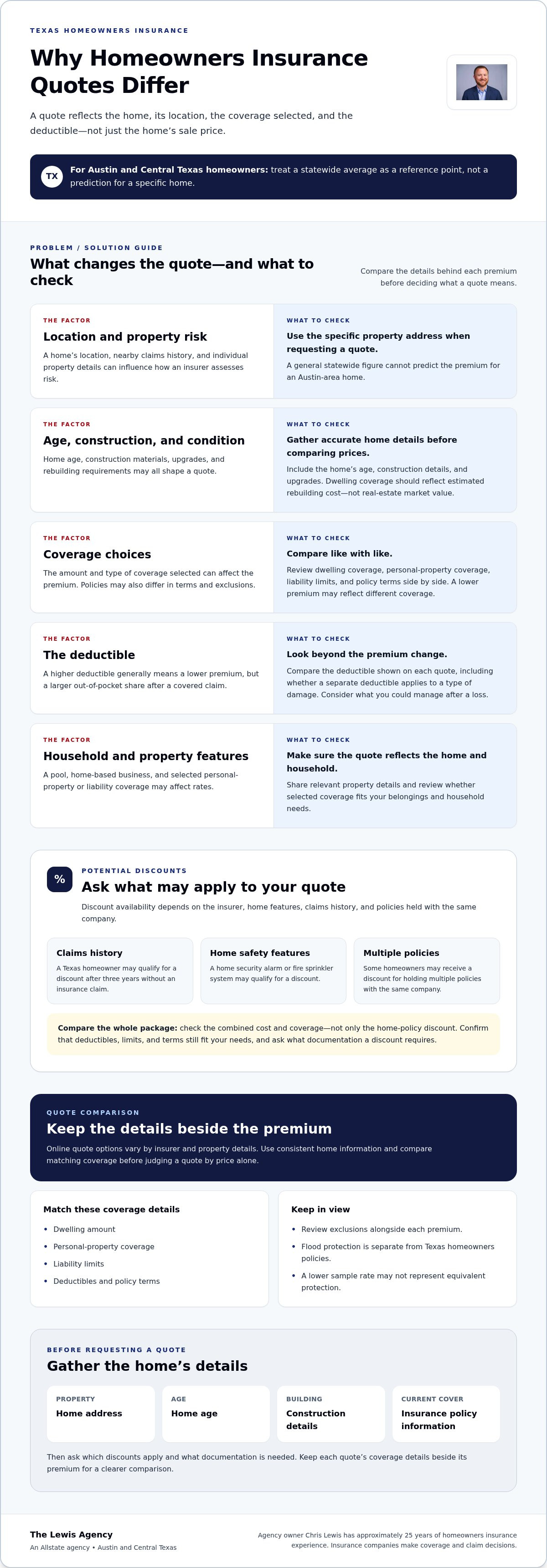
A Texas homeowners insurance quote is shaped by more than a home’s sale price. The premium can depend on the home’s age and value, its location, the coverage selected, and the deductible. For homeowners insurance quote information in Texas, these details help explain why quotes can differ from one home to another.
It’s reasonable to want a clear picture of what affects the cost before choosing coverage. This article explains the average cost of homeowners insurance in Texas, discounts that may be available, and the home and policy details insurers may consider.
You’ll also learn what information to gather before requesting a quote and how to assess factors that affect premiums, with practical considerations for homeowners in Austin and Central Texas.
Key Takeaways
- Security features, a fire sprinkler system, a claims-free history, or policies with the same company may open the door to discounts.
- Location, construction materials, home age, deductible, and coverage choices can all influence a premium.
- Learn which coverage details to review so you can prepare useful information for a homeowners insurance quote.
How Is the Average Cost of Homeowners Insurance in Texas calculated?
While industry data provides a statewide average annual premium to use as a baseline, that figure is only a general reference point, not a prediction for an Austin home. Location, age, construction, coverage choices, and the deductible can all shape a quote. Homeowners insurance quote information in Texas is most useful when it reflects the specific property and protection you need.
Texas doesn’t require homeowners insurance by law, though a mortgage lender will likely require it. Don’t end an existing policy until replacement coverage begins or you have written confirmation that coverage is in place.
Homeowners insurance commonly includes coverage for the dwelling, personal property, liability, and additional living expenses. Dwelling coverage may help pay to repair or rebuild after covered damage, such as hail or fire. Personal property coverage applies to belongings, while liability coverage may help with certain injury or property-damage expenses. Additional living expenses can help with extra costs if a covered loss makes the home temporarily unlivable. Texas homeowners policies don’t cover flood damage, so consider flood protection separately.
Check the policy for details beyond these core coverage types. Identity-theft assistance and refrigerated-food loss may have specific terms or limits. For valuable belongings, such as jewelry or artwork, review how the policy covers them and whether additional coverage is available. Quote details should clarify how the policy treats these items.
To choose a dwelling coverage amount, estimate the cost to rebuild the house, not its real-estate market value. Construction materials, home features, and rebuilding requirements shape that estimate. Then assess personal-property and liability limits in light of your belongings and household needs. An Austin homeowner with a pool, for example, should consider how liability protection relates to that feature.
Home insurance discounts
Discounts may depend on the insurer, home features, claims history, and policies held with the same company. Texas homeowners may qualify for a discount after three years without an insurance claim. A home security alarm or fire sprinkler system may also qualify. Ask how each discount applies to the quoted coverage instead of assuming it reduces every part of the premium.
Bundling home and auto insurance means placing both policies with one insurance company. Some homeowners may receive a discount for buying multiple policies from the same company. Compare the combined cost and coverage, not just the home policy’s discount. Check that the home and auto deductibles, limits, and terms still fit your needs.
Which Texas homeowners insurance companies offer online quotes? Online quote options vary by insurer and property details. Use an insurer’s own quote process where available, and provide consistent information about the home, its construction, and the coverage you want.
Compare quotes with matching dwelling amounts, personal-property coverage, liability limits, and deductibles. A lower sample rate may reflect different coverage or a different deductible, so it may not represent equivalent protection for a covered loss. If flooding is a concern, note whether flood insurance is handled separately. Keep each quote’s coverage details beside its premium for a clearer comparison.
Before requesting quotes, gather the home’s address, age, construction details, and current insurance policy information. Then ask which discounts apply and what documentation each requires. A homeowners insurance resource center can help you organize coverage questions before reviewing quote details.
Factors that affect homeowners insurance premiums
Texas premiums reflect the property’s risk and the amount and type of homeowners insurance coverage selected. Compare equivalent coverage before judging a quote by its premium alone.
Annual Premiums by Insurer
Annual premiums differ by insurer because companies assess property and coverage details differently. Compare quotes using the same dwelling amount, personal-property coverage, liability limits, and deductible. Then review exclusions and policy terms alongside each premium. A lower figure may reflect less coverage, so it doesn’t necessarily represent equivalent protection for the same property.
How Deductibles Affect Premiums
A higher deductible generally results in a lower premium. The tradeoff is a larger out-of-pocket share after a covered claim. Compare the deductible shown in each quote, including any separate deductible for a particular type of damage. Choose an amount you could manage after a loss, rather than focusing only on the premium change.
Other Premium Factors
Insurers may consider location, nearby claims history, construction materials, home age, and upgrades. Replacement cost estimates what rebuilding the home could require, rather than its market price. A pool, home-based business, or selected personal-property and liability coverage may also affect rates. Mortgage requirements can shape the coverage a homeowner selects.
What Makes Homeowners Insurance Quotes Different in Central Texas?
Homeowners in Austin, Leander, Cedar Park, Georgetown, and Round Rock face several considerations that can influence their homeowners insurance quotes. While every property is different, understanding these local factors can help homeowners make more informed coverage decisions.
Roof Age and Condition
In Central Texas, a home's roof can play an important role in the insurance quoting process. Insurance companies may consider the roof's age, material, condition, and replacement history when evaluating a property. Homeowners with older roofs may encounter different pricing or eligibility requirements than those with newer roofs.
Before requesting a quote, gather information about when your roof was installed, its construction materials, and any recent repairs or replacements.
Hail and Severe Weather Exposure
Austin and the surrounding communities experience severe thunderstorms that can bring hail, damaging winds, and heavy rainfall. Because roof damage is a common concern following these storms, homeowners should understand how their policy addresses wind and hail losses.
Coverage can vary depending on the insurance company, policy provisions, roof condition, and applicable exclusions or endorsements.
Wind and Hail Deductibles
Many Texas homeowners policies include a separate windstorm or hail deductible. These deductibles may be calculated as a percentage of the home's insured dwelling amount rather than as a fixed dollar amount.
For example, a 2% deductible on a home insured for $500,000 would equal $10,000. That amount represents the homeowner's deductible for a covered claim to which it applies, not necessarily the amount the homeowner will ultimately pay for repairs.
Understanding this distinction is particularly important for Central Texas homeowners comparing insurance quotes.
Local Rebuilding Costs
A home's market value is not necessarily the amount it would cost to rebuild after a covered loss. Construction labor, materials, architectural features, and local building requirements can all influence replacement costs.
In growing communities such as Leander, Georgetown, and Cedar Park, homeowners should periodically review their dwelling coverage to help ensure it reflects the estimated cost of rebuilding their home rather than simply its purchase price or current market value.
Get Guidance From a Central Texas Insurance Professional
With more than 25 years of insurance experience, Chris Lewis, owner of The Lewis Agency, helps homeowners throughout Austin and Central Texas understand how roof characteristics, deductibles, coverage options, and rebuilding costs can affect their insurance decisions.
Whether you're purchasing a new home or reviewing an existing policy, The Lewis Agency can help explain available Allstate coverage options and answer questions about your homeowners insurance quote.
The Lewis Agency: Homeowners Insurance Policies
The Lewis Agency is an Allstate agency offering homeowners insurance policies and guidance to help homeowners understand coverage. Agency owner Chris Lewis has approximately 25 years of homeowners insurance experience. He can explain policy language and answer questions about coverage options available through the agency.
A review can help when you’re buying a home, updating a policy, or reassessing coverage after renovations. Bring your quote or policy and note questions about how the home was evaluated. The Lewis Agency provides plain-English guidance on coverage and claims processes, while insurance companies make coverage and claim decisions.
For help with a quote or policy question, contact The Lewis Agency.
Make Your Next Coverage Review Count
A quote review can help you prepare for changes to your home, not just choose a policy today. Renovations, new belongings, or a change in how you use your property can make it useful to revisit your coverage. Keep notes about updates and questions so your next conversation focuses on what matters to your household.
For homeowners insurance quote information in Texas, The Lewis Agency can help explain policy language and answer questions about available coverage. The agency also offers Auto Insurance and Landlords Insurance for related needs. Coverage and terms depend on the policy and individual circumstances.
When you’re ready to talk through a quote or policy question, contact The Lewis Agency. A thoughtful review can help you take your next step with greater clarity.
Frequently Asked Questions
Is Home Insurance Mandatory in Texas?
Texas law doesn’t require homeowners insurance, but a mortgage lender will likely make it a condition of the loan. A lender will require flood insurance if the property is in a flood zone. Before closing, review the lender’s insurance requirements alongside the policy documents so you understand what coverage must be in place.
What risks does a homeowners insurance policy cover?
Depending on the policy, covered risks may include fire, theft, vandalism, lightning, wind, hail, explosions, falling objects, and the weight of snow or ice. For example, hail may damage a roof, while a falling tree limb may damage a structure. Review the policy’s exclusions and terms to understand how it treats each type of loss.
Are there ways I can help protect my home?
Yes. Keep records of roof work and home improvements, and store photos of important belongings in a secure location. Before a Central Texas storm, secure loose outdoor items and check that windows and doors close properly. After a storm, document visible damage from a safe location. These steps support preparedness but don’t change what a policy covers.
How Can I Lower My TX Home Insurance Rate?
Start by checking that the quote reflects the home’s current features and the coverage you want. Ask about discounts tied to safety features or policy eligibility, then compare the total premium, deductible, and coverage terms. A higher deductible may reduce the premium, but consider whether you could afford that out-of-pocket amount after a covered loss.
Trouble finding insurance?
If applications are declined or quotes are difficult to obtain, identify the reason given and gather relevant property details, such as roof age, construction, and repair records. Clear, consistent information can help explain the home’s condition during an application. The Texas FAIR Plan is an option Texas residents who can’t find an insurer may contact for information about coverage.
Article by
Chris Lewis
Chris Lewis is the owner of The Lewis Agency, an Allstate insurance agency serving Austin and Central Texas. With more than 25 years of insurance experience, Chris focuses on helping Central Texas homeowners better understand their insurance coverage, including deductibles, roofs and hail, severe weather risks, water damage and other important coverage considerations. He created LewisAgencyTX.com to provide practical homeowners insurance education and help homeowners better understand their coverage before they need it.
Service Line Coverage in Leander TX: What It Protects
Need a service line coverage endorsement in Leander, TX? Learn what underground water and sewer line repairs may be covered before unexpected breaks happen.

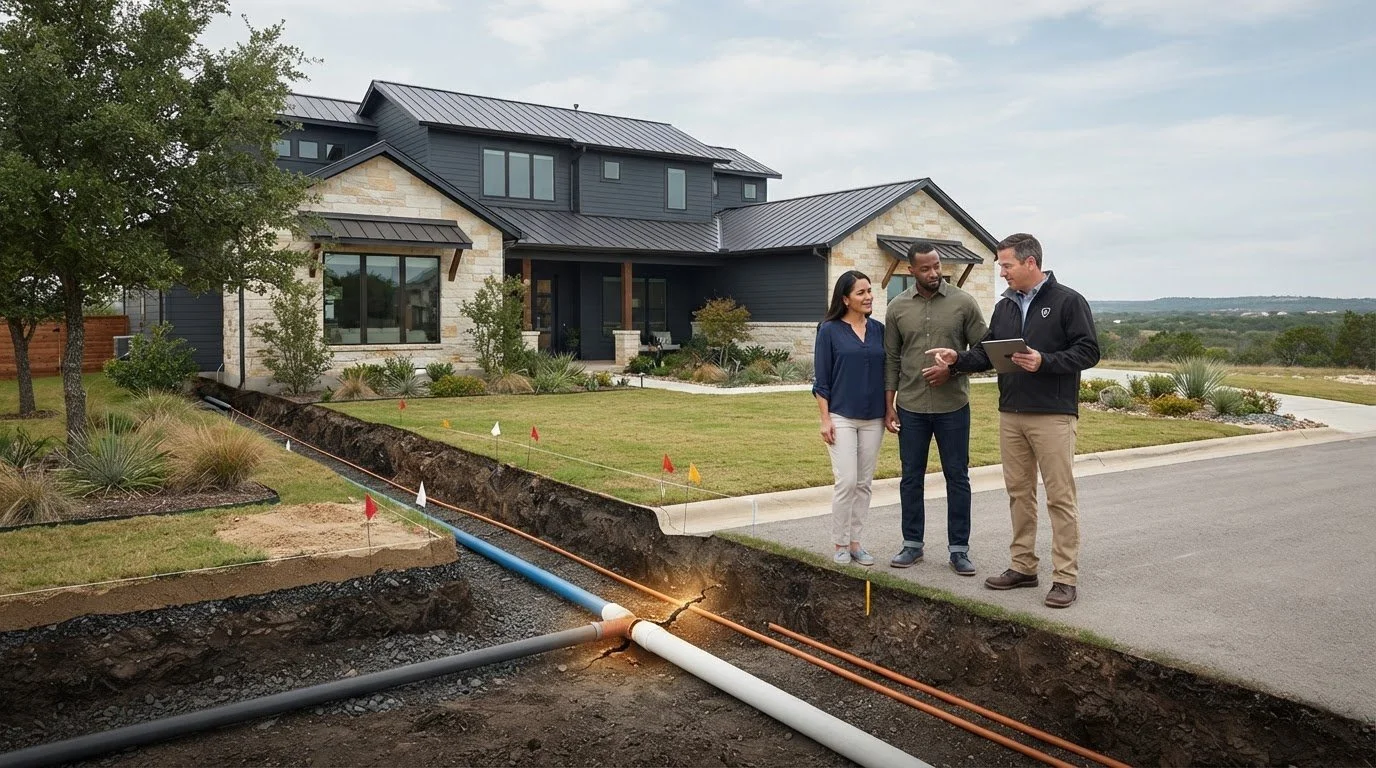
A damaged underground line can interrupt water, sewer, power, or other service to your home. A service line coverage endorsement in Leander, TX can help cover repair or replacement costs for eligible lines on the insured property, including excavation, labor, and materials. The lines and causes of damage that qualify depend on the endorsement.
It’s easy to assume the city handles a break because the line is buried, but responsibility depends on where the line runs and local rules. This article explains service line coverage, which types of damage may qualify, how an endorsement affects a homeowners policy, and where city responsibility may begin or end. Understanding these points can help you review your protection before a repair becomes urgent.
Key Takeaways
- Find out where responsibility for your water and sewer lines begins, since the boundary between homeowner and municipal responsibility can vary.
- Review the endorsement’s limit and eligible line types to understand how it may respond to a damaged underground line.
- Wear, corrosion, freezing, and other causes may qualify, depending on the endorsement’s terms and exclusions.
- Understand how an endorsement changes a homeowners policy form, including the commonly referenced HO 00 03 form.
- Compare service line coverage with any utility protection you already have to spot possible overlap.
Isn't the city responsible for my sewer and water lines?
Not necessarily. In many municipalities, homeowners are responsible for buried utility lines on their property, while local rules determine where municipal responsibility begins.
Homeowner Responsibility for Buried Lines
A homeowner may be responsible for the underground section connecting a house to a public utility line. That boundary matters: a break on the property side may leave the owner arranging and paying for repairs. For example, a sewer problem near the house may involve a different responsible party than a problem in the city’s main line.
The break’s location is central to determining responsibility. A water line may run from a municipal connection across a yard and into a home, but the division of responsibility varies by municipality. The same applies to sewer lines: a homeowner’s section may connect the house to a public sewer main, while the public system serves the wider neighborhood.
For a Leander property, find out where the city’s or utility provider’s responsibility ends before assuming a buried pipe is publicly maintained. Local rules vary, and the boundary may not match the visible edge of a street, sidewalk, or driveway. A service interruption alone does not show who owns the damaged section; its location matters.
Covered Underground Service Lines
Covered underground service lines are buried connections that carry utilities between a property and the street or utility system. Depending on the endorsement, eligible lines may include water, sewer, and electrical lines. A failure can interrupt an essential service even when the pipe or cable is hidden beneath a yard or driveway.
Other utility connections may include natural gas, internet, and cable lines, but eligible line types depend on the endorsement. For example, damage to an underground electrical line can interrupt power, while a water-line break can disrupt household water service. The policy wording determines which lines qualify and what conditions apply.
First, identify the line’s location and the utility it carries. Note whether the damaged section runs across the property, toward the street, or beyond the property boundary. Then review the municipality’s responsibility information alongside the policy endorsement. These details can help clarify whether the issue involves a private connection, a public system, or potential coverage for an eligible line.
Service line coverage may overlap with utility-company line protection plans, so compare what each covers before paying for both.
What is Service Line Coverage?
Service line coverage is an endorsement added to a homeowners policy for certain damage to underground utility lines. It may help pay eligible repair or replacement costs, including excavation, labor, and materials.
Coverage Limits and Deductible
The coverage limit is the most the endorsement may pay for a covered service line loss. The deductible is the amount applied under the endorsement’s terms. Both matter because excavation and repairs can cost more than fixing the damaged pipe or cable alone.
Compare the stated limit with the work described in the endorsement, including access to the damaged section and restoration related to repairs.
The endorsement also explains how its deductible applies. Only one service line deductible applies at each location. If a covered event damages more than one eligible line at the same location, the wording explains how the deductible and limit apply to the loss.
The limit does not guarantee a particular payment. Eligible costs, the deductible, and the policy terms determine the amount payable. That is why the limit alone does not explain the full protection.
Exclusions and Limitations
Exclusions and limitations describe circumstances or costs the endorsement does not cover. A damaged line does not automatically qualify for protection, even if it is underground and connected to the home.
Possible exclusions include neglect, intentional acts, and pre-existing conditions. For example, damage linked to an existing condition may be treated differently from a sudden failure. The endorsement’s wording defines how these terms apply and which line types and causes qualify.
Coverage can also differ by insurer and state. One endorsement may include a particular utility line, while another may define eligible lines or covered expenses differently. Review the exclusions alongside the coverage grant instead of relying on the endorsement’s name.
Service line coverage and water backup coverage address different parts of a loss. Service line coverage may pay to repair a broken pipe; water backup coverage addresses resulting water or sewage damage inside the home. Leander homeowners reviewing both can distinguish the underground repair from interior cleanup and damage.
Review the endorsement’s limit, deductible, covered-line definitions, and exclusions together. These terms show how the policy treats excavation, repair, replacement, and related expenses after a service line failure.
Covered causes of loss
Service line endorsements list causes of damage that may qualify for coverage. How a line failed matters: a frozen water pipe, corroded sewer pipe, and damaged electrical connection can involve different causes and policy terms.
How do Leander homeowners file a service line damage claim? Report the damage through the insurer’s claims process. Describe the affected line, its location, and what happened. Keep relevant records, such as repair estimates, invoices, and photographs, so the insurer can review the loss and associated expenses.
Covered occurrences can include wear and tear; rust or other corrosion; decay; deterioration; and hidden or latent defects. These terms describe different forms of gradual or concealed damage. Corrosion, for example, can weaken a buried metal pipe, while a latent defect may not be visible until the line fails. The endorsement’s wording determines how a cause is treated.
Other listed causes can include collapse, electrical, mechanical, or pressure systems breakdown, and freezing. Collapse coverage excludes collapse caused by sinkhole or subsidence. If shifting ground causes a line to give way, the physical result may look similar to other damage, but the stated cause can affect how the loss is evaluated.
Underground lines can be stressed in several ways. Tree roots can grow around a sewer pipe, aging infrastructure can deteriorate, ground shifts can put pressure on connections, and extreme weather can contribute to damage. These are possible causes, not proof that a particular loss qualifies. The insurer evaluates the cause under the endorsement’s terms.
For example, roots pressing against a buried sewer line could cause a blockage or break. A frozen water line is another possibility, while a damaged electrical connection may interrupt power. In each case, consider which line was affected, what caused the damage, and whether the endorsement lists that cause as a covered occurrence.
Some endorsements may also cover landscaping restoration or personal property damage caused by a service line failure. These associated losses are separate from repairing or replacing the line itself. For example, a lawn damaged during excavation involves restoration work, and coverage depends on how the endorsement treats that expense.
Before repairs proceed, document visible damage and keep records of communications and costs. The insurer reviews the reported cause under the applicable policy terms. Covered causes, eligible expenses, and limits depend on the endorsement, so its list of causes is a starting point, not a guarantee of payment.
Homeowners policy forms modified by the endorsement
A service line endorsement adds specific terms to a homeowners insurance policy. One identified example modifies the HO 00 03 Homeowners 3 Special Form.
Leander homeowners should treat this as an optional coverage choice, not assume it is included in every policy. The endorsement’s wording explains what it changes.
Adding the Endorsement to a Policy
An endorsement is added to an existing homeowners policy to change or expand its terms. The base policy and added wording work together when a loss occurs.
For example, the service line enhancement endorsement modifies the HO 00 03 form. It adds terms addressing eligible underground service line losses, rather than replacing the entire homeowners contract. The policy and endorsement should be read together: the base form supplies the broader structure, while the endorsement describes the added protection and its limits.
Look for the endorsement in your policy documents and note its form name, covered lines, causes, exclusions, and limit. A label alone does not show whether a particular utility or repair expense qualifies. If a water line fails, the endorsement helps explain how the added terms apply alongside the underlying homeowners policy.
Service Line Coverage Requirements
Service line coverage is an optional endorsement, not a standard feature to assume is included in every policy. This helps Leander homeowners distinguish an additional coverage choice from the basic terms of their homeowners insurance.
The endorsement can be added to a policy, but its presence depends on whether it is attached to that policy, not simply on whether the home has water, sewer, or electrical service. A buried sewer lateral, for instance, does not by itself mean the policy includes this protection.
Policy forms also vary. HO 00 03 is a commonly referenced homeowners form, but actual Texas policy forms and coverage differ by insurer. The endorsement example specifically modifies HO 00 03; that does not mean every Texas homeowner has that base form.
Look at the declarations and endorsement pages for the form names listed on your own policy. Then compare the endorsement’s coverage grant with its exclusions and limits. If the policy lists a different base form, the relevant question is how its attached endorsement changes that form, not whether the HO 00 03 example automatically applies.
This distinction matters when a utility line fails. The endorsement may add coverage for specified service line losses, while other policy terms still govern the rest of the claim. Reading the complete policy helps clarify which terms apply to a particular loss.
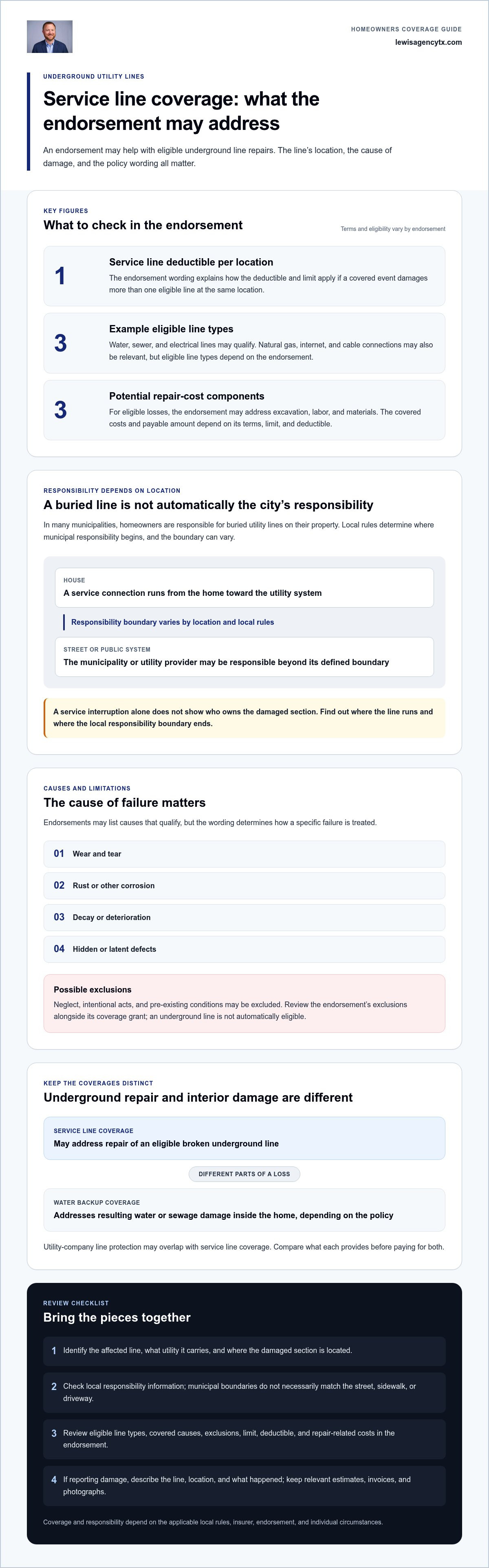
Service line coverage as a home insurance endorsement
An endorsement changes selected terms of a homeowners contract, while the rest of the policy wording remains in effect. Leander homeowners should read a service line coverage endorsement alongside the underlying policy to understand how both apply to a loss.
The endorsement may address repair or replacement costs after covered damage to an underground service line. A standard homeowners policy typically does not cover repairing or replacing a damaged service line. Depending on the endorsement’s terms, coverage may include excavation, labor, and materials, subject to stated limits.
How does service line coverage differ from a home warranty or utility service protection plan? It is an endorsement within homeowners insurance; a warranty or utility protection plan is a separate agreement. The contracts may cover different repairs and eligible lines, and may have different exclusions. Compare their terms to spot overlapping protection.
Which homeowners insurers offer service line coverage in Leander, TX? Insurers may offer it as an endorsement, but availability and terms vary. When comparing policies, focus on the endorsement’s line definitions, covered causes, and limits rather than its label.
Settlement terms can also affect the benefit. Some endorsement wording settles a covered service line loss using the smaller of the cost to replace damaged property without depreciation or the cost to repair it. If repair and replacement estimates differ, the specific settlement language determines which amount is considered.
Some endorsements may extend beyond the physical line. They may include additional living expenses if a service line failure makes the home temporarily uninhabitable. Some may also cover lost business income if the failure interrupts business operations. These benefits depend on the endorsement’s terms and address distinct consequences of a failure.
Green upgrades are another possible feature. For covered service line property, an endorsement may cap payment at 150% of the cost to repair or replace it with like kind and quality, including specified fees, costs, and loss of use. The endorsement described here recognizes LEED, Green Globes, and the Energy Star Rating System as green rating systems.
Utility-company line protection plans may overlap with a homeowners endorsement, but the contracts can cover different expenses. Compare which lines and causes each covers, how excavation is treated, and whether either includes additional living expenses. Reviewing a service line coverage endorsement in Leander, TX alongside a utility plan can clarify whether the protections address separate needs or overlap.
Review your homeowners policy to understand how an endorsement’s coverage, limits, and settlement terms fit together.
The Lewis Agency: Homeowners Insurance Policies
The Lewis Agency provides homeowners insurance guidance to Central Texas homeowners, including in Leander, Austin, Cedar Park, Georgetown, Round Rock, and Liberty Hill. If you’re reviewing an endorsement, focus on its covered lines, causes of damage, exclusions, limits, and deductible. The agency’s free online Resource Center offers plain-English guidance on deductibles, claims, water damage, and other common homeowners insurance questions.
This review can also help distinguish a service line endorsement from other policy protections, such as coverage for damage inside the home after a backup. Coverage and terms vary by policy, so the written documents matter when evaluating a specific situation.
For plain-English guidance on homeowners insurance and policy endorsements, visit The Lewis Agency’s free Resource Center or contact the agency.
Make your next policy review more useful
Many homeowners carefully review their dwelling coverage, roof deductible, and liability limits but overlook the underground utility lines serving their property.
A damaged water or sewer line can create an unexpected expense, particularly when excavation is necessary to reach the problem. And while homeowners insurance may offer service line protection through an endorsement, coverage is not automatically included in every policy.
At The Lewis Agency, we help homeowners in Leander, Austin, Cedar Park, Georgetown, and surrounding Central Texas communities understand their homeowners insurance coverage.
With more than 25 years of homeowners insurance experience, Chris Lewis understands the importance of reviewing coverage details before an unexpected loss occurs.
Have questions about service line coverage? Contact The Lewis Agency at 512-494-4888 to review your homeowners policy and discuss available coverage options. Coverage availability, eligibility, limits, deductibles, and exclusions vary by policy.
Frequently Asked Questions
What does a service line coverage endorsement cover?
It may cover eligible costs to repair or replace a damaged underground service line, according to the endorsement’s terms. A claim might involve accessing a buried line, not just fixing the damaged section, so review how excavation and related work are handled. The endorsement also defines qualifying causes of damage. Damage inside the home after a sewer backup is a separate concern and may involve different policy coverage.
Which underground utility lines are covered by service line insurance?
Water, sewer, and electrical lines are common examples. Some endorsements also include natural gas, internet, or cable connections. The listed utility type matters: a line serving one function does not automatically qualify because another line is covered. If you’re reviewing a buried cable issue, look for cable or communications lines in the endorsement’s definitions rather than relying on the general phrase “service line.”
What exclusions and coverage limits apply to service line endorsements?
Endorsements can exclude losses involving neglect, intentional acts, or pre-existing conditions. They also set a maximum payment and define which repair expenses count toward it. A repair estimate may include access work and restoration, but the endorsement determines whether each item is eligible. Read the exclusions alongside the coverage grant: a listed cause alone does not mean every cost is covered.
Does service line coverage include sewer lines, water lines, and electrical lines?
It may cover all three, but the endorsement must list or define those eligible line types. A sewer lateral, water connection, and underground electrical cable serve different purposes, so check each category separately in the policy documents. If one incident affects more than one utility, the endorsement explains how the covered property and expenses are evaluated together.
Who is responsible for repairing water and sewer lines between a Leander home and the street?
Responsibility depends on where the damaged section lies and how local rules divide responsibility between homeowners and the municipality. A private line running through a yard may be treated differently from a public main beneath a street. For a Leander property, locate the break and determine whether it is on the private connection or public system. The street edge alone does not establish the boundary.
Article by
Chris Lewis
Chris Lewis is the owner of The Lewis Agency, an Allstate insurance agency serving Austin and Central Texas. With more than 25 years of insurance experience, Chris focuses on helping Central Texas homeowners better understand their insurance coverage, including deductibles, roofs and hail, severe weather risks, water damage and other important coverage considerations. He created LewisAgencyTX.com to provide practical homeowners insurance education and help homeowners better understand their coverage before they need it.

Insurance Policy Audit Checklist for Growing Families
Use this insurance policy audit checklist for growing families to review home, auto, and life coverage after moves, renovations, or welcoming a new baby.

What if bringing home a baby, moving, or starting a home project affects more than one insurance policy? Family changes can shift what you own, drive, or want to protect, while policy details are easy to overlook. An insurance policy audit checklist for growing families can help you review those changes calmly without assuming every policy works the same way.
This guide covers which home, auto, life, and liability policies to revisit, plus the documents that make a review more useful. Use it after a new child arrives, when you move or renovate, or as your household’s belongings and responsibilities grow. Policy terms and coverage vary, so the goal is to identify questions, not guess at answers. Chris Lewis has more than 25 years of insurance experience and helps Central Texas homeowners better understand their coverage. The checklist ahead offers a practical place to start.
Key Takeaways
- Match household changes, such as a new child, move, renovation, or new driver, with the policies they may affect.
- Use the insurance policy audit checklist for growing families to review home, auto, life, and liability policy details in one place.
- Gather declarations pages and policy documents so you can distinguish written terms from questions that need an explanation.
- Keep a simple record of changes, policy details reviewed, and follow-up questions for your next coverage conversation.
- Consider how local factors, such as hail exposure, relate to your home and policy without assuming every Central Texas household has the same needs.
Why growing families should revisit their insurance policies
A new child, a move, a renovation, or a newly licensed driver can change how your household uses its home and vehicles. These milestones are good reasons to review your policies, but they don’t automatically change policy terms or mean your family needs more insurance. Start by comparing the information in your documents with your household’s current circumstances, then note questions that need an explanation.
A review is about understanding, not making assumptions. Your existing coverage may still fit, you may find a detail to clarify, or you may decide to discuss a possible change. The answer depends on your policy and circumstances. An insurance policy audit checklist for growing families helps you consider the whole household rather than focusing on just one milestone or type of coverage.
Which family changes can prompt an insurance review?
Consider changes in who lives in the home, how the home is used, and who drives your vehicles. A new child or caregiving arrangement may prompt questions about life insurance and household responsibilities. A major purchase may lead you to review personal property details. After a move, check that the policy information reflects your current home and address.
Renovations and additions are also worth noting. If you’ve changed your home’s size, layout, or features, review the dwelling details recorded in your policy and note anything that needs clarification. In Central Texas, for example, a Cedar Park family might finish a room addition while adding belongings as their household grows. Gather the project details and review the relevant policy information, but don’t assume that a particular limit is inadequate.
A newly licensed driver is another reason to review household auto arrangements. Note who drives each vehicle and how it is used, then compare that information with your auto policy. For life insurance questions, a basic overview of life insurance can help frame the purpose of coverage, while your own policy documents explain the terms that apply to you.
What an insurance policy audit can and cannot do
An audit is a structured review of your current policies, their recorded details, and questions raised by household changes. It gives you a clearer starting point for a conversation. It doesn’t guarantee that a loss will be covered or that a claim will be paid. Coverage and claim outcomes depend on the applicable policy and circumstances.
Separate what you can read in the documents from what still needs explaining. For example, record a deductible or coverage limit as it appears, then flag anything you don’t understand rather than guessing how it would apply to a future claim. A review can help identify questions, but it does not itself change policy terms.
Insurers make underwriting, rate, renewal, and coverage decisions. An agent can explain policy language and answer questions, but does not control those decisions. The aim is a more informed review, not an assumption that a milestone requires a particular purchase or outcome.
Growing-family insurance audit checklist: review each household policy
Use this checklist to compare each policy with your family’s current home, belongings, drivers, and responsibilities. The insurance policy audit checklist for growing families isn’t a recommendation to increase coverage. It’s a way to spot information that may need updating and questions that deserve a clear answer. Policy terms and options vary by insurer and policy, so use your own documents as the reference point.
Homeowners and personal property coverage questions
Start with your home and the belongings in it. A renovation, addition, move, or growing collection of family possessions can make it useful to check whether the information recorded still reflects your circumstances. Review the policy’s dwelling, personal property, liability, and deductible sections. Note what each section says and flag unfamiliar language rather than assuming how it would apply to a particular loss.
- Home details: Does the policy describe your current home and address? Note completed renovations or additions that may be relevant to the recorded details.
- Belongings: Consider whether your household’s furniture, electronics, clothing, and other possessions have changed. Review the personal property section and any related limits or conditions stated in your policy.
- Liability and deductibles: Find these sections in your documents and write down questions about how the terms work. Don’t assume another household’s policy details apply to yours.
For more background on home policy terms, consult the Austin homeowners insurance coverage guide. It can help you recognize topics to look for as you review your own policy.
Auto, life, and personal umbrella policy questions
Family routines change, too. Compare the drivers and vehicles listed on your auto policy with who drives in your household now and how each vehicle is used. If a teen has started driving or a family member’s commute has changed, record the difference and ask how the policy handles that information. Don’t assume the change automatically creates a specific coverage requirement or result.
For life insurance, review the beneficiaries and consider whether they still reflect your intentions. A growing family can also change the financial responsibilities you want to account for, such as caring for children or supporting a partner. Note those responsibilities and questions about how your existing policy fits them. The review helps you identify what to discuss; it doesn’t determine that you need a particular amount or type of coverage.
If your household has a personal umbrella policy, read its stated terms and eligibility requirements alongside the underlying policies it refers to. Write down unclear conditions or questions about how the policies relate. The NAIC Consumer Guides offer general insurance information that may help explain common terms, but your policy documents govern your specific coverage.
Keep the checklist practical: mark what you reviewed, record details that seem out of date, and list questions without guessing at the answers. The Lewis Agency can help explain policy wording. You can discuss your policy questions with the agency.
How to check policy details without assuming what is covered
Before comparing details, set aside the current declarations pages and full policy documents for each household policy. The declarations page offers a quick reference, while the policy itself provides the wording, conditions, exclusions, and definitions that help explain how coverage applies. Keep both nearby so you can record what the documents state separately from questions that need an explanation.
Use the declarations page as a starting point
A declarations page generally summarizes key policy information, such as named insureds, listed property, coverage limits, and deductibles. The exact layout varies, and the page isn’t the complete policy contract. Use the guide to reading an insurance declarations page to get oriented, then refer to your policy documents for details the summary doesn’t explain.
Copy information as written rather than interpreting it. If a term or figure is unclear, mark it as a question. Policy wording governs the coverage that applies, subject to the policy’s terms and your circumstances.
Compare current details with recent household changes
Check names, addresses, vehicles, and listed property against your household’s current information. A move, different vehicle, or home project may be a reason to ask whether a detail should be updated, but don’t assume the change automatically alters coverage. Keep the distinction clear: the document says one thing, your family’s circumstances may have changed, and the insurer or agent can help explain questions about how the policy applies.
For renewal context, note changes in the policy documents and renewal offer, then ask about differences you don’t understand. The Texas homeowners insurance rate guide for 2026 may provide broader context, but it doesn’t determine why an individual policy changed.
The insurance policy audit checklist for growing families works best when it turns observations into clear, answerable questions. Use a simple comparison:
Policy detail: What part of the policy are you reviewing?
Current information: What does the document say now?
Family change: What has changed in your household or property?
Question to ask: What needs clarification, without presuming the answer?
For example, if a home addition is complete, note the dwelling information shown in the policy, describe the project, and ask whether any policy details need attention. Don’t conclude from the declarations page alone that the addition is covered in a particular way. The same method works for auto details, names, and other listed property.
Keep your notes with the documents so a policy conversation can focus on the specific points you’ve identified. If you’d like help understanding policy wording, you can discuss your policy questions with The Lewis Agency.
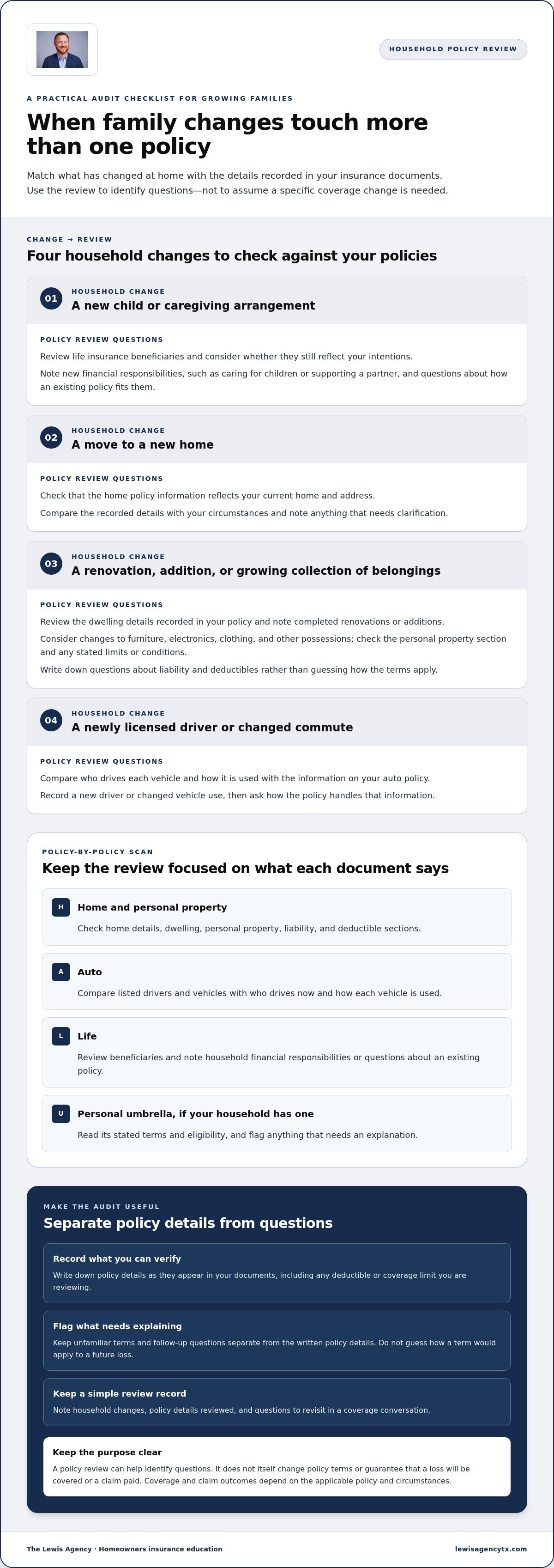
A practical checklist for when and how to review family coverage
A review is easier to finish when you give it a simple structure. Set aside time at a recurring point in the year, such as when you organize other household paperwork, and revisit relevant policies after a meaningful change. A new home, renovation, added driver, or change in caregiving responsibilities can prompt an extra review rather than waiting for the next routine check.
Keep the goal modest: know what you reviewed, note what has changed, and leave with a short list of questions. The insurance policy audit checklist for growing families can make the process repeatable without turning it into a decision to buy or change coverage.
Prepare a family insurance review folder
Gather declarations pages, full policy documents, renewal notices, and relevant updates about your home or vehicles. Your folder can be digital or paper. Keep the information needed for the review, and avoid adding sensitive personal details that aren’t necessary. Sort questions by policy so a home question doesn’t get mixed in with an auto or life insurance question.
- Gather: Collect current documents for each policy you plan to review.
- List changes: Note household updates, such as a move, completed renovation, new vehicle, or changed driver arrangements.
- Review: Compare the documents with those changes, recording what the policy says without guessing how it applies.
- Record questions: Write down unclear terms or details, along with the policy they relate to.
Add the date each policy was reviewed and mark questions as answered or still unresolved. This simple record helps you see what needs follow-up and keeps an unfinished question from disappearing into a stack of paperwork.
Know when to ask for clarification
Ask for an explanation when a term, exclusion, or deductible is unclear, or when you can’t tell how a household change relates to the policy. A summary or general example can explain an idea, but it isn’t a decision about your specific coverage. For Texas-wide consumer information, consult the Texas Department of Insurance and check that the guidance is current and relevant to your question.
Here’s a short version to save or print:
Family policy review: Gather current documents. List household changes. Compare each policy’s details with your current circumstances. Record questions, the review date, and any unresolved follow-up.
Chris Lewis and The Lewis Agency can help explain policy language and organize questions about your coverage. If you have questions about a policy you’ve reviewed, discuss your coverage questions with the agency.
How Central Texas families can turn the audit into a clear next step
Your review is useful when it leaves you with a short, workable list: details you’ve checked, changes you’ve noted, and questions that remain open. Use that list to decide what needs a conversation now and what can stay on file for the next review. Not every question needs to lead to a policy change.
Local circumstances can shape the questions, but they don’t determine the answers. A homeowner in Round Rock might want to understand how a roof-related term applies to their policy, while a family in Georgetown may have questions about a recent addition. Families in Austin, Leander, Cedar Park, and Liberty Hill can use the same review process. Homes, policy wording, and individual circumstances differ, so don’t assume one family’s answer will fit another.
What a policy conversation can clarify
Bring the specific policy page and explain what prompted your question. A focused conversation can help put unfamiliar wording into plain language, point you to related policy terms, and explain where to find information about the claims process. It can also help distinguish what the document says from what still needs clarification.
The insurer makes underwriting, renewal, rate, and coverage determinations. An explanation of policy language can help you understand the terms, but it doesn’t promise a particular decision or claim outcome.
Take the next step at your own pace
Before discussing your policy, group your notes by topic. Mark which questions concern the home, which relate to a household change, and which are about wording you couldn’t interpret. If you’ve updated a home in Austin or elsewhere in Central Texas, bring the relevant project information so your question has useful context.
There’s no need to rush through the list. Start with the question that matters most to your household, and keep the remaining notes for follow-up. A clear question is a solid next step.
If you’d like to discuss what your homeowners policy says, bring your coverage questions to The Lewis Agency when you’re ready.
Keep your family’s coverage questions moving forward
Your review can become a useful reference as your household changes. Keep the notes with your policy documents and add questions when a move, home project, or family milestone gives you a reason to revisit them. You don’t need to settle every question at once. A clear record helps you return to the details with better context.
The insurance policy audit checklist for growing families is a starting point for understanding existing coverage, not a promise about what a policy will cover or a reason to make a change before you’re ready. The Lewis Agency is an Allstate agency serving Austin and Central Texas. A policy conversation can help make language that still feels unclear easier to understand.
Bring your notes and relevant policy documents when you’re ready. Bring your policy questions to The Lewis Agency for a straightforward conversation about what your documents say. One question at a time is a good way to move forward.
Frequently Asked Questions
Does having a baby automatically change my homeowners insurance?
No. A baby’s arrival doesn’t automatically change the terms of your homeowners policy. You may still want to review the policy if your household’s belongings, home setup, or use of the property changes. For example, setting up a nursery may add furniture and equipment to your possessions. Check how your policy describes personal property and liability, and ask about language you’re unsure how to interpret.
When should I tell my insurer that my family has moved or renovated a home?
Contact your insurer or agent around the time you plan a move, and before renovation work begins if you’re unsure whether project details matter to your policy. Share the new address or a description of the planned work, and ask what information is relevant. After a renovation, keep contracts, receipts, and project notes together. Requirements and policy effects can vary, so don’t assume a change is handled automatically.
Should I review my life insurance beneficiaries after having a child?
Yes, review the beneficiary information after a birth and whenever your family circumstances or wishes change. Confirm that the names and details shown match your intentions, and ask how to submit an update if needed. If you’re considering naming a minor, the right arrangement can depend on your circumstances. Consider getting appropriate legal guidance rather than assuming the policy form answers that question.
Can adding a teen driver affect my family’s auto insurance?
It may affect your auto policy, depending on the insurer, policy, and household circumstances. Before your teen begins driving, contact your insurer or agent to ask how to report the new driver and what information is needed. Keep vehicle details and expected driving use handy. Don’t assume the policy’s current driver list or terms will automatically reflect a newly licensed household member.
How often should a growing family review its insurance policies?
Many families find it useful to set a recurring review around the same time each year, such as when renewal documents arrive, then revisit relevant policies after a major change. A new address, renovation, or added household driver can be a reason to check sooner. Put a reminder on your family calendar and note the date of each review so questions don’t get lost between renewals.
What documents should I gather for a homeowners insurance review?
Gather your current declarations page, full policy documents, and any renewal notice. If you’ve moved or completed work on the home, include relevant address information and project records, such as contracts or receipts. A current home inventory or recent photos of belongings may also help you discuss changes in what your family owns. The insurance policy audit checklist for growing families can help organize these materials and questions.
Article by
Chris Lewis
Chris Lewis is the owner of The Lewis Agency, an Allstate insurance agency serving Austin and Central Texas. With more than 25 years of insurance experience, Chris focuses on helping Central Texas homeowners better understand their insurance coverage, including deductibles, roofs and hail, severe weather risks, water damage and other important coverage considerations. He created LewisAgencyTX.com to provide practical homeowners insurance education and help homeowners better understand their coverage before they need it.

How to Read an Insurance Declarations Page (Dec Sheet)
Learn how to read an insurance declarations page dec sheet. Understand listed coverage limits, deductibles, endorsements, and what to verify before renewing.

Could your homeowners insurance summary answer some questions while leaving the most important ones open? That’s common: unfamiliar terms, coverage amounts, and deductibles can make a declarations page feel harder to understand than it should. Learning how to read an insurance declarations page dec sheet starts with treating it as a snapshot of your policy, not the full policy itself.
This guide explains how to identify the policy, insured home, and coverage dates, then make sense of the listed limits, premium, deductibles, and endorsements. Those figures tell you what’s recorded, but they don’t guarantee how a future claim will be handled. The policy itself contains the terms, conditions, and exclusions that shape coverage. Before renewal, check whether the home details and listed coverage still reflect your circumstances. With more than 25 years of insurance experience, Chris Lewis helps Central Texas homeowners understand policy language. We’ll walk through what the dec sheet can tell you, what it can’t, and how to prepare useful questions for a review.
Key Takeaways
- Follow a clear sequence to learn how to read an insurance declarations page dec sheet, starting with the policy details and moving through the property and listed coverages.
- Compare limits, deductibles, and premiums by what each figure represents, without treating them as a promise about how a claim will be handled.
- Review the address, named insureds, mortgage information, and home characteristics for changes before renewal.
- Mark unclear entries, look for related wording in the policy, and prepare focused questions for a policy review.
What an Insurance Declarations Page Shows, and What It Leaves Out
A homeowners insurance declarations page, often called a dec sheet, is a short summary of selected details about your policy. It can help you identify the insured home, policy period, and listed coverages, but it isn’t the full contract. A useful way to think about it is this: A dec sheet is a snapshot of selected policy details, not a promise that a particular claim will be paid.
If you’re learning how to read an insurance declarations page dec sheet, keep that distinction in mind. The summary points you toward key information; the full policy and any endorsements explain the terms that apply. Endorsements are documents that may change, add to, or clarify policy terms. Their effect depends on the wording in your documents.
Why homeowners receive a dec sheet
The summary gives you a practical way to identify your homeowners policy and review details without searching through every page first. You might consult it when policy documents arrive, when you’re preparing for renewal, or when you want to check the information associated with your home. It’s a starting point for review, not a substitute for reading the policy.
For example, a homeowner in Central Texas might use the page to locate the listed dwelling coverage and deductible before reviewing the related policy wording. That helps focus questions, especially before renewal, when home details or household circumstances may have changed.
What the dec sheet cannot tell you on its own
A summary has limits. Exclusions, conditions, and definitions that affect coverage may appear in the policy or an endorsement rather than on the dec sheet. Those sections explain how the policy applies, including requirements or restrictions that may matter in a particular situation. Coverage depends on the actual policy, its endorsements, and the circumstances of a loss.
A listed coverage limit tells you the amount shown for that part of the policy. By itself, it doesn’t establish whether a specific loss is covered, how damage will be evaluated, or what a claim payment might be. For instance, a listed dwelling limit alone can’t answer whether a particular roof loss is covered or how the policy would apply. Those questions depend on the policy language and the facts of the claim, and the insurer makes the claim determination.
- The dec sheet: A quick reference for selected policy details.
- The policy: The terms, conditions, exclusions, and definitions that provide context.
- Endorsements: Additional documents that may alter or clarify terms, depending on their wording.
Read the summary as a guide to where to look next. If an entry raises a question, find the related wording in the policy and review both documents together. This keeps a listed figure in perspective and gives you a clearer basis for asking informed questions.
How to Read the Policy, Property, and Coverage Details on a Dec Sheet
Start with the identifying details before looking at coverage amounts. This helps confirm which policy document you’re reading and which home it refers to. When learning how to read an insurance declarations page dec sheet, connect each listed detail to the right property and policy period, then note anything that needs a closer look.
Start with the people, property, and policy dates
Find the policy number, named insureds, insured location, and policy period. These details help distinguish one document from another, especially if you have copies from different dates. The policy number is the insurer’s reference for the policy. Named insureds are the people identified on it. The insured location is the home the document describes. Check the dates printed for the policy period rather than assuming a document is current because you recently received it.
- Identify the policy. Locate the policy number and the insurer’s name. Use the number to distinguish this document from other policy paperwork.
- Check the named insureds. Review the names as printed. If a household or ownership change has occurred, note it as a question for your policy review rather than assuming the document updated automatically.
- Verify the insured property address. Compare the listed location with the home you intend to insure. The property address identifies which home the policy details refer to. For example, a homeowner in Round Rock should check that the page names the intended Round Rock property, not a previous residence.
- Read the policy period. Note the start and end dates shown. These dates help you compare documents and identify the period each one describes; they don’t, by themselves, confirm whether another term has been issued.
Locate the listed coverages and policy references
After checking the identifying details, look for the coverage section. It may appear as a table or schedule, with coverage categories alongside listed amounts. Labels and categories can vary, so read your own document rather than expecting every Texas policy to use the same layout. The mortgagee, if listed, is generally the lender or mortgage company associated with the property, not another named insured.
Note any references to policy forms, sections, or endorsements near the coverage entries. These references point to wording that explains how a category applies or whether an endorsement changes the terms. Don’t assume a coverage label alone answers questions about a specific loss. Keep a short list of unfamiliar references so you can find them in the accompanying policy documents.
For instance, a hypothetical homeowner in Cedar Park might find the correct address and policy dates, then see a coverage label followed by a form reference. The useful next step is to record that reference and locate its wording, not to draw a conclusion from the label alone. If you’d like help understanding your policy documents, you can discuss your homeowners policy with The Lewis Agency.
How to Understand Home Insurance Limits, Deductibles, and Premiums
Coverage amounts, deductibles, and premium may sit close together on a declarations page, but they describe different parts of the policy. To understand how to read an insurance declarations page dec sheet, consider each figure separately, then check how the policy wording connects it to a particular coverage or loss.
Read coverage limits as listed amounts, not claim promises
A limit is the amount shown for a particular coverage category. Your dec sheet may display several categories and their amounts in a table or schedule. Labels and layout vary by policy, so don’t assume every homeowners policy uses the same categories or structure. A listed limit helps you understand what the document states, but it doesn’t independently determine whether a specific loss is covered or how a claim will be settled.
Policy wording, exclusions, endorsements, and the facts of a loss all matter. A listed dwelling limit, for example, doesn’t by itself explain how the policy would respond to damage from a particular event. For roof questions, check how the policy describes settlement and which roof coverage applies. The distinctions in actual cash value versus replacement cost for a Texas roof can help you identify what wording to look for.
Check deductibles and premium without assuming why they changed
A deductible is the amount or share you’re responsible for under the policy when a covered loss applies. The premium is the amount charged for the policy period shown in the documents. Neither figure has one universally suitable value. Review what your own documents say, and don’t infer the reason for a premium change from the declarations page alone.
Pay attention to the deductible’s label and which coverage it applies to. A policy may list more than one deductible, with different terms or applications. If a deductible is shown as a percentage, check the policy wording to understand what it is calculated against rather than assuming the percentage applies to the cost of repairs. Don’t assume one listed amount applies to every kind of loss. If the wording or calculation is unclear, note the question and locate the relevant policy language.
| Figure | What it represents | What it doesn’t establish by itself |
|---|---|---|
| Coverage limit | The amount shown for a coverage category | Whether a particular loss is covered or what a claim will pay |
| Deductible | Your stated share or amount under applicable policy terms | Which deductible applies without checking its label and wording |
| Premium | The policy charge for the stated period | Why the price is at that level or how it may change later |
If the premium differs from an earlier document, compare the policy periods and listed details before drawing conclusions. A rate change can have several possible explanations, and the dec sheet alone may not explain them. For broader renewal context, see Texas home insurance rate increases in 2026. Use the figures as prompts for review, then consult the policy wording for the terms that govern your coverage.
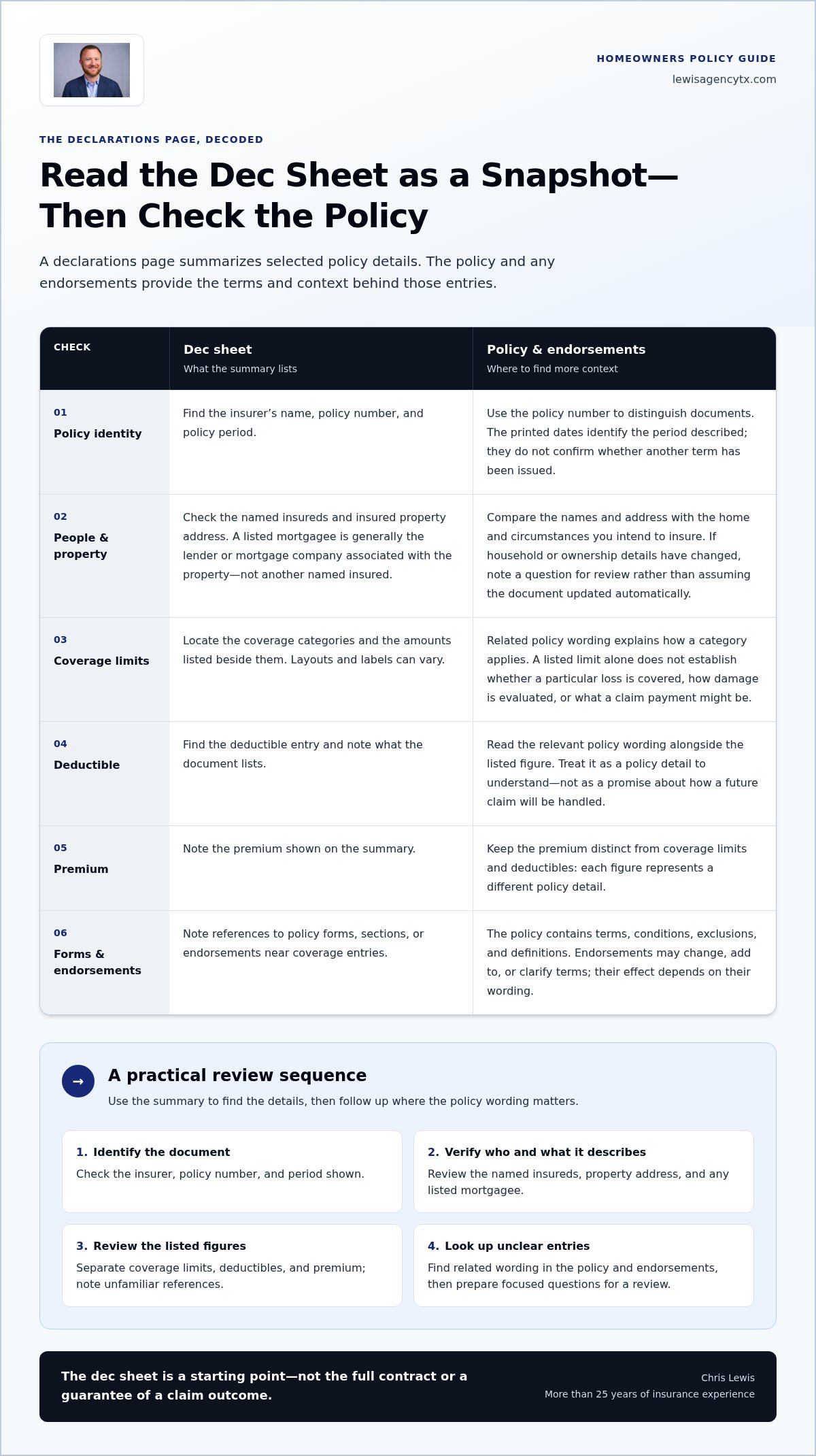
How to Review a Dec Sheet for Home Details, Changes, and Questions
A policy review is a chance to check whether the information on your declarations page still reflects your home and household. Keep the current page beside an earlier one, if you have it, and list anything that looks different or unclear. Learning how to read an insurance declarations page dec sheet also means knowing when a detail deserves a follow-up question instead of guessing what it means.
Check whether the listed information still matches your home
Compare the page with your current circumstances. Pay attention to the insured address, named insureds, mortgage information, and property characteristics shown on the document. Details such as construction or roof information may appear, depending on the policy documents. If something seems outdated or inaccurate, write it down for a policy discussion. Don’t assume that changing a detail will necessarily change coverage or premium.
- Address: Does the insured location match the home you’re reviewing?
- Named insureds: Are the listed names consistent with the current household and policy documents?
- Mortgage information: Is the mortgage company information shown, if applicable, consistent with your records?
- Property details: Do listed characteristics appear to match the home as you understand it?
Use the checklist to identify questions, not to decide whether a claim would be covered. For example, imagine a homeowner in Georgetown notices hail damage to a roof and sees a roof-related entry on the dec sheet. The summary may help identify a coverage label or endorsement to look up, but it can’t answer on its own how the policy applies to that damage. The policy wording and circumstances of the loss matter. Broader policy topics are covered in this Austin homeowners insurance coverage guide.
Compare the current page with prior policy documents
Look for changes in the policy dates, listed amounts, deductibles, or endorsements. Mark each difference and note what you want clarified. A changed entry is a reason to investigate, not proof of why it changed or what effect it has. If the premium is different, keep that question separate from the other entries; the declarations page may not explain the reason.
Before a review, gather relevant records, such as an updated mortgage statement or information about changes to the home. Keep your questions specific: “What does this listed property detail refer to?” or “Where can I find the wording for this endorsement?” Focused questions make it easier to connect a summary entry with the policy language that explains it.
If several entries have changed, review them one at a time rather than trying to infer a single cause. The Lewis Agency can help explain homeowners policy documents and clarify questions about listed information. Reviewing the details calmly before renewal gives you time to understand what the documents say and identify anything that needs attention. This review approach applies whether your home is in Austin, Leander, Cedar Park, Georgetown, Round Rock, or Liberty Hill.
What to Do After Reading Your Home Insurance Dec Sheet
Once you’ve reviewed the summary, turn anything unclear into a specific question. Mark the entry, find the related wording in your policy documents, and ask for help understanding how the documents fit together. Knowing how to read an insurance declarations page dec sheet means knowing when to look beyond the summary, too.
Prepare focused questions about unclear entries
Keep your questions neutral and tied to the wording you see. Instead of asking whether a loss is covered based only on a label, ask what that term or figure refers to in your specific policy and where its full explanation appears. That keeps the discussion grounded in your documents, rather than assumptions about what the policy might say.
- Mark the entry. Note the label, amount, date, or reference that prompted your question.
- Find related wording. Check the policy sections or endorsements connected to the entry. Look for relevant definitions, exclusions, and conditions.
- Ask a focused question. For example: “Where does the policy explain this term?” or “What wording applies to this listed coverage?”
If two documents seem to use different terms, bring both into the review and ask how they relate. If a deductible or coverage entry is unclear, ask what the specific wording says about when it applies. These questions don’t assume a particular answer or claim outcome. They help you understand which policy language is relevant.
Use a policy review to clarify next steps
A policy review can help you make sense of the documents, identify details you may want to discuss, and understand what to read next. An insurance agent can explain policy language and help you follow the claims process, but doesn’t decide whether a claim is covered or control coverage terms. Coverage interpretations and claim decisions depend on the policy and the circumstances involved.
Chris Lewis has more than 25 years of insurance experience and helps Central Texas homeowners better understand coverage and policy language. A conversation can clarify what a listed entry means and where to find its context, without treating the summary as a decision about a future claim.
Bring the declarations page and related policy documents, along with the questions you marked. You don’t need to resolve every detail at once. Start with the entries that matter most to your understanding of the home’s policy, then work through the related wording one question at a time. That steady approach can make a policy review more useful and help you know what follow-up, if any, makes sense.
If you’d like to talk through questions about your homeowners policy, you can ask The Lewis Agency about your homeowners policy.
Make Your Next Policy Review More Useful
Set aside time before renewal to make policy review a regular part of caring for your home. A brief note of questions as they arise can help you approach that review with a clearer sense of what you want to understand. Knowing how to read an insurance declarations page dec sheet isn’t about finding every answer on one page. It’s about being ready to follow up thoughtfully.
Keep your policy documents together in a place you can find them, and note when you last reviewed them. If your circumstances change, add that to your list for the next review. Small habits like these can make it easier to stay engaged with your coverage over time.
Take the process one question at a time. Understanding your policy is ongoing, and steady attention can help you feel more prepared for future decisions.
Frequently Asked Questions
What is an insurance declarations page, or dec sheet?
It’s the declarations page, a document homeowners can use to identify which contract and policy period they’re looking at. A practical way to learn how to read an insurance declarations page dec sheet is to compare its dates and policy number with the paperwork you’re reviewing. That check can help prevent mixing up current documents with older copies when you organize records or prepare questions.
Is a declarations page the same as an insurance policy?
No. Think of the declarations page as one document within the broader set of policy materials, not a replacement for them. If you’re trying to understand a particular term, note any section or form references near it and use those as clues for where to look next. Keeping the related pages together can make it easier to follow how the documents connect.
Can a declarations page prove that my home is insured?
It can provide policy information, but the organization requesting proof decides what documentation it will accept. If a mortgage lender asks for evidence, clarify whether it needs a declarations page or another document, and whether it requires a specific policy period or delivery method. Then provide the current paperwork that matches the request. This avoids assuming that one document will meet every organization’s requirements.
What should I do if my homeowners declarations page has incorrect information?
Describe the issue clearly when you contact your insurance agency or insurer. For example, identify the exact field and explain what you believe it should say, using relevant records if helpful. Ask how the discrepancy should be handled and whether updated documentation will be provided if a change is made. Keep any response with your policy records so you can refer to it during a later review.
How often should I review my insurance declarations page?
Review it when you receive new policy documents and when a change in your household or home prompts a question. Keep dated copies together and make a brief note of changes you want to discuss. That record can help you track what you noticed and when, without relying on memory at renewal. The right review timing depends on your circumstances and policy documents.
Where can I get a copy of my homeowners dec sheet?
Look through the documents provided by your insurer or its customer account tools, if available. If you can’t find the page, contact your insurance agency or insurer and specify the policy period you need. Save the copy with your other homeowners records and label it by date. That makes it easier to distinguish the current document from earlier versions when you’re discussing your policy.
Does a dec sheet show whether hail damage to my roof is covered?
It can help you identify which roof-related terms to ask about, but don’t use it alone to predict a claim result. For a Central Texas hail concern, note the deductible label and look for any roof settlement wording or related endorsement in the policy documents. An insurance professional can explain where those terms appear and how to read them; claim decisions depend on the policy and loss circumstances.
Article by
Chris Lewis
Chris Lewis is the owner of The Lewis Agency, an Allstate insurance agency serving Austin and Central Texas. With more than 25 years of insurance experience, Chris focuses on helping Central Texas homeowners better understand their insurance coverage, including deductibles, roofs and hail, severe weather risks, water damage and other important coverage considerations. He created LewisAgencyTX.com to provide practical homeowners insurance education and help homeowners better understand their coverage before they need it.

Austin Homeowners Insurance: Complete 2026 Coverage Guide
Need reliable homeowners insurance Austin coverage? Explore 2026 policy insights on hail deductibles, roof schedules, and protecting your Central Texas home.

What if the deductible on your policy doesn't work the way you expected when a severe hailstorm hits your neighborhood? For many Central Texas residents, shopping for reliable homeowners insurance austin coverage through generic national websites often creates more questions than answers. Online algorithms routinely overlook regional realities, leaving homeowners to untangle separate percentage-based storm deductibles, unexpected roof depreciation schedules, and confusing rules around freeze damage on their own.
It can feel overwhelming to sort through policy fine print, but protecting your biggest investment shouldn't involve guesswork. You can protect your Central Texas home against hail, storms, and local property risks with tailored homeowners coverage designed for our specific climate. In this guide, we'll walk through how local reconstruction expenses shape your dwelling limits, how wind and water claims are handled under Texas guidelines, and the key coverage details you should review to keep your household secure.
Key Takeaways
- Understand what standard policies protect and identify the common Central Texas weather perils that require closer policy attention.
- Learn how regional storm patterns influence homeowners insurance austin coverage, particularly regarding roof settlement terms and depreciation schedules.
- Demystify percentage-based wind and hail deductibles so you clearly understand your out-of-pocket responsibilities before severe weather strikes.
- Establish an accurate dwelling coverage limit based on local reconstruction expenses rather than fluctuating real estate market values.
- Discover how tailored guidance from a dedicated local Allstate agent helps you safeguard your home without the guesswork of generic quote tools.
What Does Homeowners Insurance in Austin Actually Cover?
Most single-family homes across Central Texas rely on an HO-3 special form policy. Under the standard homeowners insurance policy structure, coverage splits into distinct categories for your physical structure, personal belongings, liability risks, and living disruptions. Choosing the right homeowners insurance austin policy requires understanding where baseline protections end and where local regional conditions demand closer attention. A baseline policy provides essential safeguards, but it works best when tailored to the specific risks of your property.
Dwelling Protection and Extended Replacement Cost
Coverage A dwelling protection covers the physical structure of your house after sudden, covered events like fire, hail, or lightning. Detached fences, sheds, and detached garages fall under separate other structures coverage. Your dwelling limit must reflect regional labor and rebuilding expenses rather than local real estate market valuations.
Central Texas soils present unique structural challenges. Standard policies routinely exclude earth movement and settling, meaning slab leaks and foundation shifts often require specific policy endorsements. Adding an extended replacement cost endorsement gives your dwelling limit an extra buffer, helping absorb sudden surges in local contractor pricing and materials following widespread severe weather.
Personal Property, Liability, and Additional Living Expenses
Inside your home, personal property coverage helps repair or replace belongings like furniture, clothing, and electronics damaged by covered perils. Policy terms determine whether these items are settled at actual cash value or full replacement cost, with specialty endorsements available for high-value items.
Personal liability coverage safeguards your family's financial assets if a visitor is injured on your property or if you accidentally cause damage to someone else's property. If a covered peril renders your home uninhabitable, loss of use coverage, also known as Additional Living Expenses, reimburses temporary lodging and meal expenses while repairs take place. Because policy forms and endorsements vary between carriers, reviewing these limits carefully ensures your family avoids unexpected out-of-pocket gaps.
Central Texas Weather Hazards: Hail, Freezes, and Severe Storms
Austin sits directly inside a major severe storm corridor where spring cold fronts regularly trigger heavy convective cells. According to data tracked by state insurance regulators, wind and hail events account for roughly 62% of all residential property loss payouts in Texas since 2019. Securing reliable homeowners insurance austin coverage means preparing your household for rapid weather shifts that can batter your exterior or disrupt indoor plumbing within hours.
Hail Alley Activity and Structural Roof Stress
Hail represents the primary exterior threat across Travis and Williamson counties. Large hail bruises asphalt shingles, strips away protective granules, and leaves the fiberglass mat exposed to the intense Texas sun. Metal roofing panels can suffer denting that compromises seam integrity or seam seals over time.
Many roof fractures remain invisible from your driveway. Impact marks often hide beneath tile overlaps or along vulnerable valley flashing. Because storm claims depend on establishing an accurate date of loss, tracking local hail occurrences and arranging regular inspections helps preserve timely filing eligibility. If you want a clear picture of how regional storm risks affect your current policy structure, a quick consultation with The Lewis Agency can help you identify potential coverage gaps before storm season begins.
Winter Freeze Damage and Critical Flood Exclusions
While hail impacts the exterior, Central Texas winter freezes threaten the inside of your home. Hard freezes routinely cause exterior spigots and uninsulated attic pipes to burst once temperatures drop below freezing for extended stretches. Standard policies generally treat burst pipes as sudden and accidental water discharges, provided the homeowner maintained heat in the home or properly drained the plumbing lines before an absence.
The Texas Department of Insurance Home Insurance Guide emphasizes a vital distinction between interior pipe bursts and surface water intrusion. Key coverage boundaries include:
- Sudden internal plumbing breaks: Typically covered under standard property policies, subject to regular policy deductibles and heat maintenance conditions.
- Overland flash flooding: Excluded entirely under standard homeowners policies, whether water flows from a swollen creek or pools in your yard.
- Sewer and drain backups: Excluded by baseline forms unless you add a specific water backup endorsement.
Austin features significant micro-risks near waterways like Shoal Creek, Onion Creek, and the Colorado River. Because standard homeowners policies never cover rising outdoor water, securing separate flood insurance remains necessary for homes near low-lying terrain.
Deciphering Texas Deductibles: Hail Percentages and Roof Terms
Many homeowners assume a storm deductible works like a standard flat-dollar charge. In Central Texas, property policies handle severe weather very differently. According to Insurance Information Institute hail loss data, Texas consistently leads the country in severe hail events. Because storm frequency is elevated here, carriers separate wind and hail deductibles from other property perils, making deductible structure a vital consideration for your homeowners insurance austin coverage.
How Wind and Hail Percentage Deductibles Function
Rather than a fixed dollar fee, wind and hail deductibles are typically structured as a percentage, commonly 1% or 2%. This percentage applies directly to your total dwelling coverage limit, not the specific repair estimate. For example, a 2% deductible on a home with a $400,000 dwelling limit requires an $8,000 out-of-pocket responsibility before policy benefits disburse. Under Texas law, contractors cannot legally waive, absorb, or rebate your deductible, making it essential to keep an accessible emergency fund matched to your chosen tier.
Replacement Cost Value vs. Actual Cash Value Roof Terms
How an insurer calculates roof damage determines how much you pay out of pocket after a severe storm. Replacement Cost Value (RCV) pays to replace damaged roofing materials with new equivalents at current market labor rates, minus your deductible. In contrast, Actual Cash Value (ACV) subtracts depreciation based on the age and condition of your roof before issuing payment.
Many carriers add endorsements that shift roofs older than 10 to 15 years onto ACV depreciation schedules. Homeowners with metal roofing should also review whether their policy includes a cosmetic damage waiver, which restricts claims if hail dents metal panels without causing structural water penetration.
Water Backup and Foundation Endorsement Options
Central Texas expansive clay soils expand during wet seasons and shrink during summer droughts. This movement puts continuous pressure on concrete slabs and sub-surface pipes. Because standard policies exclude foundation settling and backed-up sewer lines, you should consider optional endorsements:
- Water backup endorsements: Cover interior damage caused by backed-up drains or failed sump pumps.
- Foundation and slab leak riders: Help pay the tear-out and repair expenses required to fix sub-surface plumbing pipes under the foundation.
Aligning these optional protections with your core homeowners insurance austin policy ensures you are prepared for both regional weather hazards and local soil conditions.
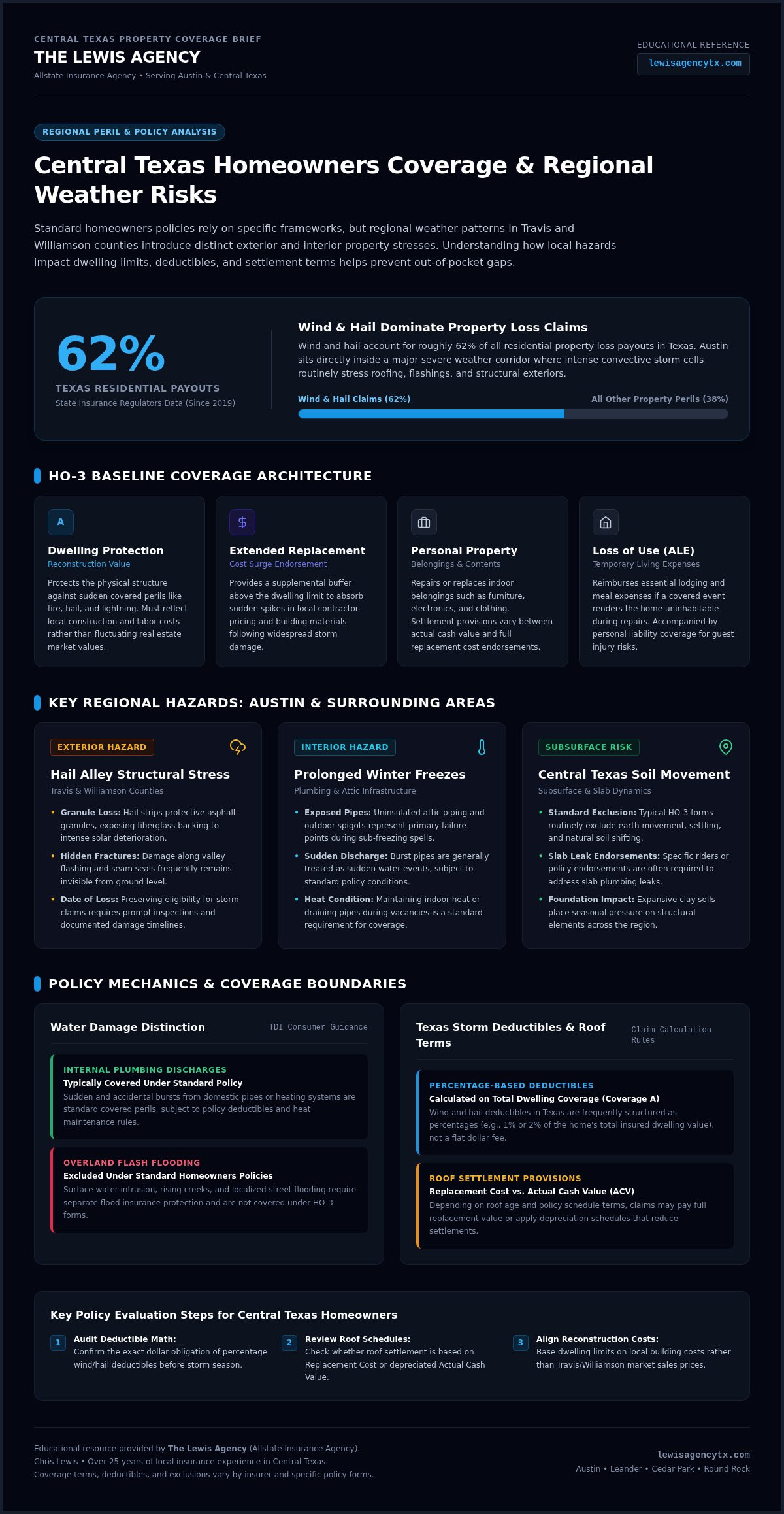
Evaluating Your Coverage Needs: A Practical Austin Buying Framework
Setting up proper coverage requires moving past automated online calculators. National quote engines often base recommendations on broad national metrics, leaving homeowners vulnerable when severe regional weather strikes. Building a dependable homeowners insurance austin policy begins with an honest evaluation of your specific structure, local construction realities, and personal property requirements.
Calculating Reconstruction Costs Versus Real Estate Market Value
Real estate market value is not the same as reconstruction cost. In Austin, a significant portion of your home's sales price reflects the underlying land and neighborhood demand. You don't insure dirt. Dwelling coverage must strictly reflect the actual expense of clearing debris, purchasing materials, and hiring licensed local trades to rebuild from the slab up.
Local construction expenses can surge quickly, especially after widespread storms strain trade availability. Rebuilding also triggers modern municipal building codes. If your home was built decades ago, full reconstruction may require updated wiring, enhanced insulation, or new plumbing standards. Setting your coverage limit solely to match a purchase price or mortgage balance can leave you underinsured during a total loss.
Reviewing Policy Endorsements and Risk-Mitigation Discounts
Auditing the physical details of your home helps uncover hidden coverage gaps before you sign a contract. Older homes in central neighborhoods often feature legacy plumbing materials that warrant closer attention, while newer builds in growing suburbs demand clear terms around roof wear and hail exposure. Tailoring endorsements to these realities keeps your coverage grounded in how you actually live.
You can also offset your overall insurance costs through practical risk-reduction steps. Insurers routinely offer premium credits for proactive safeguards, including:
- Bundling your homeowners insurance policy with auto insurance under one carrier.
- Installing monitored burglar and fire alarm systems.
- Adding automatic water shutoff valves to prevent catastrophic plumbing leaks.
- Installing qualified impact-resistant roofing shingles.
Partnering with a knowledgeable local advisor helps you identify these opportunities while structuring your coverage limits properly. Rather than leaving your structural protection to an impersonal national website, reach out to The Lewis Agency to schedule a policy review and secure peace of mind for your Central Texas household.
Navigating Homeowners Insurance with The Lewis Agency in Central Texas
When severe weather strikes, having a direct line to someone who knows your neighborhood makes a tremendous difference. Automated chat portals and out-of-state call centers treat your home as a collection of generic data points. Securing the right homeowners insurance austin coverage works best when you collaborate with a professional who lives and works right here in Central Texas.
The Value of a Dedicated Local Allstate Agency
The Lewis Agency is a dedicated Allstate agency led by Chris Lewis. Instead of leaving you to navigate complex policy forms alone, Chris serves as an approachable neighborhood advisor focused on protecting what you've built. Working with a dedicated agency allows you to structure proven Allstate insurance products around your property's specific physical needs.
Distant phone representatives rarely understand how local hail corridors, regional roof repair challenges, and soil shifts influence your coverage requirements. Having an accessible advisor means you can discuss your questions directly across a desk. When property damage happens, you have a steady, dependable resource in your corner to guide you through the initial steps of the claims process with clarity and patience.
Proactive Policy Reviews for Austin and Surrounding Communities
Property values, local rebuilding costs, and household situations evolve constantly across Central Texas. Whether your home is located in Austin, Cedar Park, Leander, Round Rock, Pflugerville, Buda, or Kyle, an unexamined policy can slowly fall behind reality over time. Regular policy audits help identify coverage shortfalls before severe convective storm seasons arrive.
A comprehensive review examines your current dwelling limits against local construction trends, confirms your storm deductibles align with your household budget, and checks that your personal property safeguards remain sufficient. It also provides an opportunity to evaluate related protections, such as auto insurance or landlords insurance, ensuring seamless coverage across all your assets.
Protecting your household begins with a straightforward, informative conversation. Connect with The Lewis Agency to schedule your personalized homeowners coverage review and ensure your Central Texas home has the reliable protection it deserves.
Protecting Your Central Texas Home with Confidence
Securing dependable homeowners insurance austin coverage comes down to understanding your specific property risks. When you base your dwelling limits on regional reconstruction costs rather than real estate market swings, you avoid serious shortfalls after a loss. Knowing how your wind and hail percentage deductibles function also ensures you aren't caught off guard when spring hailstorms roll across Travis or Williamson County.
You don't have to decipher policy provisions or roof settlement schedules alone. As a dedicated local Allstate agency, Chris Lewis and the team bring deep familiarity with Central Texas weather patterns and structural challenges. Whether your home is located in Austin, Cedar Park, or Round Rock, we are here to provide steady, plainspoken guidance. Connect with The Lewis Agency for a personalized Austin homeowners policy review, and ensure your home has the dependable protection your family deserves.
Frequently Asked Questions
How much dwelling coverage do I need for my home in Austin?
Your dwelling coverage limit should reflect the full estimated cost to rebuild your home's physical structure from the slab up, separate from your land value or market selling price. Local construction expenses, architectural materials, square footage, and regional trade labor rates determine this figure. Establishing an accurate limit ensures your policy absorbs local rebuilding costs and municipal building code requirements rather than fluctuating real estate values.
How does a percentage hail deductible work on a Texas home insurance policy?
A percentage hail deductible calculates your out-of-pocket cost as a fixed percentage of your home's total Coverage A dwelling limit, not the total repair estimate. For example, a two percent deductible on a four hundred thousand dollar dwelling limit requires an eight thousand dollar out-of-pocket responsibility. Under Texas law, contractors cannot legally waive, rebate, or absorb this deductible on your behalf.
Does standard Austin homeowners insurance cover flood and water backup damage?
Standard homeowners policies exclude damage caused by rising surface water, flash flooding, and backed-up municipal drains or sewers. Sudden and accidental internal plumbing line bursts, such as those caused by hard winter freezes, are typically covered under baseline terms. Protecting your home from rising creek water or sewer lines requires separate protection through a dedicated flood policy and an optional water backup endorsement.
How does the age and condition of my roof affect coverage terms?
As your roof ages, carriers often adjust coverage terms to account for wear and tear. Roofs older than ten to fifteen years may trigger mandatory roof inspections, underwriting restrictions, or policy endorsements that transition storm settlements from full replacement cost to an actual cash value schedule. Maintaining documentation and addressing minor wear promptly helps preserve broader settlement terms on your homeowners insurance austin policy.
What is the difference between replacement cost and actual cash value on roofs?
Replacement cost coverage pays the necessary amount to repair or replace damaged roofing materials with new equivalents at current market labor rates, minus your deductible. Actual cash value, however, deducts physical depreciation based on the roof's age and preexisting condition before issuing payment. This depreciation deduction can leave property owners facing substantial out-of-pocket expenses during storm claim repairs if their roof is settled on cash value terms.
Can bundling my auto and home insurance policies help lower overall costs?
Bundling your homeowners insurance policy with auto insurance under a single carrier is one of the most practical ways to lower your overall insurance expenses. Carriers frequently provide multi-policy premium credits for households that combine personal coverages. Beyond financial savings, keeping policies with a dedicated agency like The Lewis Agency simplifies account management, streamlines billing, and ensures you have a single point of local contact.
Why do homeowners insurance premiums fluctuate across Central Texas?
Regional premium adjustments reflect changing claim volumes from severe convective storms, rising labor and construction materials expenses, and localized environmental risks. In high-growth communities like Austin, Round Rock, and Cedar Park, frequent hailstorms and regional contractor demand heavily influence market-wide claims payouts. Evaluating your homeowners insurance austin policy annually ensures your coverage limits remain aligned with actual regional reconstruction expenses without unexpected gaps.