
Texas law doesn’t require homeowners to carry windstorm insurance. Still, Texas roof insurance often includes hail and wind coverage, though coastal homes may need a separate windstorm policy. The details that matter most are your deductible and how your policy values the roof after damage.
It’s easy to assume a covered storm loss means the policy will pay the full cost of a new roof. Your deductible, roof valuation, and policy terms all affect what you may have to pay yourself. This article explains how those factors work, what to look for in your policy, and why the rules can differ for coastal homeowners.
Key Takeaways
- Texas law doesn’t require homeowners to carry windstorm insurance, but coastal properties may need separate windstorm coverage.
- Review your policy’s roof exclusions and claim conditions so you know what could affect a hail or wind claim.
- A percentage-based wind and hail deductible is tied to dwelling coverage, so its dollar amount may be larger than expected.
- Roof valuation matters: actual cash value accounts for depreciation, while replacement cost coverage works differently. A policy review can help clarify which terms apply to your home.
Does Texas require wind and hail insurance?
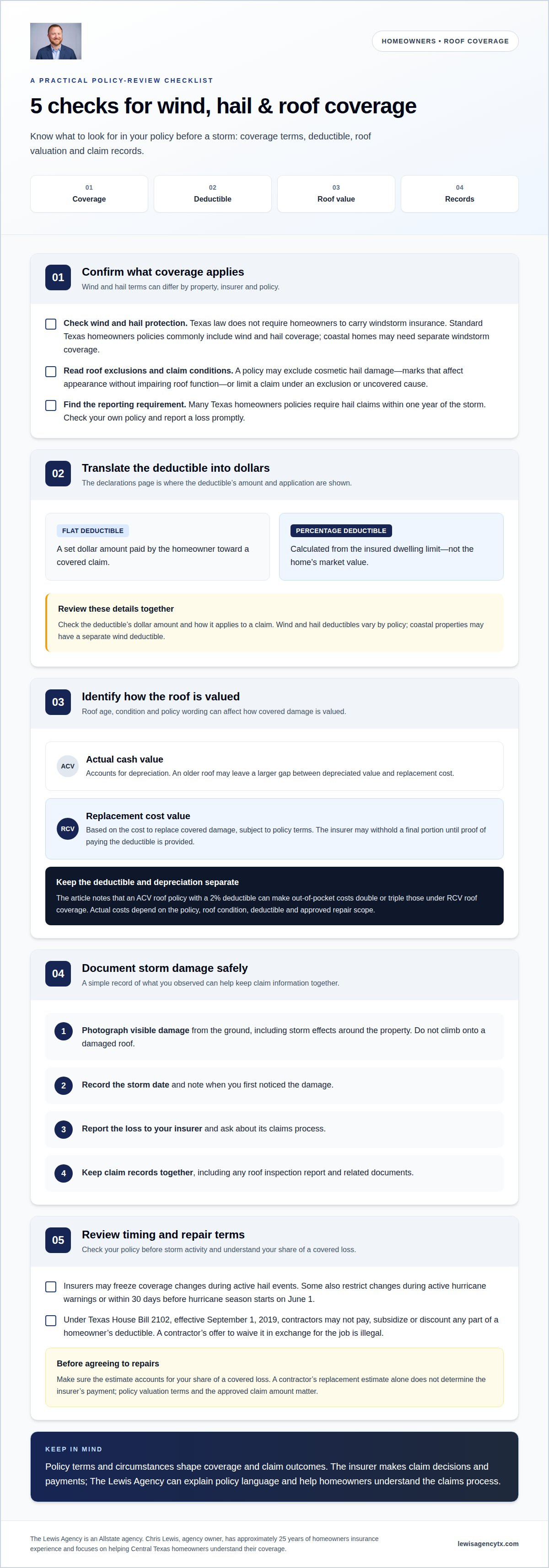
No. Texas law doesn’t require homeowners to carry windstorm insurance. Standard Texas homeowners policies commonly include wind and hail coverage, but coastal homes may need separate windstorm insurance. Roof age and condition can affect how a covered loss is valued, especially if the policy accounts for depreciation. The policy’s roof terms determine how that valuation works.
Coverage can depend on the cause and type of damage. A policy may exclude cosmetic hail damage, meaning marks that affect appearance without impairing the roof’s function. Texas adopted the HO-145 cosmetic hail damage endorsement in 1998. A claim may also be limited if the damage falls outside the policy’s covered causes or an applicable exclusion. Report a storm loss promptly, since many Texas homeowners policies require hail claims within one year of the storm.
After a thunderstorm, document visible damage from the ground. Avoid climbing onto a damaged roof.
- Photograph visible hail damage and storm effects around the property.
- Record the storm date and note when you first noticed damage.
- Contact your insurance company to report the loss and ask about its claim process.
- Keep claim-related records and any roof inspection report with your policy documents.
For roof claims, actual cash value accounts for depreciation, while replacement cost coverage may value covered damage differently. The policy terms, roof condition, deductible, and approved repair scope all affect out-of-pocket costs. An older roof may therefore leave a larger gap between its depreciated value and replacement cost.
A claim can also affect future renewal terms or premiums. Texas homeowners may see a higher premium at the next renewal after a claim. The insurer evaluates the claim under the policy, and outcomes vary. Keep your policy and claim records together so you can understand the decision and its effect at renewal.
Percentage-based wind and hail deductibles
A wind and hail deductible determines how much a homeowner pays toward a covered storm claim. Texas roof insurance may have a percentage deductible for hail and wind, so knowing its dollar amount helps with repair planning.
Flat and Percentage-Based Deductibles
A flat deductible is a set dollar amount, while a percentage-based deductible is calculated from the dwelling coverage limit. The calculation uses the insured dwelling limit, not the home’s market value. Check the declarations page for the deductible’s dollar amount and how it applies to a claim. This distinction matters when comparing a percentage deductible with a flat one.
Deductible Payment and Waiver Rules
Texas homeowners are responsible for paying their insurance deductible for roof work. Under House Bill 2102, effective September 1, 2019, contractors may not pay, subsidize, or discount any part of a homeowner’s deductible. A roofer’s offer to waive it in exchange for the job is illegal. Before agreeing to repairs, make sure the estimate accounts for your share of a covered loss.
Coastal Coverage and Timing
Wind and hail deductibles vary by policy, and coastal properties may have separate wind deductibles or need separate windstorm coverage. Insurers may freeze coverage changes during active hail events. Some also restrict changes during active hurricane warnings or within 30 days before hurricane season starts on June 1. Review your policy before storm activity. A homeowners insurance resource can help you understand what to look for.
Actual cash value versus replacement cost roof coverage
Actual cash value (ACV) and replacement cost value (RCV) describe different ways a homeowners policy can value roof damage. ACV accounts for depreciation, while RCV coverage is based on the cost to replace covered damage, subject to the policy terms. For homeowners in Central Texas, that difference can affect the claim payment and the amount left out of pocket after a hailstorm.
These examples show why depreciation and the hail deductible should be reviewed as separate parts of the claim calculation.
An ACV roof policy with a 2% deductible can make out-of-pocket costs double or triple those under RCV roof coverage. A lower premium may appeal, but the tradeoff is potentially greater expense when replacing an older roof. Under replacement cost coverage, the insurer may withhold the final portion of a payment until the homeowner provides proof of paying the deductible. The contractor’s replacement estimate alone doesn’t determine the insurer’s payment; valuation terms and the approved claim amount matter.
Before choosing coverage, compare the roof valuation language, deductible basis, and any depreciation schedule in the homeowners policy. For help understanding those terms, ask a homeowners insurance question about how your roof coverage works.
The Lewis Agency: Homeowners Insurance Policies
The Lewis Agency can help homeowners understand the roof terms in their homeowners insurance policies, including deductibles, depreciation, and replacement cost. As an Allstate agency, it can explain policy language and help you understand the claims process, but claim decisions and payments are made by the insurer. A policy review can be useful before storm season or when you’re unsure how an older roof is valued. Chris Lewis, the agency owner, has approximately 25 years of homeowners insurance experience and focuses on helping Central Texas homeowners understand their coverage. If you have questions about your policy or want to review your options, contact The Lewis Agency.
Make Your Next Review Count
Use what you’ve learned to make your next policy review more focused. Rather than waiting for a storm to damage your roof, note any questions about how your policy treats roof age, depreciation, or a future replacement. A clear understanding of Texas roof insurance coverage for hail and wind can help you compare the policy language with your priorities and plan for potential out-of-pocket costs.
Bring those questions to a policy conversation. The Lewis Agency can explain policy terms and help you understand your coverage, while the insurer makes coverage and claim decisions. Your policy and circumstances shape the details, so a review can help clarify what applies to your home. Contact The Lewis Agency to discuss your homeowners coverage. A little preparation now can make the next decision feel more manageable.
Frequently Asked Questions
Do I have to pay my deductible for hail damage?
Yes. If you file a claim and the policy applies a deductible, that amount remains your responsibility. Texas law requires homeowners to pay the deductible for roof work, and contractors can’t waive or subsidize it. If you handle repairs without filing an insurance claim, no claim deductible applies. Keep invoices and claim records together for your files.
Can I lower what hail costs me before the next storm?
Review your policy before storm activity and ask whether changing the hail deductible is an available option. Consider both the deductible amount and any premium difference so you understand the trade-off before deciding. Insurers may restrict coverage changes during active hail events or near hurricane season. Don’t wait until a storm is approaching to review your choices.
How are home insurance policies different in Texas?
Texas homeowners policies can differ by insurer, policy form, and endorsements. Roof valuation, exclusions, wind and hail deductibles, and coastal windstorm arrangements may vary. Compare the declarations page with the policy endorsements, which can add, change, or limit coverage. When buying a home in Austin, Leander, Cedar Park, Georgetown, Round Rock, or elsewhere in Central Texas, review those documents alongside the property details rather than relying only on a policy label.
How do I get windstorm coverage?
Start by determining whether the home is in a coastal area where a separate windstorm policy may be needed. The Texas Windstorm Insurance Association serves 14 designated coastal counties and parts of Harris County. Eligibility requires property in its service area, a prior denial of wind and hail coverage by an insurer, and an inspection certificate showing code compliance.
What if I disagree with the adjuster’s number?
Ask for the estimate’s itemized scope and compare it with photos, measurements, and a professional roofing report. Send relevant documentation through the insurer’s claim process and keep copies of all correspondence. For a TWIA claim, a policyholder has 60 days from the date TWIA accepts the claim to dispute the amount and request appraisal. Don’t assume that process applies identically to every policy.

Article by
Chris Lewis
Chris Lewis is the owner of The Lewis Agency, an Allstate insurance agency serving Austin and Central Texas. With more than 25 years of insurance experience, Chris focuses on helping Central Texas homeowners better understand their insurance coverage, including deductibles, roofs and hail, severe weather risks, water damage and other important coverage considerations. He created LewisAgencyTX.com to provide practical homeowners insurance education and help homeowners better understand their coverage before they need it.