
Why Do Texas Insurance Rates Keep Increasing? A Homeowners’ Guide
Wondering why do Texas insurance rates keep increasing? Explore the key factors driving higher premiums and learn what to review before changing your policy.

What if your renewal increase has less to do with one change to your home and more to do with several costs rising at once? You may be asking, why do Texas insurance rates keep increasing? A higher premium can feel abrupt, especially when the renewal notice doesn’t show how broader market pressures and details about your home fit together.
There isn’t one cause behind every increase. Severe weather losses, higher costs to repair or rebuild homes, and other pressures on insurers can all play a role. Your location, roof condition, coverage choices, and policy details may also affect your rate, so two homes in Central Texas can have different renewal changes. Cutting coverage isn’t the only step to consider. A rushed change could leave you unsure about what your policy covers.
This guide explains the main forces behind rising Texas homeowners insurance premiums, why rates vary between households, and what to review before making a change. Chris Lewis has more than 25 years of insurance experience and helps Central Texas homeowners understand their coverage and policy questions.
Key Takeaways
- Why do Texas insurance rates keep increasing? Several pressures can contribute, including weather losses, repair costs, and insurer rating practices.
- Separate broader market pressures from details specific to your home, such as its location, roof, and selected coverage.
- Hail and wind can affect Central Texas insurance costs, but a single storm doesn’t automatically explain an individual renewal increase.
- Compare your renewal documents and review the premium, coverage limits, deductibles, and listed endorsements to spot what changed.
- Understand your policy before making coverage changes. Rates and coverage vary by insurer, policy, and individual circumstances.
Why Texas Homeowners Insurance Rates Keep Increasing
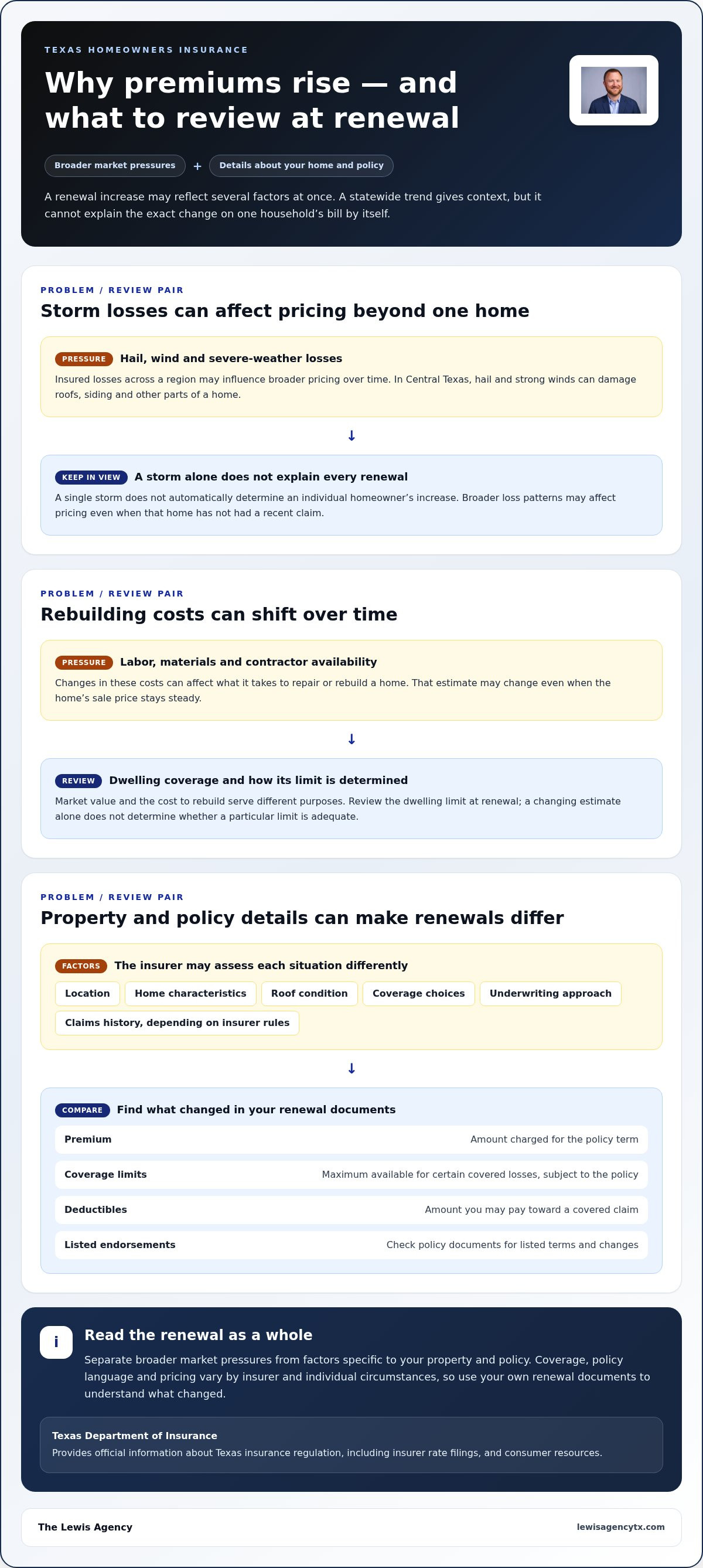
A higher renewal bill can be unsettling, especially when the notice doesn’t explain what changed. A premium increase means the amount charged for your policy term is higher than it was for the previous term. It doesn’t necessarily mean your home changed or that you filed a claim. So, why do Texas insurance rates keep increasing? Several pressures can contribute at once, and no single statewide trend explains every household’s renewal.
Insurers set prices based on expected insured losses, the cost of repairing or rebuilding homes, property risks, and rating practices under state oversight. When repair costs rise, a covered loss may cost more to address. When an insurer expects greater losses across an area or group of policies, that broader experience may also influence pricing. The Texas Department of Insurance (TDI) provides official information about insurance regulation in Texas, including insurer rate filings.
Texas premiums can rise when loss expectations, rebuilding costs, and property-level risk shift at the same time. A statewide trend can provide context for a renewal, but it can’t explain the exact amount on one household’s bill by itself.
What a homeowners insurance premium pays for
A premium is the amount you pay for insurance over the policy term. It’s separate from the deductible, which is the amount you may have to pay toward a covered claim, and from coverage limits, which describe the maximum amount available for certain covered losses under the policy. Your out-of-pocket expenses can depend on the loss, policy terms, exclusions, and applicable deductible. Policy language and structure vary by insurer, so use your own documents rather than assuming every policy handles these items the same way.
Why one Texas homeowner may see a different increase
Location, home characteristics, selected coverage, and an insurer’s underwriting approach may all affect pricing. A statewide rate trend doesn’t mean every homeowner’s renewal will change by the same amount. Insurers may assess property details differently, and coverage choices can also affect the premium. An insurer may consider a home’s claims history, depending on its rules and the policy.
Consider a hypothetical comparison: two homes in Central Texas are in the same general area, but one has a newer roof while the other has an older roof. The homeowners have also chosen different coverage. Those details could contribute to different pricing or renewal outcomes, depending on the insurer’s rules. This is an illustration, not a prediction about how a specific company will rate either home.
When a renewal arrives, separate what may be happening across the market from what may relate to your property or policy. Higher repair costs or expected losses may affect pricing beyond one household. Location, home condition, coverage selections, and underwriting are more specific to your situation. Start with the renewal documents to identify which figures or terms changed.
How Severe Weather and Rebuilding Costs Put Pressure on Texas Premiums
Storm damage can affect insurance costs beyond the home that was hit. When hail, wind, or other severe weather leads to insured losses across a region, insurers may account for those broader loss patterns when setting prices over time. That doesn’t mean one storm automatically determines a particular homeowner’s renewal. Pricing reflects multiple factors, and each insurer assesses risk under its own rating practices.
In parts of Central Texas, hail and strong winds are practical concerns for homeowners, especially when storms damage roofs, siding, or other parts of a house. Local exposure isn’t a prediction that a specific home will have a loss. The Texas Department of Insurance official website offers Texas insurance information and consumer resources homeowners can use to understand the broader market.
Hail, wind, and other weather-related losses
Weather losses can add up across many properties, even though each home’s experience is different. An insurer may consider patterns in covered claims and the cost of paying them as part of its broader pricing decisions. That’s one reason a homeowner’s premium may be affected by market conditions even without a recent claim on that property.
Insured storm losses can put broader pressure on premiums, while higher rebuilding expenses can raise the cost of repairing or replacing damaged homes. These overlapping pressures help explain why Texas insurance rates keep increasing, though they don’t mean every policyholder faces the same risk or premium change.
Why rebuilding-cost changes matter
Repair and rebuilding costs can change as labor, materials, and contractor availability shift. The amount needed to rebuild a home may therefore change even if its sale price stays steady. A home’s market value includes factors such as land and location. Dwelling coverage is intended to address the home’s insured structure, subject to the policy’s terms and limits. These figures serve different purposes.
For example, a Central Texas homeowner could see local home values remain relatively stable while the estimated cost of replacing building materials and labor rises. That doesn’t automatically mean a specific coverage limit is adequate or inadequate. It does make the dwelling limit and how it’s determined useful items to review at renewal.
Roof damage is one area where the distinction between rebuilding terms can matter. Policies may treat roof losses differently depending on whether settlement is based on replacement cost or actual cash value, as well as on the policy and circumstances. Understanding those terms can help you assess what a roof claim might mean for your out-of-pocket costs. You can review your homeowners coverage with those questions in mind before making changes.
Weather losses and rebuilding expenses are related pressures, but neither explains every renewal on its own. Your location, property details, and policy terms still matter. Keep those differences in view when considering how broader market forces may relate to your coverage.
Which Rate Pressures Are Shared Across Texas, and Which Are Property-Specific?
A renewal reflects more than one kind of risk. Some pressures may affect an insurer’s broader pool of policies, while others relate to a particular home or the coverage selected for it. Separating those categories can make a renewal easier to understand. It also helps answer the question, “why do texas insurance rates keep increasing?” without assuming every homeowner is affected in the same way.
| Shared market pressures | Property-level considerations |
|---|---|
| Insured catastrophe losses across a wider area | Location and characteristics of the home |
| Changes in repair and rebuilding expenses | Roof condition or age and other property details |
| Possible insurer expenses, including reinsurance and operating costs | Coverage selections, policy terms, and claims history |
Broader forces that can affect many policyholders
Weather-related claims and changes in repair costs can influence insurers’ overall expenses. Reinsurance, which is insurance purchased by insurers to help manage large losses, may also be part of an insurer’s broader cost picture. Operating expenses are another possible business consideration. These factors don’t establish how much of a particular premium change came from any one source, and a statewide pattern doesn’t mean all policyholders receive identical renewals.
The Texas Department of Insurance provides official information about insurance in Texas, including consumer guidance and rate-related resources. State-level information can help put market developments in context, but it won’t explain every detail of an individual policy’s price.
Property and policy details that can affect an individual renewal
An insurer may consider a home’s location, roof condition or age, construction characteristics, selected coverage, and claims history. Which factors apply, and how they affect a premium, depends on that insurer’s rating and underwriting rules and the policy involved. A factor that matters for one home or insurer may be treated differently for another.
For example, two hypothetical homes in the same Central Texas community could differ in roof condition, building features, or the coverage choices their owners made. Their renewals could therefore differ, even though both households face some of the same wider market pressures. This illustrates why a statewide rate trend can’t predict an individual homeowner’s renewal.
Use the table as a guide, not a rating formula. It can help you sort questions into two groups: what may reflect broader insurance-market conditions, and what may be specific to your home or policy. Compare your renewal documents with your current policy. Look for changes in the premium, coverage selections, and other listed details before deciding what questions to raise. A change in one figure doesn’t, on its own, identify the reason for the full increase.
What to Review When Your Texas Home Insurance Premium Goes Up
A higher renewal premium can be frustrating, but you don’t have to make a quick coverage decision to understand it. Compare your renewal documents with your current policy, note what changed, and ask focused questions about the differences. If you’re wondering why Texas insurance rates keep increasing, this review can help separate a change in your premium from a change in coverage.
Compare the renewal with your current policy
Use the declarations page as a starting point. Depending on the insurer and policy, it lists key details such as your premium, coverage limits, deductibles, and endorsements. Compare the current version with the renewal, looking for changed amounts or listed terms. The declarations page is a snapshot, not a replacement for the full policy wording, which explains conditions, exclusions, and how coverage applies.
Check one item at a time. Did the dwelling limit change? Is a deductible different? Was an endorsement added, removed, or revised? If something looks unfamiliar, mark it for follow-up rather than guessing what it means. Keep the documents side by side so you can point to the exact figure or wording when asking about the change.
Compare policy terms, not just the total premium. A lower price doesn’t necessarily mean the coverage is the same. A change to a limit, deductible, or endorsement could affect what you pay or what the policy may cover after a loss. The effect depends on the policy language and circumstances.
Ask questions before changing coverage
Once you’ve identified the differences, ask your agent specific questions. For example, ask which policy terms changed, how a deductible applies to a covered loss, or what an endorsement does. If a term is unclear, ask for an explanation in plain language. Focused questions are more useful than trying to infer the reason from the premium alone.
Before changing a limit or deductible, consider how that change could affect your finances after a loss. A different deductible may shift more or less of a covered loss to you, depending on its terms. A lower limit could also change the amount available for a covered loss. Don’t treat a lower renewal price as a like-for-like option until you understand what changed.
Write down your questions and keep the answers with your policy documents. The Lewis Agency can help explain homeowners policy language and renewal details. The goal is to understand the coverage and the change, not to assume that a review will produce a particular rate. See the agency’s policy information.
How Central Texas Homeowners Can Make Sense of the Next Renewal
A renewal makes more sense when you compare it with the policy you already have. Statewide pressures, such as weather-related losses and higher repair expenses, may affect the broader market. Other considerations may be tied to your home, its location, its claims history, or the coverage you selected. These forces can overlap, but your own policy is the starting point for understanding how they relate to your renewal.
That’s a practical way to approach the question, “why do texas insurance rates keep increasing?” Market trends provide context, but they don’t explain every detail of an individual premium. Comparing documents and asking about unfamiliar changes can help you make decisions deliberately rather than reacting to the total alone.
Build a practical annual policy-review habit
Set aside time to review your coverage when the renewal arrives, and revisit it after a major home improvement or household change. An addition or significant renovation, for example, may change what you want to ask about your home’s insured value. A change in who lives in the home or how it’s used may also be a reason to review relevant policy details.
Keep the current policy, declarations page, endorsements, and renewal notice together. Having those documents in one place makes it easier to compare terms from one policy period to the next and see what questions remain. Don’t rely on memory alone. A written comparison can help distinguish changed figures from terms that stayed the same.
Review your deductibles and limits before a loss occurs. Make sure you understand what the deductible means for your share of a covered loss and what the stated limits apply to under your policy. Details vary by insurer and policy, so read the wording that applies to your coverage rather than assuming it matches someone else’s.
Get help understanding your policy
Insurance language can be difficult to interpret on your own. An agent can help explain policy terms, answer coverage questions, and clarify what appears in the policy documents. That guidance can make it easier to understand your options, but it doesn’t control the insurer’s rates, underwriting, renewal decisions, or claim outcomes.
Understanding the forces behind rising premiums is useful, but a broad explanation can’t replace a careful look at your own documents. Write down anything you don’t understand, such as a change to an endorsement or a term that affects how a deductible applies. Then you can ask clear questions and consider coverage changes with a better sense of what they mean.
For homeowners in Austin and across Central Texas, including Leander, Cedar Park, Georgetown, Round Rock, and Liberty Hill, a careful policy review can put renewal questions in context. The Lewis Agency is an Allstate agency that helps homeowners understand their coverage and policy language.
Make Your Next Renewal a More Informed One
A renewal can be a useful moment to check whether your policy still reflects your home and your priorities. Keep notes about renovations or household changes, and bring unclear terms into the conversation before making adjustments. That way, decisions can start with what matters for your own situation, not just the amount due.
If you’re still asking, “why do texas insurance rates keep increasing,” remember that a general explanation can’t answer every question about your specific policy. The next step is to understand the wording and choices in front of you. Chris Lewis has more than 25 years of insurance experience and helps Austin and Central Texas homeowners understand their coverage.
For help understanding policy language or reviewing your homeowners coverage, talk with The Lewis Agency. A clear conversation can help you understand what your policy says before you need to rely on it.
Frequently Asked Questions
Are Texas homeowners insurance rates rising faster than rates in other states?
Not necessarily in every comparison. Whether Texas rates are rising faster depends on the time period, type of policy, and how each comparison measures premiums. A fair comparison needs to look at similar coverage and dates across states. Statewide averages also don’t tell you what will happen at one address. For your own renewal, compare the same policy details across terms rather than relying on a national ranking alone.
Can a roof replacement lower my Texas homeowners insurance premium?
It may affect the premium, but a lower price isn’t guaranteed. An insurer may consider the roof’s age, materials, condition, and other details under its own rating rules. Replacing a worn roof could change how the property is assessed, but the renewal price may also reflect other factors. Before deciding on a project for insurance reasons, ask how your policy treats roof details and what documentation may be useful.
Does filing a homeowners insurance claim make my Texas rates go up?
Not automatically in every case. An insurer may consider claims history when assessing a policy, but whether a claim affects a future premium depends on the insurer, the claim, and other circumstances. A claim also doesn’t guarantee a particular payment or rate change. Before deciding whether to file, review your policy and consider the damage, deductible, and possible claim outcome. Your agent can explain policy terms and help clarify the claims process.
Do Texas property taxes affect homeowners insurance rates?
Property taxes generally aren’t part of the homeowners insurance premium. They’re separate expenses, even though both may appear in a mortgage escrow payment. If your monthly escrow amount rises, check the escrow statement to see whether the change comes from taxes, insurance, or both. A tax assessment change doesn’t, by itself, show that your insurance premium changed. Compare the insurer’s renewal documents to identify the premium amount.
Why can two similar homes in the same Central Texas neighborhood have different premiums?
Homes that look alike from the street may have different policy details or risk characteristics. One homeowner may have selected different limits or endorsements, while the homes may differ in construction, roof condition, or claims history. Insurers also apply their own rating and underwriting rules. In Austin, Leander, Cedar Park, Georgetown, Round Rock, or Liberty Hill, sharing a neighborhood doesn’t mean two policies are identical.
Can I lower my premium by choosing a higher deductible?
A higher deductible may reduce a premium in some cases, but the effect depends on the insurer and policy. It also means you could be responsible for more of a covered loss before insurance applies. Before changing it, consider whether you could manage that added expense after a storm or other covered damage. Compare the premium change with the revised deductible and review how the deductible applies to different types of losses in your policy.

Article by
Chris Lewis
Chris Lewis is the owner of The Lewis Agency, an Allstate insurance agency serving Austin and Central Texas. With more than 25 years of insurance experience, Chris focuses on helping Central Texas homeowners better understand their insurance coverage, including deductibles, roofs and hail, severe weather risks, water damage and other important coverage considerations. He created LewisAgencyTX.com to provide practical homeowners insurance education and help homeowners better understand their coverage before they need it.

Dwelling Coverage Homeowners Insurance Texas: Complete Policy Guide (2026)
Learn how dwelling coverage homeowners insurance Texas policies protect your home. Understand rebuild costs, hail deductibles, and policy limits with confide...

One of the most important numbers on a Texas homeowners insurance policy is the dwelling coverage limit—but it's also one of the easiest to misunderstand. Your home's insured value isn't necessarily the same as its market value, tax appraisal or purchase price.
In reality, market values and physical construction expenses are entirely different calculations. You don't want to pay high premiums for bloated protection, but you also cannot afford an unexpected shortfall when severe hailstorms strike. In this guide, you'll learn how Coverage A protects your home's structure, why rebuild expenses differ from market valuations, and how to establish accurate policy limits. We'll examine how replacement cost mechanics work, unpack percentage-based hail deductibles, and help you evaluate your coverage options with total confidence.
Key Takeaways
- Learn how dwelling coverage homeowners insurance Texas policies provide essential structural protection for your foundation, framing, and roof system after covered losses.
- Discover why real estate market value and property tax appraisals differ significantly from the actual labor and material costs required to reconstruct your home.
- Understand the vital financial distinctions between replacement cost settlements and actual cash value claim payouts, particularly for aging roof systems.
- Find out how evolving municipal building codes across Central Texas impact your repair requirements and why regular limit reviews prevent costly out-of-pocket shortfalls.
What Is Dwelling Coverage in Texas Homeowners Insurance?
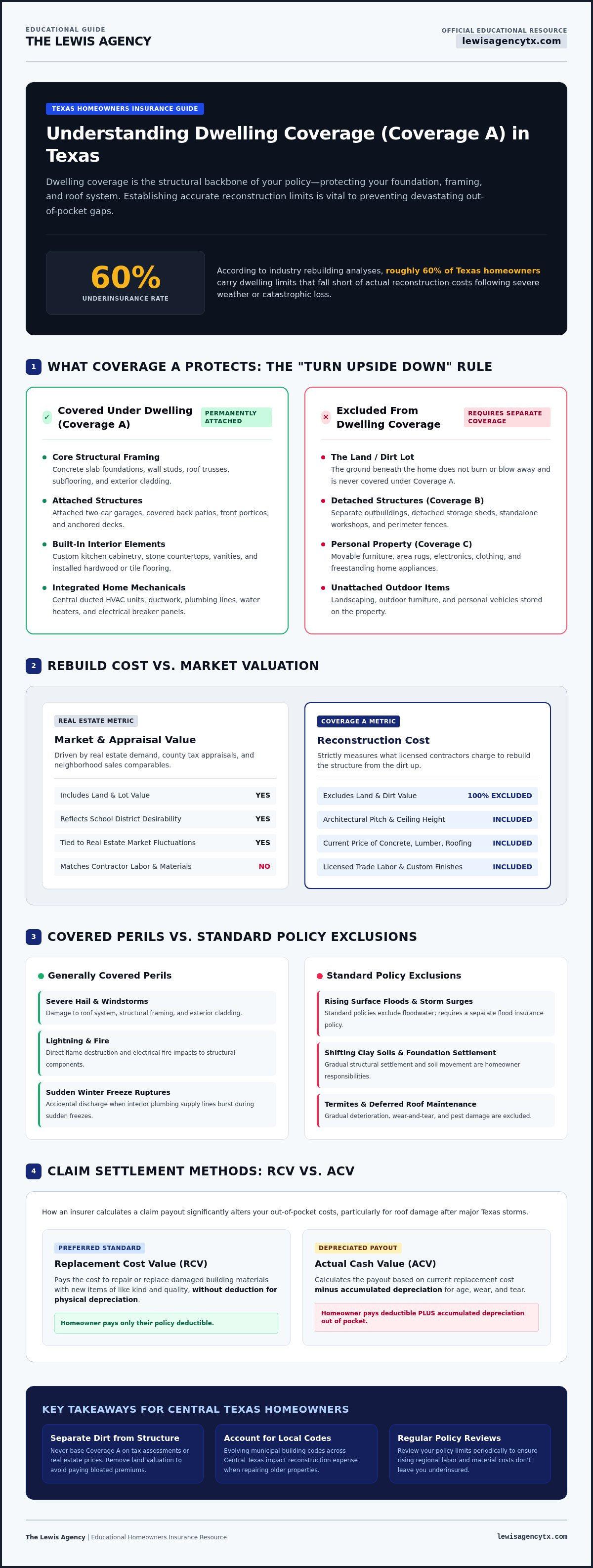
Dwelling coverage, officially designated as Coverage A, forms the structural backbone of your policy. It pays to repair or rebuild the physical structure of your primary residence if damaged or destroyed by a covered loss. Rather than protecting the land beneath your feet or the furniture inside your rooms, this specific coverage focuses entirely on the bricks, mortar, and framing that keep a roof over your head.
In standard homeowners insurance policies, the dwelling limit serves as the baseline for the rest of your protection. The dollar amount you select for Coverage A directly dictates the formulaic limits available for other structures, personal property, and temporary living expenses. That makes setting an accurate limit for your dwelling coverage homeowners insurance Texas policy one of the most critical decisions you will make as a homeowner.
What Dwelling Coverage Protects Inside and Outside
Coverage A extends beyond the exterior siding to include permanently installed fixtures that make the house functional. If you could turn the house upside down, anything that stays attached typically falls under dwelling protection:
- Core structural framing: Concrete slab foundations, wall studs, roof trusses, subflooring, and exterior cladding.
- Attached structures: Attached two-car garages, covered back patios, front porticos, and permanently anchored decks.
- Built-in interior elements: Custom kitchen cabinetry, stone countertops, vanities, and installed hardwood or tile flooring.
- Integrated home mechanicals: Central ducted HVAC units, ductwork, plumbing lines, water heaters, and electrical breaker panels.
Items not permanently joined to the structure fall outside this protection. Separate outbuildings like detached storage sheds, standalone workshops, and perimeter fences require separate other structures coverage, while furniture and rugs belong to personal property.
Common Covered Perils vs. Standard Policy Exclusions
Texas weather presents substantial hazards to residential framing and roofs. Understanding how your dwelling coverage homeowners insurance Texas policy responds to sudden regional weather events ensures you know where policy boundaries lie.
Most standard policies cover perils like lightning, fire, high winds, and severe hail damage. They also generally cover sudden, accidental water discharge, such as an interior supply line that ruptures during an unexpected winter freeze. However, standard policies carry strict exclusions. Rising surface floodwaters, river overflows, and storm surges are excluded, requiring separate flood insurance policies. Similarly, gradual structural issues, such as foundation cracks caused by shifting clay soils, termite damage, or deferred roof maintenance, remain the homeowner's responsibility.
Dwelling Rebuild Value vs. Market Value in Texas
One common mistake homeowners make is assuming market value equals reconstruction cost. When your county appraisal district sends its annual property valuation, that total reflects buyer demand, school district boundaries, and neighborhood appeal. Your policy's Coverage A limit, however, exists strictly to purchase physical materials and hire licensed trades to reconstruct your home from the dirt up. As highlighted in the Texas Department of Insurance Home insurance guide, your structural limits need to reflect true replacement expense rather than real estate transactions or outstanding mortgage balances.
Why Real Estate Market Valuations Mislead Homeowners
Real estate appraisals bundle the value of your physical home together with the raw land it occupies. When a total catastrophe strikes, the lot beneath your home does not burn away. Factoring land value into your dwelling limits results in purchasing unnecessary coverage and paying inflated premiums for dirt that cannot be destroyed. Conversely, if local property sales cool down, the price of concrete, roofing, and skilled trade labor does not suddenly drop alongside home prices.
Key Factors Driving Texas Reconstruction Expenses
Calculating accurate replacement limits requires looking directly at physical construction variables rather than neighborhood sales comparables. Several regional elements determine what contractors charge to restore a damaged property:
- Architectural complexity: Steep roof pitches, custom masonry, high ceilings, and non-standard floor plans require specialized installation labor.
- Interior finish tiers: Rebuilding basic builder-grade trim involves different material expenses than replicating custom hardwood cabinetry, imported tile, and solid stone surfaces.
- Suburban trade demand: Fast-growing Central Texas communities like Leander, Liberty Hill, and Pflugerville experience high competition for subcontracting crews, which directly affects local labor rates.
- Demolition and debris haul-away: Before a builder pours fresh concrete, heavy equipment must break down damaged structures, clear hazardous rubble, and haul away debris to designated landfills.
If you aren't sure whether your current policy accounts for these regional construction realities, sitting down with The Lewis Agency can help you evaluate your property's specific characteristics and verify your numbers against local building trends.
Replacement Cost vs. Actual Cash Value on Texas Homes
Setting an accurate limit is only half the equation; the claim settlement method written into your contract determines how disbursements are calculated after a loss. When damage occurs, insurance carriers settle structural claims under either Actual Cash Value (ACV) or Replacement Cost Value (RCV). Knowing which provision applies to your structure protects your household from unexpected out-of-pocket bills.
Industry guidance on calculating your home's replacement cost emphasizes meeting your insurer's coinsurance requirements. According to the Texas Department of Insurance, most insurers require homeowners to maintain coverage equal to at least 80% of the home's total replacement cost. Falling short of this threshold can trigger coinsurance penalties, meaning the carrier reduces claim payouts on partial losses proportionally, leaving you responsible for the remaining balance.
Comparing Actual Cash Value and Replacement Cost
Actual cash value subtracts physical depreciation, factoring in the age and prior condition of your building materials before issuing payment. If an older roof sustains severe damage under an ACV provision, the insurer subtracts years of normal wear, paying only its current value. Replacement cost coverage pays to rebuild or replace damaged property with new materials of like kind and quality, without deductions for deterioration. Because of this added financial security, mortgage lenders routinely require replacement cost coverage on residential loans.
Extended Replacement Cost and Inflation Guard Endorsements
Severe storm outbreaks frequently generate localized shortages of building materials and trade labor. When widespread hail damages hundreds of homes in a single community, local construction costs can surge overnight, occasionally exceeding initial estimates.
Adding an extended replacement cost endorsement gives your dwelling coverage homeowners insurance Texas policy an extra safety buffer. Depending on policy terms, this endorsement provides an additional percentage of structural coverage above your stated Coverage A limit if localized demand drives up reconstruction expenses. Pairing this buffer with an inflation guard endorsement helps ensure your base limits steadily adjust over time, preserving your financial protection against ongoing price increases.
Tailoring Dwelling Coverage to Texas Perils and Local Codes
Every region presents its own set of environmental threats, but the Lone Star State is notorious for volatile weather patterns. From severe straight-line winds and tornadoes to spring hail swarms and bitter winter freezes, your home's structural framing and roof endure extraordinary strain. Structuring your dwelling coverage homeowners insurance Texas policy requires tailoring your protections to these specific regional realities rather than settling for a generic policy template.
Managing Hail Risks and Percentage Deductibles
Severe convective storms, hail, and high winds generate over 60% of all Texas homeowners insurance losses. Because hail risk is so high across the state, Texas insurers commonly write separate wind and hail deductibles structured as a percentage rather than a flat dollar amount. Crucially, this percentage applies directly to your Coverage A dwelling limit, not the total amount of storm damage.
For example, if your dwelling limit sits at $400,000 and your policy includes a 2% wind and hail deductible, your out-of-pocket obligation is $8,000 before insurance proceeds cover a single dollar of roof repairs. Under Texas Business & Commerce Code § 27.02, it is illegal for roofing contractors to absorb, rebate, or waive this deductible, meaning policyholders must pay this amount themselves. Keeping your baseline dwelling limit accurate prevents your percentage deductible from inflating unnecessarily while still ensuring adequate reconstruction funds.
The Role of Ordinance or Law Coverage in Growing Communities
Standard home policies agree to rebuild damaged structures back to their original specifications. However, fast-growing municipalities across Travis and Williamson counties regularly update local building standards. Cities like Cedar Park, Buda, and Round Rock frequently adopt newer revisions of the International Residential Code (IRC) along with stricter energy conservation mandates.
If extensive repairs require upgraded electrical panels, modified roof decking fasteners, or modern plumbing pipe configurations, standard policies typically provide little or no funding for those mandatory improvements. Adding an Ordinance or Law endorsement bridges this financial gap, providing dedicated funds to cover the code-mandated upgrades required by municipal inspectors during reconstruction.
Taking time to review your policy details can save your family thousands of dollars after a storm. If you want a clear, personalized assessment of your structural limits and roof deductibles, contact The Lewis Agency to walk through your current homeowners coverage.
How to Review and Adjust Your Texas Dwelling Coverage Limits
Homes evolve over time, and regional construction expenses shift alongside them. Leaving a policy on autopilot for years creates a dangerous gap between your coverage limits and actual local building expenses. Maintaining the right dwelling coverage homeowners insurance Texas policy requires ongoing attention rather than a one-time estimate. Instead of relying on rough square-footage guesses, accurate structural evaluations utilize comprehensive replacement cost estimators that account for your home's unique layout, foundation, and interior craftsmanship.
Triggers That Require Adjusting Your Coverage A Limits
Everyday improvements and market shifts alter your replacement needs. You should reach out to adjust your Coverage A baseline whenever you experience one of these key milestones:
- Interior remodeling: Upgrading to custom solid wood cabinetry, luxury bathroom fixtures, or high-end stone countertops increases the physical cost required to restore damaged rooms.
- Added square footage: Finishing a bonus room over your garage, enclosing a back patio, or constructing an attached guest suite expands your total rebuild footprint.
- Mechanical installations: Adding permanent infrastructure like whole-home standby generators, multi-stage HVAC systems, or built-in water filtration systems adds substantial replacement value.
- Regional cost shifts: General changes in subcontractor availability and supply chain pricing across Williamson and Travis counties can quietly leave older policy limits behind.
Working with The Lewis Agency on Your Coverage
Having experienced local guidance makes evaluating structural protection straightforward and stress-free. As a dedicated Allstate agency serving Central Texas communities like Austin, Round Rock, Cedar Park, Leander, and Pflugerville, The Lewis Agency understands how regional weather exposures and municipal building standards affect your home.
Agent Chris Lewis takes the time to sit down with you, examine your home's specific building features, and ensure your structural limits and deductibles work together effectively. When you want clear answers and personalized attention, schedule a consultation with The Lewis Agency to review your Texas homeowners policy and ensure your coverage matches your family's needs.
Protect Your Central Texas Home with the Right Structural Limits
Securing adequate dwelling coverage homeowners insurance Texas policies offer isn't about matching your neighbor's policy or relying on county tax appraisals. It's about making sure your Coverage A limit realistically reflects the current materials, specialized labor, and building codes required to restore your home after an unexpected catastrophe. Balancing replacement cost provisions with manageable percentage deductibles ensures you aren't caught off guard when severe weather rolls across the state.
You don't have to decipher these complex structural details by yourself. As a dedicated local Allstate agency serving Austin, Round Rock, Cedar Park, Leander, and Pflugerville, The Lewis Agency provides personalized coverage reviews tailored to regional construction trends. Agent Chris Lewis brings experienced, neighborly guidance to every conversation, helping you evaluate your property's specific rebuild requirements with total clarity.
Take the uncertainty out of your homeowners policy. Review your Texas homeowners coverage with The Lewis Agency today, and enjoy the lasting confidence that comes from knowing your home is thoroughly protected.
Frequently Asked Questions
How do I know if my Texas dwelling coverage limit is high enough?
Your limit is high enough if it matches a professional replacement cost calculation rather than your home's purchase price. A detailed replacement cost estimate examines your square footage, roof pitch, custom finishes, and local trade wages across Central Texas cities like Round Rock and Leander. Annual reviews ensure your dwelling coverage homeowners insurance Texas policy limit keeps pace with shifts in material costs and regional building expenses.
Is dwelling coverage based on the county property tax appraisal value in Texas?
No, dwelling coverage is never based on county property tax appraisal numbers. County appraisals evaluate the market value of your property, which includes both the physical house and the underlying parcel of land. Rebuild insurance strictly covers the labor, equipment, and building materials needed to reconstruct the structural dwelling. Because your land doesn't disappear during a loss, tying your policy limit to tax records results in inaccurate coverage.
What happens if my home costs more to rebuild than my dwelling coverage limit?
If rebuild expenses exceed your limit, you must pay the remaining balance out of pocket. Standard policies pay claims only up to the stated Coverage A limit on your declarations page. However, adding an extended replacement cost endorsement provides an additional percentage buffer above your base limit if localized disasters cause sudden surges in labor and lumber costs. Reviewing your policy prevents catastrophic out-of-pocket shortfalls during major community rebuilding phases.
Does dwelling insurance cover roof damage caused by severe Texas hailstorms?
Yes, standard policies generally cover hail damage to roofs, but specific settlement terms depend on your policy language. Hail is typically a covered peril, but your claim payout depends on whether your policy pays replacement cost or actual cash value based on roof age. Texas policies also apply separate wind and hail deductibles, which require an out-of-pocket percentage payment based on your total dwelling limit before claim funds are released.
Can I lower my dwelling coverage to reduce my homeowners insurance premium?
You shouldn't artificially lower your Coverage A limit simply to reduce your premium. Insurers generally require coverage equal to at least 80% of replacement costs to avoid coinsurance penalties on partial claims. Dropping your structural limit below true rebuild expenses exposes your family to major out-of-pocket liabilities. Instead of cutting essential dwelling protection, explore adjusting your policy deductibles or reviewing eligible policy credits with your local agent.
Does dwelling insurance cover foundation damage caused by shifting Texas soil?
Standard policies exclude foundation damage caused by normal soil expansion, contraction, or settling. The expansive clay soils common across Austin, Pflugerville, and Williamson County frequently cause ground movement, but standard Texas home policies treat this as gradual wear. However, if foundation cracking results directly from an accidental, sudden plumbing freeze or interior pipe rupture, limited coverage may apply depending on your specific policy endorsements and water damage riders.
What is the difference between dwelling coverage and other structures coverage?
Dwelling coverage protects your primary residence and permanently attached features, while other structures coverage protects unattached outbuildings. Your dwelling limit pays for repairs to your house, roof, foundation, and attached garage. Other structures coverage, known as Coverage B, specifically covers separate physical assets on your property grounds, such as detached storage sheds, standalone workshops, gazebos, and perimeter fencing, typically set as a default percentage of your dwelling limit.
Article by
Chris Lewis
Chris Lewis is the owner of The Lewis Agency, an Allstate insurance agency serving Austin and Central Texas. With more than 25 years of insurance experience, Chris focuses on helping Central Texas homeowners better understand their insurance coverage, including deductibles, roofs and hail, severe weather risks, water damage and other important coverage considerations. He created LewisAgencyTX.com to provide practical homeowners insurance education and help homeowners better understand their coverage before they need it.