
What if your renewal increase has less to do with one change to your home and more to do with several costs rising at once? You may be asking, why do Texas insurance rates keep increasing? A higher premium can feel abrupt, especially when the renewal notice doesn’t show how broader market pressures and details about your home fit together.
There isn’t one cause behind every increase. Severe weather losses, higher costs to repair or rebuild homes, and other pressures on insurers can all play a role. Your location, roof condition, coverage choices, and policy details may also affect your rate, so two homes in Central Texas can have different renewal changes. Cutting coverage isn’t the only step to consider. A rushed change could leave you unsure about what your policy covers.
This guide explains the main forces behind rising Texas homeowners insurance premiums, why rates vary between households, and what to review before making a change. Chris Lewis has more than 25 years of insurance experience and helps Central Texas homeowners understand their coverage and policy questions.
Key Takeaways
- Why do Texas insurance rates keep increasing? Several pressures can contribute, including weather losses, repair costs, and insurer rating practices.
- Separate broader market pressures from details specific to your home, such as its location, roof, and selected coverage.
- Hail and wind can affect Central Texas insurance costs, but a single storm doesn’t automatically explain an individual renewal increase.
- Compare your renewal documents and review the premium, coverage limits, deductibles, and listed endorsements to spot what changed.
- Understand your policy before making coverage changes. Rates and coverage vary by insurer, policy, and individual circumstances.
Why Texas Homeowners Insurance Rates Keep Increasing
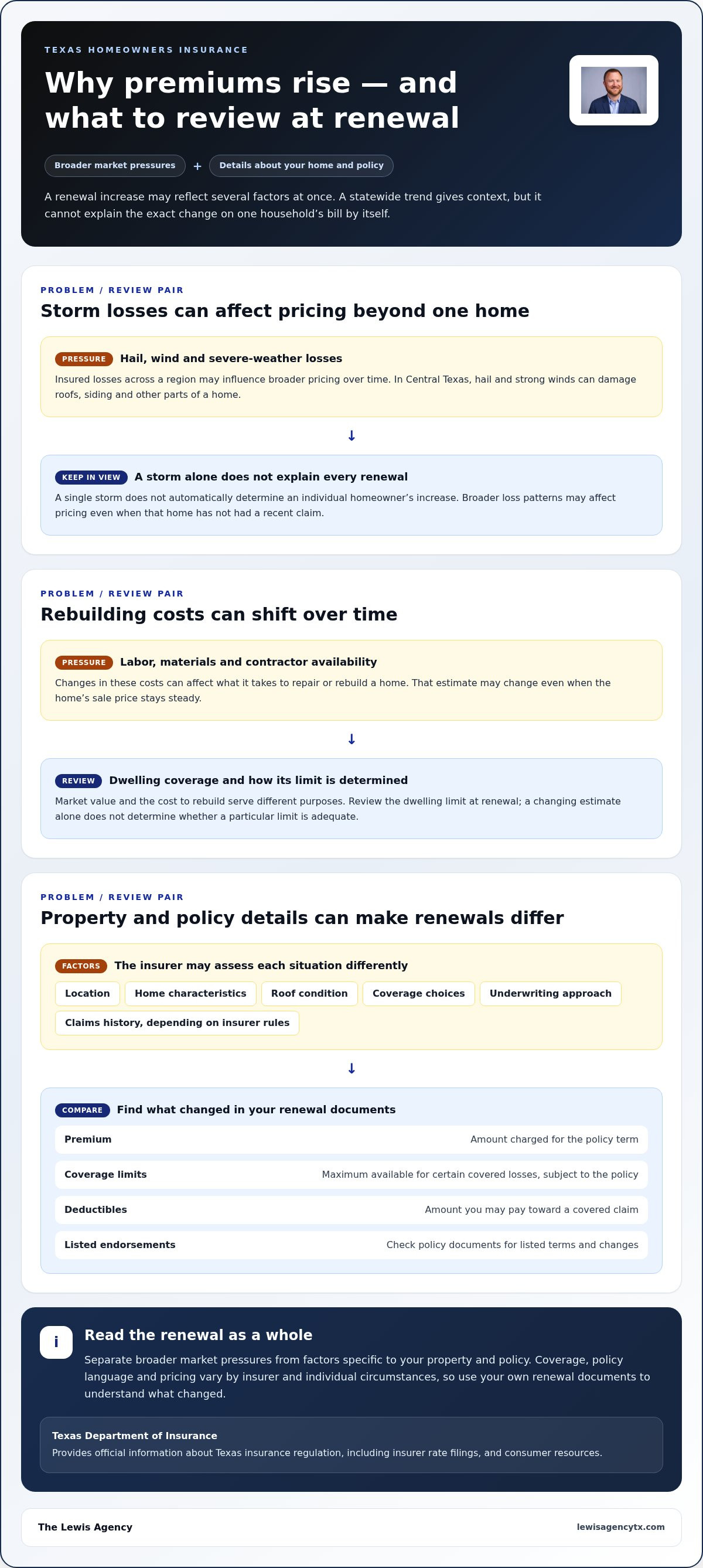
A higher renewal bill can be unsettling, especially when the notice doesn’t explain what changed. A premium increase means the amount charged for your policy term is higher than it was for the previous term. It doesn’t necessarily mean your home changed or that you filed a claim. So, why do Texas insurance rates keep increasing? Several pressures can contribute at once, and no single statewide trend explains every household’s renewal.
Insurers set prices based on expected insured losses, the cost of repairing or rebuilding homes, property risks, and rating practices under state oversight. When repair costs rise, a covered loss may cost more to address. When an insurer expects greater losses across an area or group of policies, that broader experience may also influence pricing. The Texas Department of Insurance (TDI) provides official information about insurance regulation in Texas, including insurer rate filings.
Texas premiums can rise when loss expectations, rebuilding costs, and property-level risk shift at the same time. A statewide trend can provide context for a renewal, but it can’t explain the exact amount on one household’s bill by itself.
What a homeowners insurance premium pays for
A premium is the amount you pay for insurance over the policy term. It’s separate from the deductible, which is the amount you may have to pay toward a covered claim, and from coverage limits, which describe the maximum amount available for certain covered losses under the policy. Your out-of-pocket expenses can depend on the loss, policy terms, exclusions, and applicable deductible. Policy language and structure vary by insurer, so use your own documents rather than assuming every policy handles these items the same way.
Why one Texas homeowner may see a different increase
Location, home characteristics, selected coverage, and an insurer’s underwriting approach may all affect pricing. A statewide rate trend doesn’t mean every homeowner’s renewal will change by the same amount. Insurers may assess property details differently, and coverage choices can also affect the premium. An insurer may consider a home’s claims history, depending on its rules and the policy.
Consider a hypothetical comparison: two homes in Central Texas are in the same general area, but one has a newer roof while the other has an older roof. The homeowners have also chosen different coverage. Those details could contribute to different pricing or renewal outcomes, depending on the insurer’s rules. This is an illustration, not a prediction about how a specific company will rate either home.
When a renewal arrives, separate what may be happening across the market from what may relate to your property or policy. Higher repair costs or expected losses may affect pricing beyond one household. Location, home condition, coverage selections, and underwriting are more specific to your situation. Start with the renewal documents to identify which figures or terms changed.
How Severe Weather and Rebuilding Costs Put Pressure on Texas Premiums
Storm damage can affect insurance costs beyond the home that was hit. When hail, wind, or other severe weather leads to insured losses across a region, insurers may account for those broader loss patterns when setting prices over time. That doesn’t mean one storm automatically determines a particular homeowner’s renewal. Pricing reflects multiple factors, and each insurer assesses risk under its own rating practices.
In parts of Central Texas, hail and strong winds are practical concerns for homeowners, especially when storms damage roofs, siding, or other parts of a house. Local exposure isn’t a prediction that a specific home will have a loss. The Texas Department of Insurance official website offers Texas insurance information and consumer resources homeowners can use to understand the broader market.
Hail, wind, and other weather-related losses
Weather losses can add up across many properties, even though each home’s experience is different. An insurer may consider patterns in covered claims and the cost of paying them as part of its broader pricing decisions. That’s one reason a homeowner’s premium may be affected by market conditions even without a recent claim on that property.
Insured storm losses can put broader pressure on premiums, while higher rebuilding expenses can raise the cost of repairing or replacing damaged homes. These overlapping pressures help explain why Texas insurance rates keep increasing, though they don’t mean every policyholder faces the same risk or premium change.
Why rebuilding-cost changes matter
Repair and rebuilding costs can change as labor, materials, and contractor availability shift. The amount needed to rebuild a home may therefore change even if its sale price stays steady. A home’s market value includes factors such as land and location. Dwelling coverage is intended to address the home’s insured structure, subject to the policy’s terms and limits. These figures serve different purposes.
For example, a Central Texas homeowner could see local home values remain relatively stable while the estimated cost of replacing building materials and labor rises. That doesn’t automatically mean a specific coverage limit is adequate or inadequate. It does make the dwelling limit and how it’s determined useful items to review at renewal.
Roof damage is one area where the distinction between rebuilding terms can matter. Policies may treat roof losses differently depending on whether settlement is based on replacement cost or actual cash value, as well as on the policy and circumstances. Understanding those terms can help you assess what a roof claim might mean for your out-of-pocket costs. You can review your homeowners coverage with those questions in mind before making changes.
Weather losses and rebuilding expenses are related pressures, but neither explains every renewal on its own. Your location, property details, and policy terms still matter. Keep those differences in view when considering how broader market forces may relate to your coverage.
Which Rate Pressures Are Shared Across Texas, and Which Are Property-Specific?
A renewal reflects more than one kind of risk. Some pressures may affect an insurer’s broader pool of policies, while others relate to a particular home or the coverage selected for it. Separating those categories can make a renewal easier to understand. It also helps answer the question, “why do texas insurance rates keep increasing?” without assuming every homeowner is affected in the same way.
| Shared market pressures | Property-level considerations |
|---|---|
| Insured catastrophe losses across a wider area | Location and characteristics of the home |
| Changes in repair and rebuilding expenses | Roof condition or age and other property details |
| Possible insurer expenses, including reinsurance and operating costs | Coverage selections, policy terms, and claims history |
Broader forces that can affect many policyholders
Weather-related claims and changes in repair costs can influence insurers’ overall expenses. Reinsurance, which is insurance purchased by insurers to help manage large losses, may also be part of an insurer’s broader cost picture. Operating expenses are another possible business consideration. These factors don’t establish how much of a particular premium change came from any one source, and a statewide pattern doesn’t mean all policyholders receive identical renewals.
The Texas Department of Insurance provides official information about insurance in Texas, including consumer guidance and rate-related resources. State-level information can help put market developments in context, but it won’t explain every detail of an individual policy’s price.
Property and policy details that can affect an individual renewal
An insurer may consider a home’s location, roof condition or age, construction characteristics, selected coverage, and claims history. Which factors apply, and how they affect a premium, depends on that insurer’s rating and underwriting rules and the policy involved. A factor that matters for one home or insurer may be treated differently for another.
For example, two hypothetical homes in the same Central Texas community could differ in roof condition, building features, or the coverage choices their owners made. Their renewals could therefore differ, even though both households face some of the same wider market pressures. This illustrates why a statewide rate trend can’t predict an individual homeowner’s renewal.
Use the table as a guide, not a rating formula. It can help you sort questions into two groups: what may reflect broader insurance-market conditions, and what may be specific to your home or policy. Compare your renewal documents with your current policy. Look for changes in the premium, coverage selections, and other listed details before deciding what questions to raise. A change in one figure doesn’t, on its own, identify the reason for the full increase.
What to Review When Your Texas Home Insurance Premium Goes Up
A higher renewal premium can be frustrating, but you don’t have to make a quick coverage decision to understand it. Compare your renewal documents with your current policy, note what changed, and ask focused questions about the differences. If you’re wondering why Texas insurance rates keep increasing, this review can help separate a change in your premium from a change in coverage.
Compare the renewal with your current policy
Use the declarations page as a starting point. Depending on the insurer and policy, it lists key details such as your premium, coverage limits, deductibles, and endorsements. Compare the current version with the renewal, looking for changed amounts or listed terms. The declarations page is a snapshot, not a replacement for the full policy wording, which explains conditions, exclusions, and how coverage applies.
Check one item at a time. Did the dwelling limit change? Is a deductible different? Was an endorsement added, removed, or revised? If something looks unfamiliar, mark it for follow-up rather than guessing what it means. Keep the documents side by side so you can point to the exact figure or wording when asking about the change.
Compare policy terms, not just the total premium. A lower price doesn’t necessarily mean the coverage is the same. A change to a limit, deductible, or endorsement could affect what you pay or what the policy may cover after a loss. The effect depends on the policy language and circumstances.
Ask questions before changing coverage
Once you’ve identified the differences, ask your agent specific questions. For example, ask which policy terms changed, how a deductible applies to a covered loss, or what an endorsement does. If a term is unclear, ask for an explanation in plain language. Focused questions are more useful than trying to infer the reason from the premium alone.
Before changing a limit or deductible, consider how that change could affect your finances after a loss. A different deductible may shift more or less of a covered loss to you, depending on its terms. A lower limit could also change the amount available for a covered loss. Don’t treat a lower renewal price as a like-for-like option until you understand what changed.
Write down your questions and keep the answers with your policy documents. The Lewis Agency can help explain homeowners policy language and renewal details. The goal is to understand the coverage and the change, not to assume that a review will produce a particular rate. See the agency’s policy information.
How Central Texas Homeowners Can Make Sense of the Next Renewal
A renewal makes more sense when you compare it with the policy you already have. Statewide pressures, such as weather-related losses and higher repair expenses, may affect the broader market. Other considerations may be tied to your home, its location, its claims history, or the coverage you selected. These forces can overlap, but your own policy is the starting point for understanding how they relate to your renewal.
That’s a practical way to approach the question, “why do texas insurance rates keep increasing?” Market trends provide context, but they don’t explain every detail of an individual premium. Comparing documents and asking about unfamiliar changes can help you make decisions deliberately rather than reacting to the total alone.
Build a practical annual policy-review habit
Set aside time to review your coverage when the renewal arrives, and revisit it after a major home improvement or household change. An addition or significant renovation, for example, may change what you want to ask about your home’s insured value. A change in who lives in the home or how it’s used may also be a reason to review relevant policy details.
Keep the current policy, declarations page, endorsements, and renewal notice together. Having those documents in one place makes it easier to compare terms from one policy period to the next and see what questions remain. Don’t rely on memory alone. A written comparison can help distinguish changed figures from terms that stayed the same.
Review your deductibles and limits before a loss occurs. Make sure you understand what the deductible means for your share of a covered loss and what the stated limits apply to under your policy. Details vary by insurer and policy, so read the wording that applies to your coverage rather than assuming it matches someone else’s.
Get help understanding your policy
Insurance language can be difficult to interpret on your own. An agent can help explain policy terms, answer coverage questions, and clarify what appears in the policy documents. That guidance can make it easier to understand your options, but it doesn’t control the insurer’s rates, underwriting, renewal decisions, or claim outcomes.
Understanding the forces behind rising premiums is useful, but a broad explanation can’t replace a careful look at your own documents. Write down anything you don’t understand, such as a change to an endorsement or a term that affects how a deductible applies. Then you can ask clear questions and consider coverage changes with a better sense of what they mean.
For homeowners in Austin and across Central Texas, including Leander, Cedar Park, Georgetown, Round Rock, and Liberty Hill, a careful policy review can put renewal questions in context. The Lewis Agency is an Allstate agency that helps homeowners understand their coverage and policy language.
Make Your Next Renewal a More Informed One
A renewal can be a useful moment to check whether your policy still reflects your home and your priorities. Keep notes about renovations or household changes, and bring unclear terms into the conversation before making adjustments. That way, decisions can start with what matters for your own situation, not just the amount due.
If you’re still asking, “why do texas insurance rates keep increasing,” remember that a general explanation can’t answer every question about your specific policy. The next step is to understand the wording and choices in front of you. Chris Lewis has more than 25 years of insurance experience and helps Austin and Central Texas homeowners understand their coverage.
For help understanding policy language or reviewing your homeowners coverage, talk with The Lewis Agency. A clear conversation can help you understand what your policy says before you need to rely on it.
Frequently Asked Questions
Are Texas homeowners insurance rates rising faster than rates in other states?
Not necessarily in every comparison. Whether Texas rates are rising faster depends on the time period, type of policy, and how each comparison measures premiums. A fair comparison needs to look at similar coverage and dates across states. Statewide averages also don’t tell you what will happen at one address. For your own renewal, compare the same policy details across terms rather than relying on a national ranking alone.
Can a roof replacement lower my Texas homeowners insurance premium?
It may affect the premium, but a lower price isn’t guaranteed. An insurer may consider the roof’s age, materials, condition, and other details under its own rating rules. Replacing a worn roof could change how the property is assessed, but the renewal price may also reflect other factors. Before deciding on a project for insurance reasons, ask how your policy treats roof details and what documentation may be useful.
Does filing a homeowners insurance claim make my Texas rates go up?
Not automatically in every case. An insurer may consider claims history when assessing a policy, but whether a claim affects a future premium depends on the insurer, the claim, and other circumstances. A claim also doesn’t guarantee a particular payment or rate change. Before deciding whether to file, review your policy and consider the damage, deductible, and possible claim outcome. Your agent can explain policy terms and help clarify the claims process.
Do Texas property taxes affect homeowners insurance rates?
Property taxes generally aren’t part of the homeowners insurance premium. They’re separate expenses, even though both may appear in a mortgage escrow payment. If your monthly escrow amount rises, check the escrow statement to see whether the change comes from taxes, insurance, or both. A tax assessment change doesn’t, by itself, show that your insurance premium changed. Compare the insurer’s renewal documents to identify the premium amount.
Why can two similar homes in the same Central Texas neighborhood have different premiums?
Homes that look alike from the street may have different policy details or risk characteristics. One homeowner may have selected different limits or endorsements, while the homes may differ in construction, roof condition, or claims history. Insurers also apply their own rating and underwriting rules. In Austin, Leander, Cedar Park, Georgetown, Round Rock, or Liberty Hill, sharing a neighborhood doesn’t mean two policies are identical.
Can I lower my premium by choosing a higher deductible?
A higher deductible may reduce a premium in some cases, but the effect depends on the insurer and policy. It also means you could be responsible for more of a covered loss before insurance applies. Before changing it, consider whether you could manage that added expense after a storm or other covered damage. Compare the premium change with the revised deductible and review how the deductible applies to different types of losses in your policy.

Article by
Chris Lewis
Chris Lewis is the owner of The Lewis Agency, an Allstate insurance agency serving Austin and Central Texas. With more than 25 years of insurance experience, Chris focuses on helping Central Texas homeowners better understand their insurance coverage, including deductibles, roofs and hail, severe weather risks, water damage and other important coverage considerations. He created LewisAgencyTX.com to provide practical homeowners insurance education and help homeowners better understand their coverage before they need it.