Slab Leak and Foundation Coverage in Cedar Park, TX: What Homeowners Should Know
Understand slab leak foundation coverage Cedar Park homeowners need to know. Learn how insurance may treat access work, pipe repairs, and foundation damage.
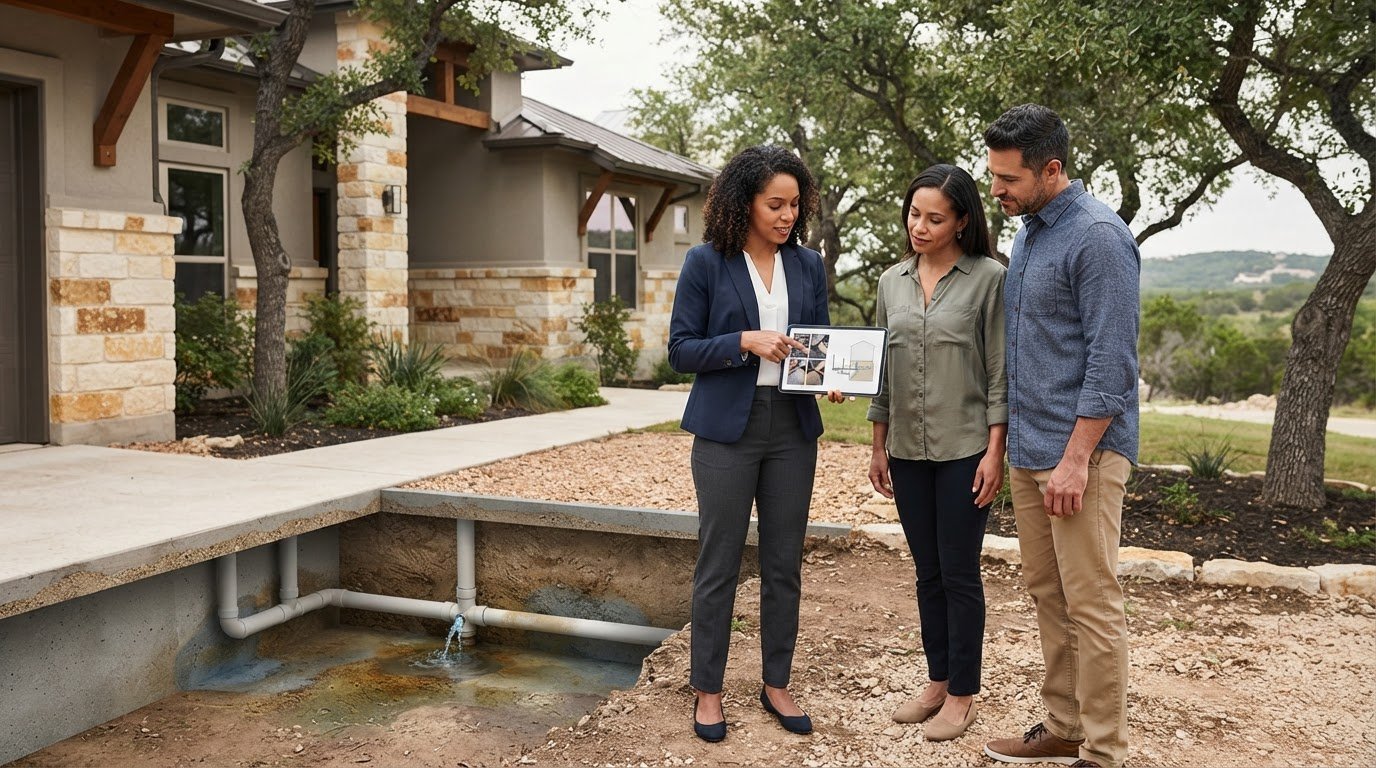
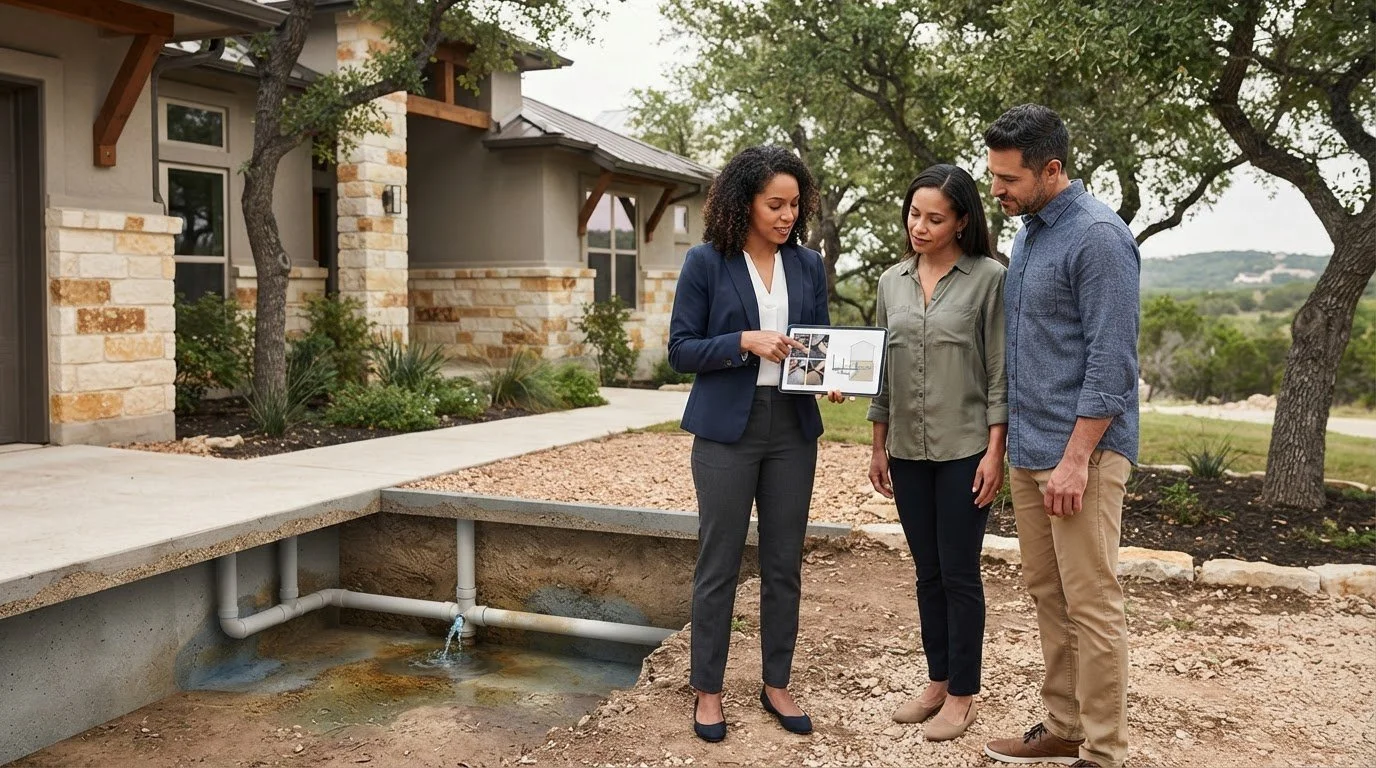
What if a slab leak is covered in one part of the loss, but not another? For Cedar Park homeowners, questions about foundation coverage after a slab leak rarely have a simple yes-or-no answer. A policy may treat the pipe repair, the work needed to reach the leak, water damage inside the home, and damage to the foundation differently. While the cause is being investigated, it’s understandable to worry about what the water may be doing beneath your home.
Coverage often depends on how and when the leak developed, what damage it caused, and the wording of your policy and any endorsements. A sudden pipe failure may be evaluated differently from a slow leak or gradual foundation movement, but no general rule can determine the outcome of an individual claim.
This article explains which parts of a slab leak loss may be considered separately, what policy language and records can help clarify the situation, and why the distinction between sudden damage and gradual deterioration matters. Chris Lewis has more than 25 years of insurance experience. He and The Lewis Agency help Cedar Park and Central Texas homeowners understand their coverage and the claims process, without promising a particular claim outcome.
Key Takeaways
- Notice possible warning signs, such as unexplained water use, damp flooring, or unusual sounds. Record what you observe without assuming the cause.
- Review the policy wording and applicable endorsements to understand how slab leak and foundation coverage may apply to your Cedar Park home.
- Consider leak detection, pipe repair, access work, and damage to the home or foundation as separate coverage questions.
- After suspecting a leak, document what you observe, take reasonable steps to limit further damage, and keep related records and receipts.
- Review your policy’s exclusions and claim-reporting instructions. A policy conversation can help clarify the wording.
Slab Leak Warning Signs in Cedar Park: What Homeowners May Notice
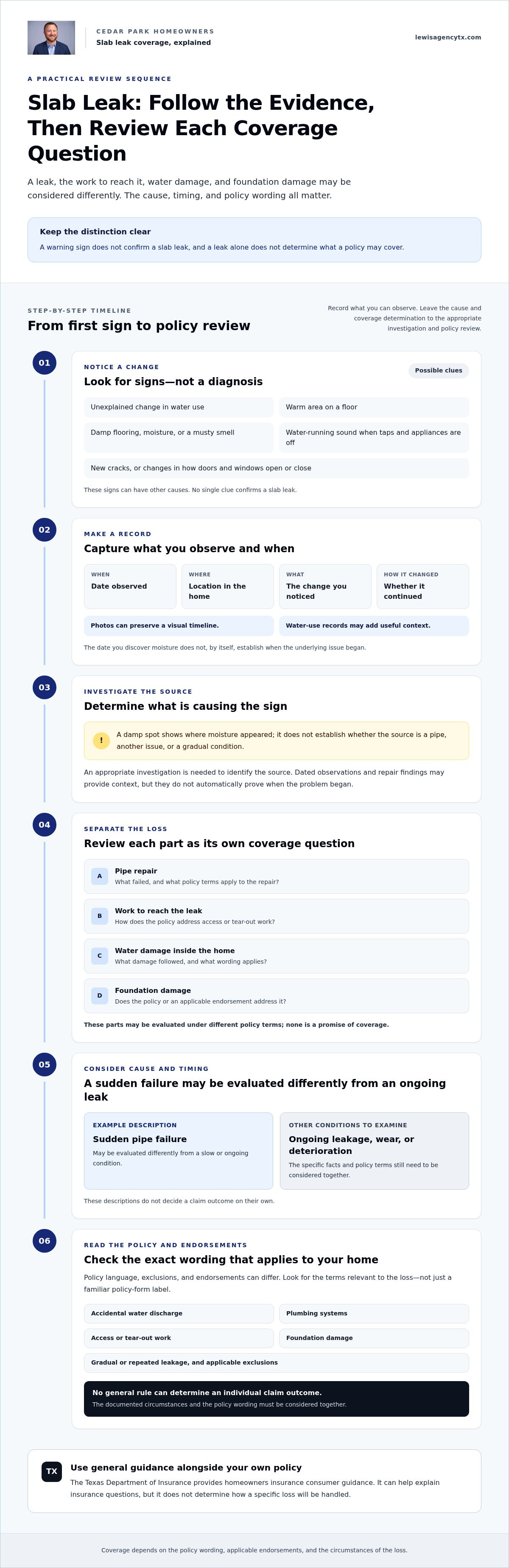
A suspected leak beneath your floor can raise two concerns at once: what might need repair, and whether your homeowners policy could apply to resulting damage. In Cedar Park, a damp spot or an unexplained change in water use can be unsettling, but no single clue confirms a slab leak. Note what you’re seeing and avoid treating a symptom as a diagnosis.
Which household changes can point to a possible slab leak?
Pay attention to changes from your home’s usual pattern. Recording where and when a change appears, and whether it continues, can make it easier to describe later.
- An unexplained increase in water use or a water bill that differs from your usual pattern.
- A warm area on the floor, which may be associated with a hot-water line but doesn’t prove a leak.
- Damp flooring, unexplained moisture, or a musty smell in one area.
- The sound of water running when taps and appliances are off.
- New cracks or changes in how doors and windows open or close.
These signs can have other causes, including issues unrelated to plumbing. A warm floor, for example, isn’t enough on its own to identify what is happening beneath the slab. An appropriate investigation is needed to determine the source. Until then, make a simple record: note the date, location, what you observed, and whether it changed. Photos and relevant water-use records may help preserve a clearer timeline.
Why identifying the source matters for an insurance review
A plumbing problem and damage to the home are related, but they are not necessarily the same coverage question. An insurance review may consider what failed, when the problem began, and what damage followed. The policy wording and any applicable endorsements also matter. A symptom alone doesn’t establish the cause or determine whether a loss is covered.
This distinction matters when Cedar Park homeowners review coverage for a slab leak and possible foundation damage. A damp patch, for instance, shows where moisture appeared, but not whether it came from a pipe, another source, or a gradual condition. Records of when the patch first appeared and how it changed can give later discussions useful context, though they don’t prove when the underlying issue began.
A slab is part of a home’s structure. For general background on how foundations fit into building design, see Foundation (architecture). That overview isn’t insurance guidance, but it can help frame why a plumbing issue and possible structural damage may need to be considered separately. Dated, factual observations give you a practical starting point for understanding both the source and the policy questions that follow.
Does Homeowners Insurance Cover a Slab Leak in Cedar Park?
A homeowners policy may help with parts of a slab leak loss, but there isn’t one answer for every home. Coverage depends on the cause, the resulting damage, the policy wording, and the circumstances. The presence of a leak alone doesn’t establish what may be covered.
It helps to separate the loss into parts. The policy may evaluate the plumbing repair, the work needed to reach the pipe, and damage to the home under different terms. Foundation damage can raise an additional question, including whether applicable policy language or an endorsement addresses it. The details matter.
How cause and timing may affect the coverage question
When a leak began and how it developed may be relevant during a review. A sudden pipe failure and resulting water damage may be evaluated differently from damage associated with ongoing leakage, wear, or deterioration. Those descriptions don’t decide the outcome on their own. The specific facts and policy terms still need to be considered together.
For example, a homeowner may discover water damage on one day without knowing when the leak started. Dated photos, repair findings, and other records may help establish what was observed and when. They provide context, but the discovery date alone doesn’t prove the leak began that day. When reviewing possible foundation coverage after a slab leak, Cedar Park homeowners should focus on the documented cause and exact policy wording rather than assume that a sudden discovery settles the coverage question.
Why policy wording matters more than a general rule
Home policies can differ in their coverage language, exclusions, and endorsements. A familiar policy-form label doesn’t tell you every term in your own contract or determine whether a particular loss qualifies. Review the policy documents that apply to your home, including any endorsements, and look for wording about accidental water discharge, plumbing systems, access or tear-out work, foundation damage, and gradual or repeated leakage. These are areas to examine, not promises of coverage.
The Texas Department of Insurance offers homeowners insurance consumer guidance to help Texans understand policies and insurance questions. Use it as general information alongside your own policy, since it can’t determine how a specific loss will be handled. If the wording is difficult to follow, a policy conversation can help clarify the relevant terms. The Lewis Agency helps Cedar Park homeowners understand policy language and the claims process. Coverage decisions remain subject to the policy and individual circumstances.
A practical next step is to gather your policy and any applicable endorsements before drawing conclusions. If you’d like help understanding the wording in your homeowners policy, review your coverage with The Lewis Agency.
Slab Leak, Pipe Repair, and Foundation Damage: Compare the Coverage Questions
A slab leak can involve several different expenses, and they don’t all raise the same insurance question. Separating the work into parts can make policy language easier to review. The table below is a guide to what to examine, not a prediction of whether a particular cost will be covered.
| Part of the loss | Policy question to review |
|---|---|
| Leak detection | Does the policy address the cost of locating the source, and under what circumstances? |
| Pipe repair or replacement | How does the policy treat repairing the failed pipe itself? |
| Access and tear-out | What wording applies to opening flooring, concrete, or other parts of the home to reach the pipe? |
| Resulting damage to the home | How does the policy address water damage to finishes or belongings, and any reported foundation damage? |
The leak and the plumbing repair
Finding the source and fixing the pipe are separate steps. Detection work aims to locate the leak; plumbing work addresses the damaged or failed line. A policy may treat those expenses differently from damage caused by water escaping from the pipe. Review the relevant coverage language, exclusions, and endorsements rather than assuming the detection fee or pipe repair has the same treatment as the resulting damage.
Keep records that distinguish these tasks. An itemized estimate or invoice may show which charges relate to locating the leak, repairing the line, or addressing other work. That detail can make a policy discussion more specific.
Access work, flooring, and foundation effects
Reaching a pipe beneath a slab may require opening part of the home. That access work is not the same as repairing flooring or other finishes afterward. Neither task is the same as diagnosing or structurally repairing a foundation. Each may involve different policy wording and facts.
A crack, uneven floor, or other foundation change also doesn’t by itself establish that a plumbing leak caused it. The cause may require separate evaluation. For slab leak foundation coverage, Cedar Park homeowners should keep the reported plumbing source, access work, visible damage, and foundation findings distinct in their records. This helps reviewers assess what happened without treating every repair as one undifferentiated expense.
Policy terms and claim outcomes vary. A careful review considers the documented cause, timing, damage, applicable exclusions, and endorsements. The practical question is not simply, “Is a slab leak covered?” It’s which part of the loss is being considered and what the policy says about that specific part.
What Cedar Park Homeowners Can Do After Suspecting a Slab Leak
A suspected leak can feel urgent, especially if moisture is spreading or you’re unsure how long it has been present. A steady record can help you explain what you observed and keep the insurance questions organized. Focus first on the condition of the home, then on your policy’s reporting instructions.
Document the condition and timeline
Write down when you first noticed a change and what happened afterward. Keep the notes factual: describe the location, appearance, and any changes without guessing at the cause. Dated photos can help show what was visible at different points.
- Record observations. Note the date, room or area, and what you saw or heard. Add updates if the condition changes.
- Take reasonable steps to limit further damage. If it’s safe and practical, address an active water source or protect affected belongings. Avoid actions that could put anyone at risk.
- Keep related records together. Save photos, receipts, invoices, inspection or service findings, and communications about the issue. If work is performed, keep paperwork that describes what was inspected or repaired.
- Review your policy and reporting instructions. Find the applicable claim-reporting steps and timeframes in your policy documents, and follow them if you decide to report a loss.
For a hypothetical example, a homeowner might note a damp area on Monday, photograph it, and record that it appeared larger later in the week. That timeline documents observations, but it doesn’t establish when a leak began or prove what caused the moisture. Keep conclusions separate from what you directly observed.
Report the issue and understand the next steps
If you report a claim, use the process and timeframes stated in your policy. You can ask what information is needed and how to provide records about the condition, investigation, and work performed. Keep a note of when you reported the issue and any instructions or follow-up communications you receive.
The insurer makes coverage and claim decisions based on the policy and circumstances. Reporting a concern doesn’t guarantee approval or payment, and documentation doesn’t predetermine the investigation. The Lewis Agency can help explain policy language and process questions, but it doesn’t decide claim outcomes.
A clear record can make a policy conversation more productive, particularly if you’re reviewing slab leak foundation coverage in Cedar Park. To discuss your policy wording and understand the claims process, talk with The Lewis Agency about your homeowners coverage.
Reviewing Slab Leak Foundation Coverage with The Lewis Agency
A policy conversation can help turn a confusing set of terms into practical questions about your home. For a suspected slab leak, that may mean locating the relevant coverage language, exclusions, and endorsements, then understanding how the policy distinguishes the pipe, access work, water damage, and possible foundation effects. The goal is clarity, not a promised claim result.
What a policy review can help clarify
Bring the policy documents and any records you have about the suspected loss. A review can help identify wording to consider and questions that may be useful to ask during the claims process, such as what information is needed or how to report the issue under the policy. It can also help distinguish an endorsement’s terms from the policy’s general language.
Chris Lewis has more than 25 years of insurance experience and helps homeowners understand policy language and the claims process. The Lewis Agency is an Allstate agency. It can provide guidance about the policy and process, but the insurer makes claim and coverage decisions. Those decisions depend on the applicable policy and the circumstances of the loss.
A useful discussion can start with what you know: when you noticed the issue, what has been investigated, and which costs or damage are being considered. Then you can look at the relevant policy wording without assuming that one answer applies to every part of the loss. That’s a practical way to approach questions about slab leak foundation coverage in Cedar Park.
A local resource for Cedar Park homeowners
Slab leak questions are one part of a broader homeowners coverage picture. Homeowners in Cedar Park and across Austin and Central Texas, including Leander, Georgetown, Round Rock, Liberty Hill, and nearby communities, can benefit from understanding their policy before a problem arises. Review how the contract describes covered property, exclusions, and endorsements. The Austin homeowners insurance coverage guide offers additional context for reviewing homeowners coverage.
You don’t need to know every insurance term before asking a question. Start with the part of the policy or situation that feels unclear, and work through it step by step. A conversation can help you better understand what your policy says and what questions remain, while leaving any claim determination to the insurer.
If you’d like to talk through your policy questions, Talk with The Lewis Agency.
Make Your Next Policy Review a Clear One
Before a future loss, take a few minutes to get familiar with the parts of your homeowners policy that feel unclear. Keep the policy and any endorsements together, and note questions you want answered. That preparation can make a later conversation more focused, especially if you need to understand how a specific situation relates to the wording in your contract.
For slab leak foundation coverage, Cedar Park homeowners should rely on their own policy language rather than broad assumptions about what a policy may cover. A review can help you understand the terms and identify questions to raise, though only the insurer can make a coverage determination for a claim.
The Lewis Agency serves homeowners in Cedar Park and Central Texas. Chris Lewis brings more than 25 years of insurance experience and can help explain policy language and the claims process. For a clearer understanding of your homeowners policy, ask The Lewis Agency about reviewing your coverage. A little preparation can help you feel more informed about your next steps.
Frequently Asked Questions
Does homeowners insurance cover the pipe under a concrete slab?
It depends on the policy and the circumstances surrounding the pipe failure. The cost to repair or replace a pipe may be treated differently from damage caused by water escaping from it. Check the policy’s wording for plumbing-system coverage, exclusions, and relevant endorsements. If you’re reviewing an estimate, separate pipe work from other charges so you can ask focused questions about each item.
Can homeowners insurance cover the cost of accessing a slab leak?
Possibly, depending on the policy language and the facts of the loss. Access work could involve removing flooring or opening concrete to reach a pipe, while restoring finishes afterward may be a separate expense. Keep estimates or invoices that describe each task separately. That detail can help you compare the work performed with the policy terms, but it can’t establish coverage by itself.
Is foundation damage from a slab leak covered by homeowners insurance?
It may be, depending on what caused the damage, the policy, and any applicable endorsements. For questions about slab leak foundation coverage, Cedar Park homeowners should focus on the documented cause and their policy’s wording, not assume a crack proves a plumbing leak caused it. The insurer may consider available findings when reviewing the loss. Keep plumbing records and foundation observations distinct so their relationship can be evaluated.
Does a slow or long-term slab leak affect whether damage is covered?
It can affect the review, but a slow leak doesn’t automatically determine the outcome. Policies may address sudden water discharge, repeated leakage, wear, and deterioration differently, and the exact wording matters. If the start date is unclear, describe when you first noticed the issue separately from when you believe it may have begun. Avoid guessing; let documented findings and the applicable policy terms guide the discussion.
Should I file a homeowners insurance claim for a suspected slab leak?
Review your policy’s reporting instructions and consider contacting the insurer to ask how to report the situation and what information may be needed. A suspected leak alone doesn’t establish whether a claim is covered. Before deciding what to do, gather the policy, relevant estimates, and available findings, then consider how the terms apply. The insurer makes claim decisions, so reporting doesn’t guarantee payment or approval.
What records should I keep after discovering a possible slab leak?
Keep dated photos, notes describing when you first noticed changes, water-use records, inspection findings, estimates, invoices, and receipts related to the issue. Save claim-related communications and note the date and substance of important calls. For example, if an inspection identifies a suspected source, retain the written report rather than relying only on memory. Organized records can help explain the timeline and the work involved.
Can The Lewis Agency decide whether my slab leak claim will be paid?
No. The insurer determines coverage and claim outcomes under the applicable policy and the facts of the loss. The Lewis Agency can help explain policy language and the claims process, but it doesn’t control the insurer’s decision. If you’re reviewing slab leak foundation coverage in Cedar Park, a policy conversation can clarify what wording to review and what questions to raise with the insurer.

Article by
Chris Lewis
Chris Lewis is the owner of The Lewis Agency, an Allstate insurance agency serving Austin and Central Texas. With more than 25 years of insurance experience, Chris focuses on helping Central Texas homeowners better understand their insurance coverage, including deductibles, roofs and hail, severe weather risks, water damage and other important coverage considerations. He created LewisAgencyTX.com to provide practical homeowners insurance education and help homeowners better understand their coverage before they need it.
Can a Class 4 Impact-Resistant Roof Affect Homeowners Insurance in Texas?
Seeking a hail impact resistant roof shingle insurance discount in Round Rock? Learn how Class 4 shingles affect your Texas homeowners insurance policy today.
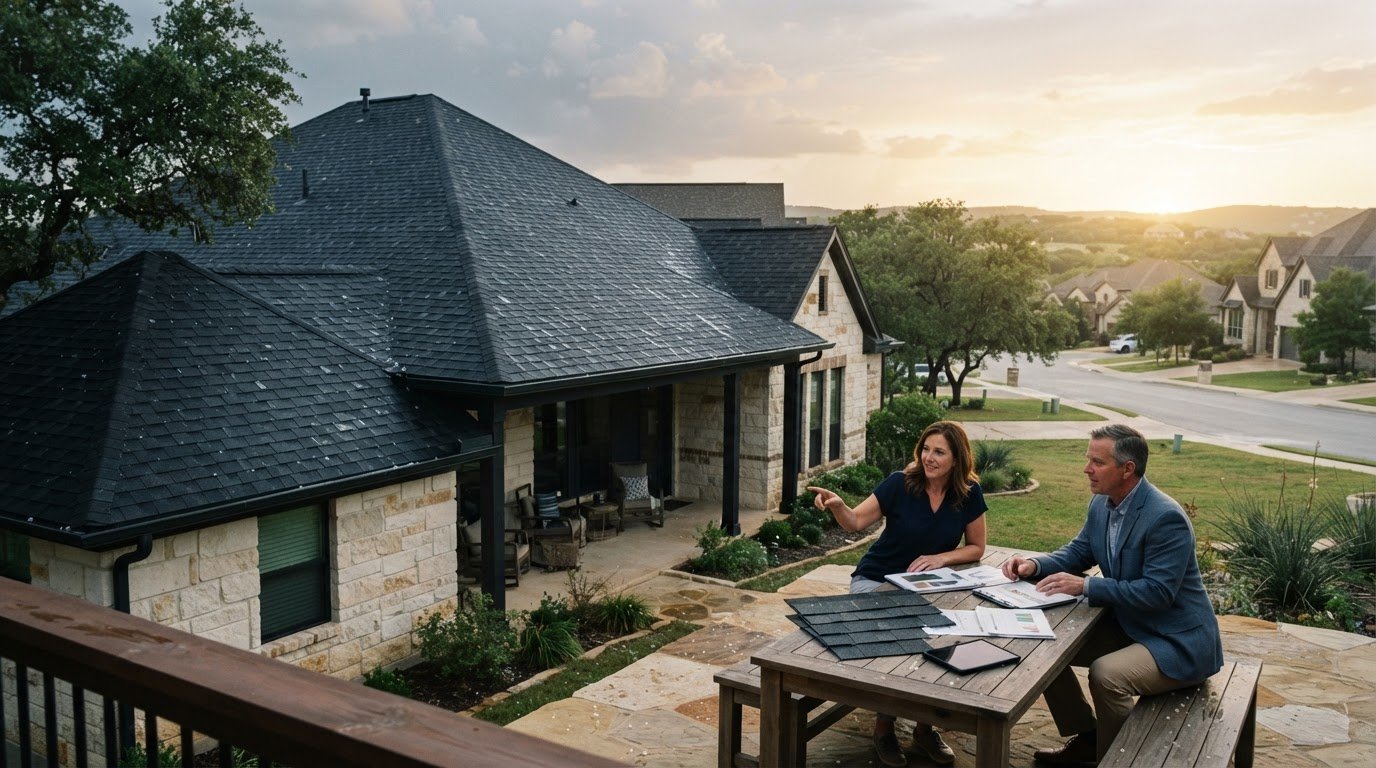
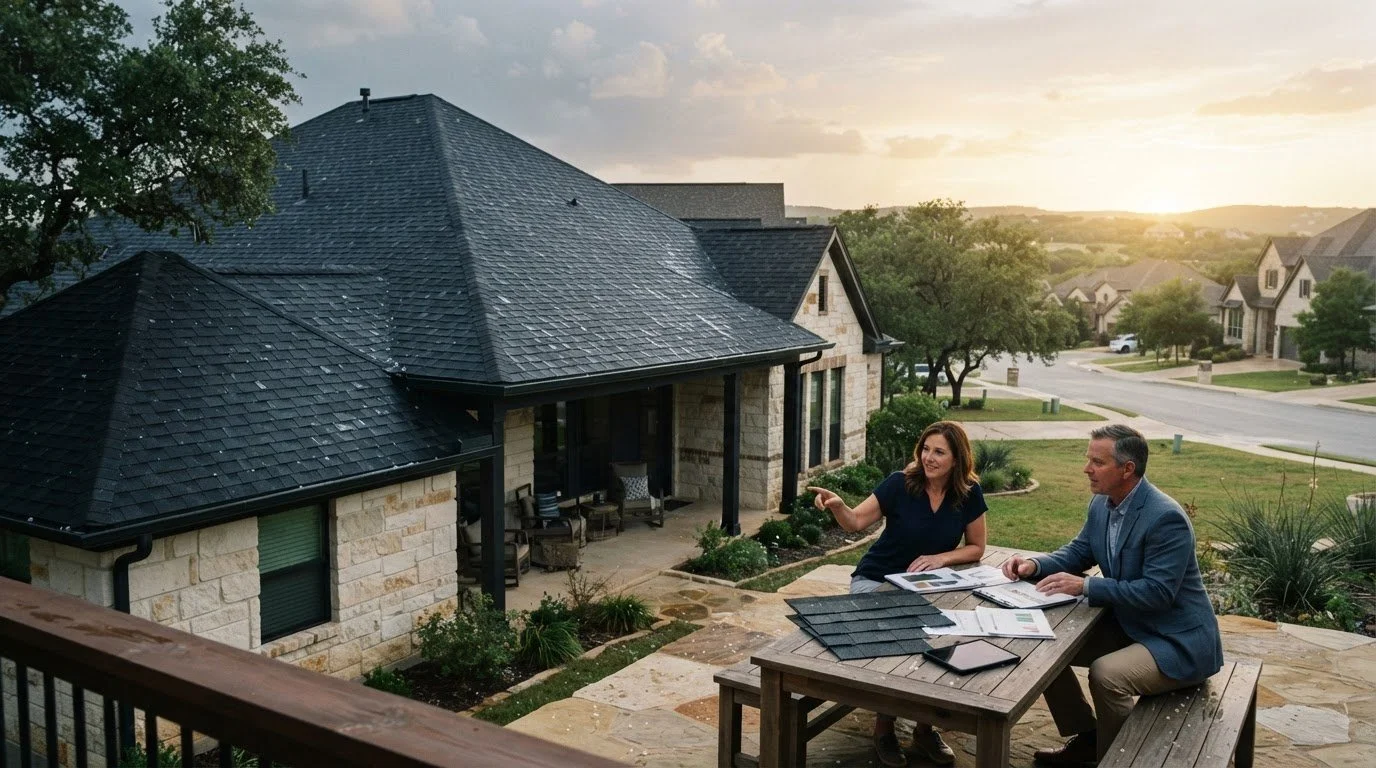
If you are searching for a hail impact resistant roof shingle insurance discount in Round Rock, start with an important distinction: a Class 4 rating does not guarantee a lower homeowners insurance premium. Whether a roof affects your premium depends on the insurer, the policy, and your circumstances. Review those details before treating a possible credit as part of the value of a roofing upgrade.
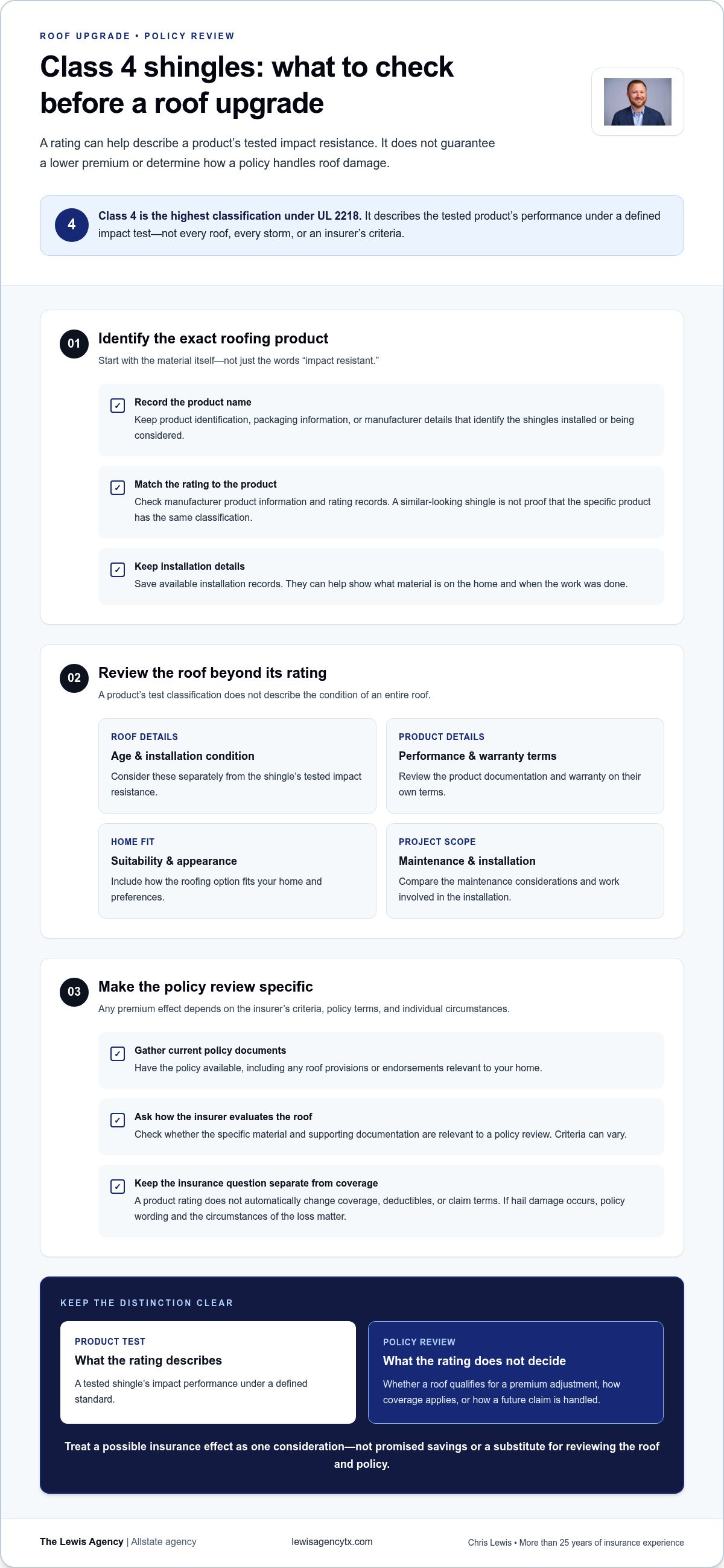
Impact-resistant shingles are designed to better withstand impacts, and a Class 4 rating describes a product’s performance under a standardized test. It does not make a roof hail-proof or determine how a policy will treat damage. Before choosing shingles, identify the exact product, gather its rating and installation records, and review how your policy addresses the roof.
This article explains what to compare and which questions can make a policy review more useful. Chris Lewis of The Lewis Agency has more than 25 years of insurance experience and helps homeowners in Round Rock and across Austin and Central Texas understand their coverage. That includes homeowners in Leander, Cedar Park, Georgetown, Liberty Hill, and nearby communities.
Key Takeaways
- A Class 4 rating describes a shingle’s tested impact resistance. It does not guarantee an insurance discount or prevent hail damage.
- For Round Rock homeowners, any possible effect on a premium depends on the policy and insurer’s criteria. Review the question before committing to an upgrade.
- Gather product identification, rating information, installation records, and current policy documents to make a roof review more specific.
- Compare roofing options by their product documentation and suitability for your home, not by the rating alone.
- Chris Lewis has more than 25 years of insurance experience and can help explain policy language through The Lewis Agency, an Allstate agency.
Can impact-resistant roof shingles earn a homeowners insurance discount in Round Rock?
A roof upgrade may affect a homeowners insurance premium, but a Class 4 shingle rating does not guarantee a discount. Any premium effect depends on the insurer’s criteria, the policy terms, and your individual circumstances. If you live in Round Rock or elsewhere in Central Texas, review the insurance question before you include a possible credit in your roofing budget.
Impact-resistant shingles are designed and tested to better withstand impacts than standard products. That may be one consideration when choosing roofing in a hail-prone area, but it is separate from the policy’s coverage, deductibles, and claim terms. A product rating does not automatically change any of those policy details.
What does impact-resistant mean for roof shingles?
Impact-resistance testing gives buyers a standardized way to compare how roofing materials respond to impacts. For asphalt shingles, the UL 2218 standard assigns impact classifications, with Class 4 as its highest classification. The classification describes a product’s performance in a test. It does not establish how an insurer will treat the roof. For general background on asphalt shingles, see Asphalt shingle.
A test result does not promise that a roof will avoid damage from real hail. Storm conditions and specific impacts can differ from a controlled test. A manufacturer’s warranty also has its own terms and does not determine insurance coverage. Keep these distinctions in mind when comparing products and reviewing roof documents.
Does a Class 4 rating guarantee a Round Rock insurance discount?
No. A Class 4 rating does not establish that a roof qualifies for a discount. Insurers set their own criteria, which can depend on the policy and the homeowner’s circumstances. Even if impact-resistant materials are considered, the rating alone may not show whether a particular roof qualifies for a premium adjustment.
Before counting on a lower premium, review the specific product and policy. Ask how the insurer evaluates the roof material and what documentation it uses. Then assess the roofing decision on its own merits, including tested performance, warranty terms, and suitability for your home. This helps you consider a possible insurance effect without treating it as promised savings.
What a Class 4 shingle rating tells you, and what it does not
A Class 4 label describes a product’s performance under a defined impact test. It does not tell you whether the roof meets an insurer’s underwriting or discount criteria. One is an assessment of a roofing product in testing. The other depends on the insurer’s rules and the details of your policy.
How should homeowners interpret a Class 4 classification?
UL 2218 is a test standard used to classify the impact resistance of roofing materials. Class 4 is the highest classification under that standard. UL Solutions Roofing Testing and Certification Services explains UL’s work testing and certifying roofing products.
The classification applies to the tested product. It does not certify every shingle that looks similar, the complete roof assembly, or how a roof will perform in every storm. It also does not determine whether an insurer will offer a credit, accept a product for a particular home, or handle a future claim in a particular way.
Which roof details can matter beyond the rating?
A product label is a useful starting point, but it may not provide all the information relevant to a policy review. Keep records that identify the shingle and its rating, along with available installation details. These records can help establish what material is on the home and when the work was done. Insurers may consider details beyond the rating, and the information they use can vary.
Roof age, installation condition, and visible damage are separate from a shingle’s tested impact resistance. A Class 4 product does not show that an existing roof is in good condition. Likewise, cosmetic marks alone do not establish whether the roof’s function is affected. If hail damage occurs, the policy wording and circumstances of the loss matter. The product rating by itself does not determine coverage or a claim outcome.
Compare the label with the manufacturer’s product information and the roof records you have. Then review the policy language that applies to your home, including relevant roof provisions or endorsements. Chris Lewis and The Lewis Agency can help explain your current policy. Review your homeowners coverage with The Lewis Agency.
Compare roofing choices by documentation and possible insurance relevance
Roof options are easier to assess when you separate three questions: What is the material? What documentation supports its claims? How does it fit your home and policy? A possible insurance credit can be one factor, but it should not replace consideration of performance, appearance, maintenance, warranty terms, and the installation scope.
| Roof option | Product identification and available documentation | Questions to review with the insurer |
|---|---|---|
| Standard asphalt shingles | Product name or packaging information, product specifications, and installation records, if available. | How does the policy treat this roof type? Are there roof details or records relevant to a policy review? |
| Documented impact-resistant shingles | Manufacturer product identification, rating information, and installation records that connect the product to the home. | Does the insurer consider this specific product or documentation, and are there policy-specific criteria? |
| Other roof materials | Material and product details, available specifications, and records describing the installation. | How does the policy treat this material, and what information would help clarify its eligibility or coverage? |
What should homeowners compare before selecting shingles?
Look beyond a sales description. Compare the exact product information with the written installation scope. Consider whether the material suits your home, preferred appearance, maintenance expectations, and long-term plans. Read the warranty terms, including what the warranty covers and excludes. These are roofing considerations, separate from whether an insurer may apply a credit.
For a Round Rock homeowner, a possible hail impact resistant roof shingle insurance discount is one factor to explore, not the sole reason to choose a product. The insurer’s review may depend on its rules, the policy, and the records available. Do not treat a rating or marketing statement as a promise of premium savings.
How do warranties and insurance coverage differ?
A manufacturer warranty and a homeowners policy serve different purposes. A warranty sets out the manufacturer’s terms for the product. Homeowners insurance addresses covered losses according to the policy, its exclusions and endorsements, and the circumstances of the loss. Do not assume a warranty will pay for storm damage or replace insurance coverage.
Cosmetic damage is another policy question. A mark or dent may not mean the roof’s function has changed, and policy language can affect how cosmetic damage is treated. Review the applicable wording rather than relying on the shingle rating or warranty alone. The useful comparison is not simply which material sounds more resistant. It is what you can document and how the roof fits your home and policy.
How to check whether a Round Rock roof upgrade may affect your policy
Before choosing a roof upgrade, put the product details alongside your current policy. A focused review can help clarify what the insurer considers and what documents may be relevant. It cannot guarantee a discount, but it can help you make the roofing decision with fewer assumptions.
What documents should you gather for a policy review?
Collect the records you have before discussing proposed or completed roof work. Useful documents may include:
- Product labels or packaging that identify the shingle or roofing material.
- Manufacturer documentation showing the product’s impact-resistance rating.
- An invoice, written scope, or installation records describing the work and materials.
- Your current declarations page and any policy wording or endorsements that address the roof.
Documentation requirements can vary. Keep any instructions about which records are relevant with your roof documents.
What questions can clarify possible insurance effects?
Use these questions to guide a review of your specific policy:
- Does my current policy recognize this product’s documented impact-resistance rating?
- Are there eligibility conditions or proof requirements for this policy?
- Could the roof affect the premium, and how would any change be reflected?
- Would the upgrade affect any policy terms or endorsements, not just the premium?
For the hail impact resistant roof shingle insurance discount Round Rock homeowners may be considering, focus on the specific product and policy rather than a general statement about Class 4 roofs. Record the response, the date of the conversation, and any documents discussed. Save written explanations with your declarations page and installation records. If a review depends on information you do not yet have, note what is needed and keep it with your roof file.
Chris Lewis and The Lewis Agency can help explain policy language and answer questions about your current homeowners coverage. Review your roof and policy questions with The Lewis Agency.
Reviewing a possible roof discount with The Lewis Agency
A hail impact resistant roof shingle insurance discount is not guaranteed. Round Rock homeowners can still review how a documented roof relates to their current policy and get a clearer understanding of its terms. Chris Lewis has more than 25 years of insurance experience and helps homeowners across Austin and Central Texas understand coverage questions.
The Lewis Agency is an Allstate agency. It does not shop homeowners insurance among multiple carriers, and it does not approve discounts or decide whether a roof meets an insurer’s eligibility rules. Insurers make decisions about eligibility, underwriting, rates, renewals, and claims. Those decisions depend on the insurer, policy, endorsements, and individual circumstances.
What can an insurance agency help you understand?
An agency can help explain relevant policy wording and identify questions about roof materials and supporting documents. For example, you can review whether the product label, rating information, and installation records clearly identify the roof. The agency can also help you understand the claims process if damage occurs, but it does not control claim decisions or payments.
A policy review can clarify the terms that apply to your home. It is not a promise that your premium will change or that a particular roof will qualify for a credit. Keep the discussion focused on your policy wording and the insurer’s response to the specific documentation provided.
What is a sensible next step for Round Rock homeowners?
Before replacing a roof or reviewing your policy, gather the product rating information and installation records you have. Set them alongside your current declarations page and any relevant roof coverage terms. Reviewing these materials before renewal or replacement can help you ask focused questions and keep useful records together.
If you’d like help understanding your homeowners policy, ask The Lewis Agency about your homeowners policy. A clear conversation can help you understand your current coverage without assuming a discount is available.
Make your roof decision with clearer policy information
A Class 4 rating describes tested impact resistance. It does not guarantee an insurance discount or determine how a claim will be handled. The hail impact resistant roof shingle insurance discount Round Rock homeowners may be considering depends on the insurer, policy terms, and available roof documentation.
Before choosing an upgrade, gather product and installation records, then review your declarations page and relevant policy wording. Ask how your specific policy treats the documented roofing material and whether any requirements or policy changes apply. Consider durability, maintenance, appearance, and warranty terms alongside any possible insurance effect.
Chris Lewis has more than 25 years of insurance experience and helps homeowners in Round Rock and across Austin and Central Texas understand their coverage through The Lewis Agency, an Allstate agency. The insurer makes decisions about eligibility, rates, renewals, and claims. A policy review can help you understand the terms and ask informed questions, whether you are in Round Rock, Leander, Cedar Park, Georgetown, or Liberty Hill.
Review your homeowners policy with The Lewis Agency before a roof replacement or renewal. Bring your roof records and policy questions to make the conversation more useful.
Frequently Asked Questions
Do Class 4 shingles qualify for an insurance discount in Round Rock?
They may be considered, but a Class 4 rating does not guarantee a discount. Eligibility and any premium effect depend on the insurer’s rules, the policy, and individual circumstances. For the hail impact resistant roof shingle insurance discount Round Rock homeowners may be considering, review the specific product documents alongside the current policy. Do not assume the rating alone will change the premium.
How can I find out whether my policy recognizes impact-resistant shingles?
Review your current policy with The Lewis Agency and ask how it treats the specific shingle product you are considering. Provide the product identification and rating documentation, then discuss any applicable eligibility conditions or proof requirements. Chris Lewis can help explain policy wording. The insurer determines eligibility and any resulting premium or policy changes.
What does a Class 4 roof rating mean?
Class 4 is the highest impact-resistance classification under UL 2218, a standardized test for roofing materials. It indicates how the tested product performed under that test, not how every roof or roof assembly will perform in a storm. A Class 4 rating does not mean a roof is hail-proof, establish insurance eligibility, or promise a particular outcome if damage occurs.
Can impact-resistant shingles lower my homeowners insurance premium?
They may affect a premium if the insurer recognizes the material and the policy’s conditions are met, but do not assume a reduction. The insurer determines whether a roof qualifies and whether a premium change applies. Before choosing an upgrade, review product and installation records alongside your current policy. Consider the roof’s performance, appearance, maintenance, and warranty separately from any possible insurance effect.
What documents may an insurer request for an impact-resistant roof review?
Useful records may include product labels or packaging, manufacturer documents showing the rating, an invoice or written installation scope, and installation records. Keep your declarations page and any relevant policy wording or endorsements with them. Requirements vary, so the insurer may specify which documents it considers. Save the response and requested materials for future reference, such as at renewal or after roof work.
Are impact-resistant shingles worth considering if a discount is not guaranteed?
They may be worth considering for reasons beyond insurance, including their tested impact resistance and suitability for your home and maintenance preferences. Compare the manufacturer’s product information, installation details, and warranty terms. A possible discount is one factor, not a promised saving. Weigh the roof’s overall fit for your home before deciding.
Does a roof rating guarantee that hail damage will be covered?
No. A product rating does not determine whether a specific loss is covered. That depends on the policy wording, applicable exclusions or endorsements, and the circumstances of the damage. If hail affects your roof, the rating may help identify the material, but it does not guarantee claim payment or a particular outcome. Review your policy before a storm and keep roof documentation available.
Article by
Chris Lewis
Chris Lewis is the owner of The Lewis Agency, an Allstate insurance agency serving Austin and Central Texas. With more than 25 years of insurance experience, Chris focuses on helping Central Texas homeowners better understand their insurance coverage, including deductibles, roofs and hail, severe weather risks, water damage and other important coverage considerations. He created LewisAgencyTX.com to provide practical homeowners insurance education and help homeowners better understand their coverage before they need it.

What a 2% Homeowners Insurance Deductible Means in Texas
Understand your 2 percent homeowners insurance deductible Texas policy. Learn how dwelling coverage sets your out-of-pocket costs for wind and hail claims.

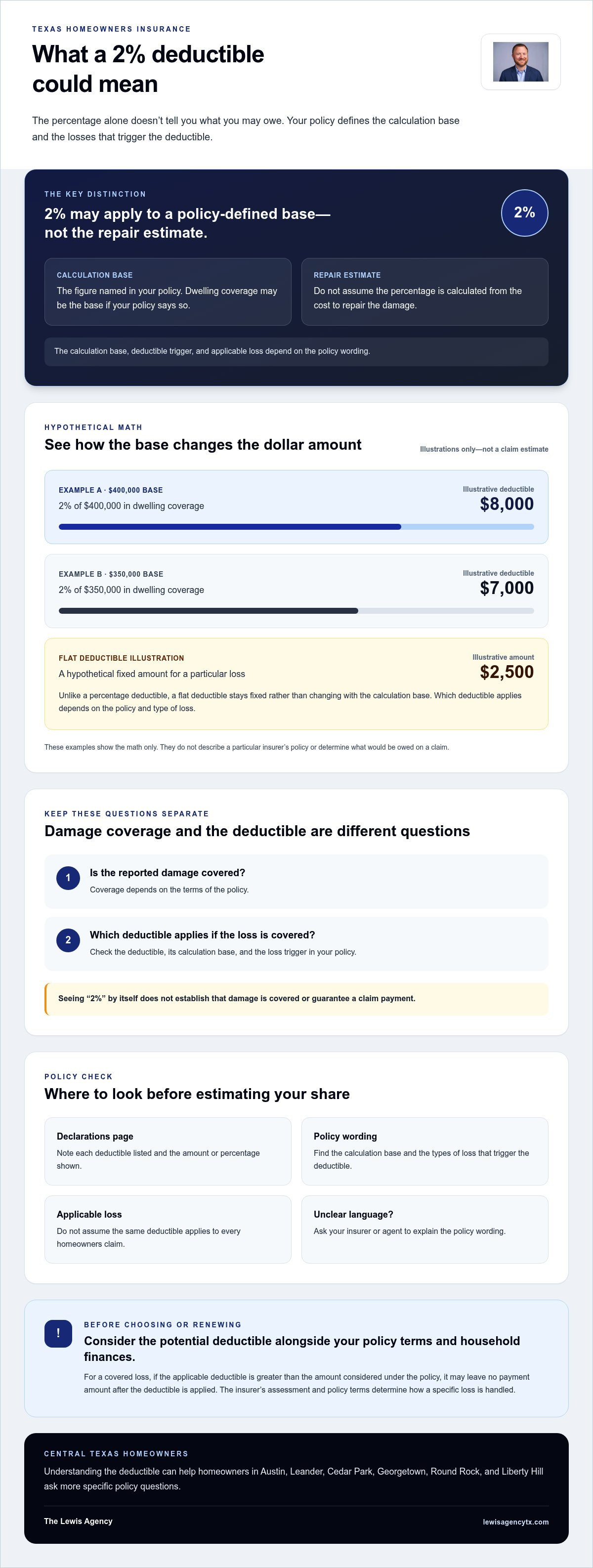
What if a 2% deductible is based on your home’s insured value, not the cost of repairing storm damage? That’s a key point to understand about a 2% homeowners insurance deductible in Texas. It’s reasonable to wonder how the math works and how much you might pay after hail or wind damage.
For a simple hypothetical example, 2% of $400,000 in dwelling coverage is $8,000. That figure isn’t a promise about what you’d owe on a claim. The deductible that applies depends on your policy’s wording, the cause of the damage, and any stated trigger. A percentage deductible can work very differently from a flat dollar deductible, so check which one applies before a storm.
This article explains how the calculation may work, what it could mean for a covered loss, and where to check your policy documents. If you’re reviewing homeowners coverage in Austin, Central Texas, Leander, Cedar Park, Georgetown, Round Rock, or Liberty Hill, understanding the deductible can help you ask more specific questions when choosing or renewing a policy.
Key Takeaways
- A percentage deductible may be calculated using a base stated in your policy, not the repair estimate. Check the wording before estimating what you might pay.
- If your Texas policy has a 2% deductible, confirm which types of loss trigger it.
- Find the declarations page, note each deductible listed, and check the policy wording for the calculation base and applicable losses.
- A deductible is only one part of a coverage decision. Consider its potential cost alongside your policy’s terms and your household finances.
- The Lewis Agency works with homeowners to identify risks and match them with appropriate coverage, including policy limits and endorsements suited to their needs.
What does a 2% homeowners insurance deductible mean in Texas?
A percentage deductible is calculated using a base identified in the policy, rather than automatically using the repair estimate. The base and the losses that trigger the deductible can vary by insurer, policy form, and endorsements. In general, a deductible is the amount applied to a covered loss under the policy before any claim payment is considered. For a broader overview, see this explanation of an insurance deductible.
So, a 2% deductible doesn’t necessarily mean you pay 2% of your roof repair bill. The percentage alone doesn’t tell you the dollar amount. Find the calculation base in your own policy documents before estimating your share.
What figure might a 2% deductible apply to?
Check the declarations page and the policy wording for the base used to calculate the deductible. Dwelling coverage may be the base if your policy says so, but don’t assume that applies to every Texas policy. Look for the stated percentage, the figure it applies to, and the types of loss for which it applies.
If those details aren’t clear, ask your insurer or agent to explain the wording. A quote or summary may not include all the terms that appear in the policy.
How is a percentage deductible different from a flat deductible?
A percentage deductible is a policy-defined share of a specified base, while a flat deductible is a fixed dollar amount. Which applies depends on the policy and the type of loss. Both are ways a policy may set the homeowner’s deductible. Don’t assume one replaces or applies alongside the other without checking the documents.
Here’s a hypothetical calculation, not a statement about a particular insurer’s policy: if a policy identifies $350,000 in dwelling coverage as the base, a 2% deductible using that base would be $7,000. If a separate hypothetical policy instead lists a flat $2,500 deductible for a particular loss, that amount would stay fixed rather than rise or fall with the selected calculation base. These figures illustrate the math only.
For Texas homeowners considering a 2% deductible, the policy’s specific wording, not a general example, determines the calculation. Before estimating what you might pay, verify the deductible amount, its calculation base, and its trigger in your documents. Whether the damage itself is covered is a separate question, also determined by the policy terms.
How a Texas 2% deductible may affect a wind or hail claim
After a hailstorm in Central Texas, a homeowner may see roof damage and wonder whether a 2% deductible applies. The answer depends on the policy’s wording. A percentage deductible applies only to the types of loss identified in the policy and when its stated conditions are met.
Keep two questions separate. First, does the policy cover the reported damage? Second, which deductible applies if the loss is covered? A deductible doesn’t establish that damage is covered or guarantee a claim payment. For broader context on Texas homeowners policies and deductibles, see the Texas Department of Insurance Home insurance guide.
Does a 2% deductible apply to every homeowners claim?
Not necessarily. A policy may describe different deductibles for different causes of loss, but don’t assume every Texas policy has a separate wind or hail deductible. Check the declarations page and policy wording for the loss trigger and the deductible that applies. If the wording is unclear, ask your insurer or agent to explain it.
Imagine a hypothetical hailstorm damages a home in Round Rock. The policy’s terms would determine whether the reported damage is covered and whether the wind or hail deductible applies. Seeing “2%” on a document alone doesn’t answer either question. For homeowners researching “2 percent homeowners insurance deductible texas,” the policy’s specific wording is the useful guide, not the percentage in isolation.
What if the damage estimate is less than the deductible?
If a loss is covered and the applicable deductible is greater than the amount considered under the policy, the deductible may leave no payment amount after it is applied. That’s a general explanation, not a claim outcome. The insurer’s assessment and the policy’s terms determine how a particular loss is handled.
If you receive an estimate below your deductible, don’t treat that figure alone as a coverage decision. Confirm which deductible applies, what amount the insurer is evaluating, and whether other policy terms affect the claim. Your insurer can answer questions about a specific claim. An agent can help clarify policy language.
Before storm season, identify the trigger and deductible in your documents. If you’re choosing or reviewing homeowners coverage, contact The Lewis Agency to discuss your coverage needs. The agency works with homeowners in Austin, Central Texas, Leander, Cedar Park, Georgetown, Round Rock, and Liberty Hill to identify risks and match them with appropriate policies.
How to check whether your Texas policy has a 2% deductible
A review of your policy documents can help you understand whether a 2% deductible applies and what the percentage means. Start with the declarations page, then use the full policy and any endorsements to confirm how the deductible works. The declarations page is a useful summary, but a short label may not explain every condition.
If you’re searching for a “2 percent homeowners insurance deductible texas” explanation, use general information as a starting point. Your own documents determine the calculation base, which types of loss may trigger the deductible, and how it works with other policy terms.
Where should you look on the declarations page?
Find the section that lists deductibles. Look for a percentage and any wording that identifies wind, hail, or another cause of loss. Note the exact language and any amount or coverage limit the percentage may be based on.
Next, check the full policy wording and endorsements. A label such as “wind/hail” may not explain all the conditions that determine when the deductible applies. If a term is unclear, don’t rely on the label alone.
The Texas homeowners insurance deductibles guide can provide additional context as you review your documents.
Which questions should you ask about the deductible?
Use the policy wording when you contact your insurer or agent. Specific questions can help clarify how the terms apply to your coverage:
- What is the calculation base? Ask what amount or limit the percentage is applied to under this policy.
- Which losses trigger it? Confirm the causes of loss named in the policy and whether the deductible applies to the event you’re asking about.
- How does it work with other terms? Ask how the deductible interacts with other applicable deductibles, conditions, or endorsements.
For example, if the documents list a percentage but don’t clearly state what it applies to, ask the insurer or agent to point to the relevant policy language. Avoid estimating your out-of-pocket share from the percentage alone.
Keep a note of the answers alongside your policy documents, especially when reviewing coverage before renewal or storm season. Terms can vary by insurer, policy form, endorsements, and individual circumstances, so a general explanation may not settle a question about your specific policy. Confirm the percentage, calculation base, and loss trigger using the documents that apply to your home.
How to weigh a 2% deductible before choosing or renewing coverage
A deductible is one part of a homeowners policy decision, not a stand-alone measure of whether coverage fits your needs. Consider the policy’s coverage and exclusions, the deductible’s calculation base, and whether your household could manage the amount if a covered loss occurred. The right choice depends on your circumstances and the exact policy terms.
Don’t compare quotes by percentage alone. A “2%” figure can’t tell you the potential dollar amount unless you know what the policy applies it to and which loss triggers it. Review the actual deductible wording in the proposed policy, and check that you understand the calculation before deciding. Choosing a higher or lower deductible doesn’t guarantee a particular premium change or savings.
What should homeowners consider alongside the percentage?
Start with the policy’s stated calculation base, then consider whether the resulting deductible would be manageable for your household. Also review roof coverage separately. The deductible describes your share of an applicable covered loss, while roof settlement terms address how the policy may value covered roof damage. For help understanding that distinction, see this guide to actual cash value versus replacement cost for a Texas roof.
These are related but different policy questions. A deductible figure alone doesn’t explain how roof damage may be settled, and settlement wording doesn’t tell you which deductible applies. Look at both parts of the policy rather than assuming one answers the other.
What should you clarify before renewal?
Compare your current policy with the proposed renewal documents. Check whether the deductible percentage, calculation base, or stated loss triggers have changed. If a term is unfamiliar, ask your insurer or agent to explain it using the actual policy wording before deciding whether to renew or change coverage.
It can help to write down what you want clarified: the amount the percentage applies to, the losses that trigger it, and how roof settlement terms work. For wider context on reviewing policy details, consult this Austin homeowners insurance coverage guide.
A search for “2 percent homeowners insurance deductible texas” can provide a general starting point, but your policy documents are what matter for your decision. If you’re considering homeowners coverage or reviewing your options, contact The Lewis Agency to discuss your coverage needs. The agency works with homeowners across Austin, Central Texas, Leander, Cedar Park, Georgetown, Round Rock, and Liberty Hill, helping identify risks and match them with appropriate policies.
Where Central Texas homeowners can get help understanding a 2% deductible
Before you need to make a claim, take a few minutes to find the deductible wording in your policy. Confirm the percentage, identify the amount or limit it’s calculated against, and check which types of loss may trigger it. Those details make “2 percent homeowners insurance deductible texas” more concrete, but only your policy documents can explain how the terms apply to your home.
The Lewis Agency works with homeowners in Austin, Central Texas, Leander, Cedar Park, Georgetown, Round Rock, and Liberty Hill. Its homeowners insurance service helps clients consider their risks, policy limits, and endorsements when choosing coverage. The insurer and policy terms govern whether a loss is covered and what a claim will pay.
What an agency can and cannot clarify
An agency can help you understand coverage options and identify questions to ask about policy wording. That guidance can make it easier to consider how limits and endorsements relate to your needs, but it doesn’t change the contract. The insurer makes coverage, claim, underwriting, and renewal decisions. For a specific claim or final interpretation, refer to the governing policy documents and confirm details with the insurer.
This distinction matters. A general explanation can help you understand what to look for, but it can’t guarantee how the terms will apply to a particular loss. Policy language, endorsements, and circumstances all matter.
A practical next step for Austin and Central Texas homeowners
Review your deductible before storm season or policy renewal, rather than waiting until you’re trying to understand it during a stressful situation. Have your declarations page and the relevant policy wording ready. If a term is unclear, note the exact wording and ask what the calculation base is, which loss triggers the deductible, and how other policy terms may affect its application.
That preparation can help you have a more focused conversation with your insurer or agent. It also gives you a chance to consider whether the deductible amount would fit your household finances, without assuming a particular claim outcome.
If you’re choosing or reviewing homeowners coverage, learn more about The Lewis Agency and discuss your needs. The agency works with homeowners in Austin, Central Texas, Leander, Cedar Park, Georgetown, Round Rock, and Liberty Hill to identify risks and match them with appropriate coverage.
Review your deductible before the next storm
A 2% deductible is easier to assess once you know the calculation base and which losses trigger it. The percentage alone doesn’t tell you what you might owe, and it doesn’t determine whether damage is covered. Check the declarations page and full policy wording, then consider the deductible alongside your roof coverage and household finances.
Understanding the “2 percent homeowners insurance deductible texas” homeowners may see in a policy starts with those specific terms, not a general example. Insurance coverage and wording vary, so confirm unclear details with your insurer or agent before renewal or a claim.
If you’re a homeowner in Austin, Central Texas, Leander, Cedar Park, Georgetown, Round Rock, or Liberty Hill and want to discuss coverage options, contact The Lewis Agency. The agency works directly with clients to identify risks and match them with appropriate homeowners policies. Review your policy terms with your insurer for answers about a specific claim.
Frequently Asked Questions
Is a 2% wind and hail deductible based on my home's value?
Not necessarily. Your policy identifies the calculation base, so don’t assume the percentage applies to your home’s market value or the repair cost. Check the declarations page and the applicable policy wording for the amount or limit used and the losses that trigger the deductible. If the base isn’t clear, ask your insurer or agent to explain how the actual calculation works for your policy.
How do I calculate a 2% homeowners insurance deductible?
Use this formula only if your policy confirms the base: stated calculation base × 0.02. For example, if a hypothetical policy specifies a $300,000 base, the calculation would be $300,000 × 0.02, or $6,000. This illustrates the math, not a standard Texas policy structure. The resulting deductible applies only as the policy describes for a qualifying loss, so confirm both the base and loss trigger in your documents.
Does a 2% deductible apply to every homeowners insurance claim in Texas?
No, don’t assume a percentage deductible applies to every claim or every cause of damage. The applicable deductible and its trigger depend on the specific policy and loss. Check the declarations page for deductible entries, then review the policy wording for conditions or endorsements that explain when each applies. If the trigger is uncertain, ask your insurer or agent to clarify it using your actual policy documents.
Can I change my 2% deductible when my homeowners policy renews?
That depends on the insurer and the renewal terms. Ask whether any deductible options are available and what policy wording would change before assuming you can select a different amount. A change shouldn’t be treated as a guaranteed way to save money or alter your premium by a particular amount. Review the proposed renewal documents alongside your current policy so you can understand the terms before deciding.
What happens if hail damage costs less than my deductible?
A deductible generally reduces an otherwise covered payment according to the policy. If an estimate is below the applicable deductible, that may mean no payment is made, but an estimate alone doesn’t establish coverage or the final claim amount. The insurer evaluates the claim under the policy terms. Report damage concerns as appropriate, and ask your insurer about the claim and which deductible applies.
Where can I find my Texas homeowners insurance deductible?
Start with your declarations page and locate the deductible amount or percentage. If the summary doesn’t explain the calculation base or applicable loss, check the full policy and endorsements. An agent can help clarify policy language, while the policy and insurer govern coverage and claim decisions. The Lewis Agency works with homeowners in Austin, Central Texas, Leander, Cedar Park, Georgetown, Round Rock, and Liberty Hill.
Article by
Chris Lewis
Chris Lewis is the owner of The Lewis Agency, an Allstate insurance agency serving Austin and Central Texas. With more than 25 years of insurance experience, Chris focuses on helping Central Texas homeowners better understand their insurance coverage, including deductibles, roofs and hail, severe weather risks, water damage and other important coverage considerations. He created LewisAgencyTX.com to provide practical homeowners insurance education and help homeowners better understand their coverage before they need it.