
What if a 2% deductible is based on your home’s insured value, not the cost of repairing storm damage? That’s a key point to understand about a 2% homeowners insurance deductible in Texas. It’s reasonable to wonder how the math works and how much you might pay after hail or wind damage.
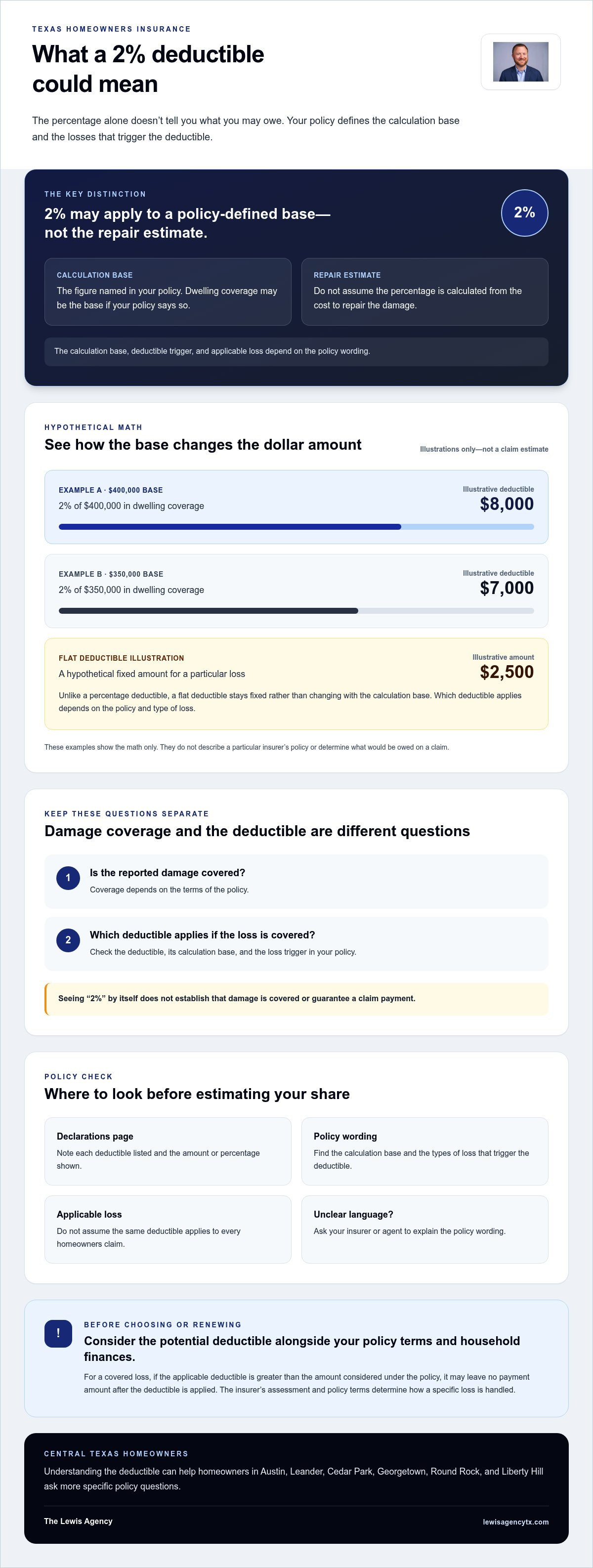
For a simple hypothetical example, 2% of $400,000 in dwelling coverage is $8,000. That figure isn’t a promise about what you’d owe on a claim. The deductible that applies depends on your policy’s wording, the cause of the damage, and any stated trigger. A percentage deductible can work very differently from a flat dollar deductible, so check which one applies before a storm.
This article explains how the calculation may work, what it could mean for a covered loss, and where to check your policy documents. If you’re reviewing homeowners coverage in Austin, Central Texas, Leander, Cedar Park, Georgetown, Round Rock, or Liberty Hill, understanding the deductible can help you ask more specific questions when choosing or renewing a policy.
Key Takeaways
- A percentage deductible may be calculated using a base stated in your policy, not the repair estimate. Check the wording before estimating what you might pay.
- If your Texas policy has a 2% deductible, confirm which types of loss trigger it.
- Find the declarations page, note each deductible listed, and check the policy wording for the calculation base and applicable losses.
- A deductible is only one part of a coverage decision. Consider its potential cost alongside your policy’s terms and your household finances.
- The Lewis Agency works with homeowners to identify risks and match them with appropriate coverage, including policy limits and endorsements suited to their needs.
What does a 2% homeowners insurance deductible mean in Texas?
A percentage deductible is calculated using a base identified in the policy, rather than automatically using the repair estimate. The base and the losses that trigger the deductible can vary by insurer, policy form, and endorsements. In general, a deductible is the amount applied to a covered loss under the policy before any claim payment is considered. For a broader overview, see this explanation of an insurance deductible.
So, a 2% deductible doesn’t necessarily mean you pay 2% of your roof repair bill. The percentage alone doesn’t tell you the dollar amount. Find the calculation base in your own policy documents before estimating your share.
What figure might a 2% deductible apply to?
Check the declarations page and the policy wording for the base used to calculate the deductible. Dwelling coverage may be the base if your policy says so, but don’t assume that applies to every Texas policy. Look for the stated percentage, the figure it applies to, and the types of loss for which it applies.
If those details aren’t clear, ask your insurer or agent to explain the wording. A quote or summary may not include all the terms that appear in the policy.
How is a percentage deductible different from a flat deductible?
A percentage deductible is a policy-defined share of a specified base, while a flat deductible is a fixed dollar amount. Which applies depends on the policy and the type of loss. Both are ways a policy may set the homeowner’s deductible. Don’t assume one replaces or applies alongside the other without checking the documents.
Here’s a hypothetical calculation, not a statement about a particular insurer’s policy: if a policy identifies $350,000 in dwelling coverage as the base, a 2% deductible using that base would be $7,000. If a separate hypothetical policy instead lists a flat $2,500 deductible for a particular loss, that amount would stay fixed rather than rise or fall with the selected calculation base. These figures illustrate the math only.
For Texas homeowners considering a 2% deductible, the policy’s specific wording, not a general example, determines the calculation. Before estimating what you might pay, verify the deductible amount, its calculation base, and its trigger in your documents. Whether the damage itself is covered is a separate question, also determined by the policy terms.
How a Texas 2% deductible may affect a wind or hail claim
After a hailstorm in Central Texas, a homeowner may see roof damage and wonder whether a 2% deductible applies. The answer depends on the policy’s wording. A percentage deductible applies only to the types of loss identified in the policy and when its stated conditions are met.
Keep two questions separate. First, does the policy cover the reported damage? Second, which deductible applies if the loss is covered? A deductible doesn’t establish that damage is covered or guarantee a claim payment. For broader context on Texas homeowners policies and deductibles, see the Texas Department of Insurance Home insurance guide.
Does a 2% deductible apply to every homeowners claim?
Not necessarily. A policy may describe different deductibles for different causes of loss, but don’t assume every Texas policy has a separate wind or hail deductible. Check the declarations page and policy wording for the loss trigger and the deductible that applies. If the wording is unclear, ask your insurer or agent to explain it.
Imagine a hypothetical hailstorm damages a home in Round Rock. The policy’s terms would determine whether the reported damage is covered and whether the wind or hail deductible applies. Seeing “2%” on a document alone doesn’t answer either question. For homeowners researching “2 percent homeowners insurance deductible texas,” the policy’s specific wording is the useful guide, not the percentage in isolation.
What if the damage estimate is less than the deductible?
If a loss is covered and the applicable deductible is greater than the amount considered under the policy, the deductible may leave no payment amount after it is applied. That’s a general explanation, not a claim outcome. The insurer’s assessment and the policy’s terms determine how a particular loss is handled.
If you receive an estimate below your deductible, don’t treat that figure alone as a coverage decision. Confirm which deductible applies, what amount the insurer is evaluating, and whether other policy terms affect the claim. Your insurer can answer questions about a specific claim. An agent can help clarify policy language.
Before storm season, identify the trigger and deductible in your documents. If you’re choosing or reviewing homeowners coverage, contact The Lewis Agency to discuss your coverage needs. The agency works with homeowners in Austin, Central Texas, Leander, Cedar Park, Georgetown, Round Rock, and Liberty Hill to identify risks and match them with appropriate policies.
How to check whether your Texas policy has a 2% deductible
A review of your policy documents can help you understand whether a 2% deductible applies and what the percentage means. Start with the declarations page, then use the full policy and any endorsements to confirm how the deductible works. The declarations page is a useful summary, but a short label may not explain every condition.
If you’re searching for a “2 percent homeowners insurance deductible texas” explanation, use general information as a starting point. Your own documents determine the calculation base, which types of loss may trigger the deductible, and how it works with other policy terms.
Where should you look on the declarations page?
Find the section that lists deductibles. Look for a percentage and any wording that identifies wind, hail, or another cause of loss. Note the exact language and any amount or coverage limit the percentage may be based on.
Next, check the full policy wording and endorsements. A label such as “wind/hail” may not explain all the conditions that determine when the deductible applies. If a term is unclear, don’t rely on the label alone.
The Texas homeowners insurance deductibles guide can provide additional context as you review your documents.
Which questions should you ask about the deductible?
Use the policy wording when you contact your insurer or agent. Specific questions can help clarify how the terms apply to your coverage:
- What is the calculation base? Ask what amount or limit the percentage is applied to under this policy.
- Which losses trigger it? Confirm the causes of loss named in the policy and whether the deductible applies to the event you’re asking about.
- How does it work with other terms? Ask how the deductible interacts with other applicable deductibles, conditions, or endorsements.
For example, if the documents list a percentage but don’t clearly state what it applies to, ask the insurer or agent to point to the relevant policy language. Avoid estimating your out-of-pocket share from the percentage alone.
Keep a note of the answers alongside your policy documents, especially when reviewing coverage before renewal or storm season. Terms can vary by insurer, policy form, endorsements, and individual circumstances, so a general explanation may not settle a question about your specific policy. Confirm the percentage, calculation base, and loss trigger using the documents that apply to your home.
How to weigh a 2% deductible before choosing or renewing coverage
A deductible is one part of a homeowners policy decision, not a stand-alone measure of whether coverage fits your needs. Consider the policy’s coverage and exclusions, the deductible’s calculation base, and whether your household could manage the amount if a covered loss occurred. The right choice depends on your circumstances and the exact policy terms.
Don’t compare quotes by percentage alone. A “2%” figure can’t tell you the potential dollar amount unless you know what the policy applies it to and which loss triggers it. Review the actual deductible wording in the proposed policy, and check that you understand the calculation before deciding. Choosing a higher or lower deductible doesn’t guarantee a particular premium change or savings.
What should homeowners consider alongside the percentage?
Start with the policy’s stated calculation base, then consider whether the resulting deductible would be manageable for your household. Also review roof coverage separately. The deductible describes your share of an applicable covered loss, while roof settlement terms address how the policy may value covered roof damage. For help understanding that distinction, see this guide to actual cash value versus replacement cost for a Texas roof.
These are related but different policy questions. A deductible figure alone doesn’t explain how roof damage may be settled, and settlement wording doesn’t tell you which deductible applies. Look at both parts of the policy rather than assuming one answers the other.
What should you clarify before renewal?
Compare your current policy with the proposed renewal documents. Check whether the deductible percentage, calculation base, or stated loss triggers have changed. If a term is unfamiliar, ask your insurer or agent to explain it using the actual policy wording before deciding whether to renew or change coverage.
It can help to write down what you want clarified: the amount the percentage applies to, the losses that trigger it, and how roof settlement terms work. For wider context on reviewing policy details, consult this Austin homeowners insurance coverage guide.
A search for “2 percent homeowners insurance deductible texas” can provide a general starting point, but your policy documents are what matter for your decision. If you’re considering homeowners coverage or reviewing your options, contact The Lewis Agency to discuss your coverage needs. The agency works with homeowners across Austin, Central Texas, Leander, Cedar Park, Georgetown, Round Rock, and Liberty Hill, helping identify risks and match them with appropriate policies.
Where Central Texas homeowners can get help understanding a 2% deductible
Before you need to make a claim, take a few minutes to find the deductible wording in your policy. Confirm the percentage, identify the amount or limit it’s calculated against, and check which types of loss may trigger it. Those details make “2 percent homeowners insurance deductible texas” more concrete, but only your policy documents can explain how the terms apply to your home.
The Lewis Agency works with homeowners in Austin, Central Texas, Leander, Cedar Park, Georgetown, Round Rock, and Liberty Hill. Its homeowners insurance service helps clients consider their risks, policy limits, and endorsements when choosing coverage. The insurer and policy terms govern whether a loss is covered and what a claim will pay.
What an agency can and cannot clarify
An agency can help you understand coverage options and identify questions to ask about policy wording. That guidance can make it easier to consider how limits and endorsements relate to your needs, but it doesn’t change the contract. The insurer makes coverage, claim, underwriting, and renewal decisions. For a specific claim or final interpretation, refer to the governing policy documents and confirm details with the insurer.
This distinction matters. A general explanation can help you understand what to look for, but it can’t guarantee how the terms will apply to a particular loss. Policy language, endorsements, and circumstances all matter.
A practical next step for Austin and Central Texas homeowners
Review your deductible before storm season or policy renewal, rather than waiting until you’re trying to understand it during a stressful situation. Have your declarations page and the relevant policy wording ready. If a term is unclear, note the exact wording and ask what the calculation base is, which loss triggers the deductible, and how other policy terms may affect its application.
That preparation can help you have a more focused conversation with your insurer or agent. It also gives you a chance to consider whether the deductible amount would fit your household finances, without assuming a particular claim outcome.
If you’re choosing or reviewing homeowners coverage, learn more about The Lewis Agency and discuss your needs. The agency works with homeowners in Austin, Central Texas, Leander, Cedar Park, Georgetown, Round Rock, and Liberty Hill to identify risks and match them with appropriate coverage.
Review your deductible before the next storm
A 2% deductible is easier to assess once you know the calculation base and which losses trigger it. The percentage alone doesn’t tell you what you might owe, and it doesn’t determine whether damage is covered. Check the declarations page and full policy wording, then consider the deductible alongside your roof coverage and household finances.
Understanding the “2 percent homeowners insurance deductible texas” homeowners may see in a policy starts with those specific terms, not a general example. Insurance coverage and wording vary, so confirm unclear details with your insurer or agent before renewal or a claim.
If you’re a homeowner in Austin, Central Texas, Leander, Cedar Park, Georgetown, Round Rock, or Liberty Hill and want to discuss coverage options, contact The Lewis Agency. The agency works directly with clients to identify risks and match them with appropriate homeowners policies. Review your policy terms with your insurer for answers about a specific claim.
Frequently Asked Questions
Is a 2% wind and hail deductible based on my home's value?
Not necessarily. Your policy identifies the calculation base, so don’t assume the percentage applies to your home’s market value or the repair cost. Check the declarations page and the applicable policy wording for the amount or limit used and the losses that trigger the deductible. If the base isn’t clear, ask your insurer or agent to explain how the actual calculation works for your policy.
How do I calculate a 2% homeowners insurance deductible?
Use this formula only if your policy confirms the base: stated calculation base × 0.02. For example, if a hypothetical policy specifies a $300,000 base, the calculation would be $300,000 × 0.02, or $6,000. This illustrates the math, not a standard Texas policy structure. The resulting deductible applies only as the policy describes for a qualifying loss, so confirm both the base and loss trigger in your documents.
Does a 2% deductible apply to every homeowners insurance claim in Texas?
No, don’t assume a percentage deductible applies to every claim or every cause of damage. The applicable deductible and its trigger depend on the specific policy and loss. Check the declarations page for deductible entries, then review the policy wording for conditions or endorsements that explain when each applies. If the trigger is uncertain, ask your insurer or agent to clarify it using your actual policy documents.
Can I change my 2% deductible when my homeowners policy renews?
That depends on the insurer and the renewal terms. Ask whether any deductible options are available and what policy wording would change before assuming you can select a different amount. A change shouldn’t be treated as a guaranteed way to save money or alter your premium by a particular amount. Review the proposed renewal documents alongside your current policy so you can understand the terms before deciding.
What happens if hail damage costs less than my deductible?
A deductible generally reduces an otherwise covered payment according to the policy. If an estimate is below the applicable deductible, that may mean no payment is made, but an estimate alone doesn’t establish coverage or the final claim amount. The insurer evaluates the claim under the policy terms. Report damage concerns as appropriate, and ask your insurer about the claim and which deductible applies.
Where can I find my Texas homeowners insurance deductible?
Start with your declarations page and locate the deductible amount or percentage. If the summary doesn’t explain the calculation base or applicable loss, check the full policy and endorsements. An agent can help clarify policy language, while the policy and insurer govern coverage and claim decisions. The Lewis Agency works with homeowners in Austin, Central Texas, Leander, Cedar Park, Georgetown, Round Rock, and Liberty Hill.

Article by
Chris Lewis
Chris Lewis is the owner of The Lewis Agency, an Allstate insurance agency serving Austin and Central Texas. With more than 25 years of insurance experience, Chris focuses on helping Central Texas homeowners better understand their insurance coverage, including deductibles, roofs and hail, severe weather risks, water damage and other important coverage considerations. He created LewisAgencyTX.com to provide practical homeowners insurance education and help homeowners better understand their coverage before they need it.