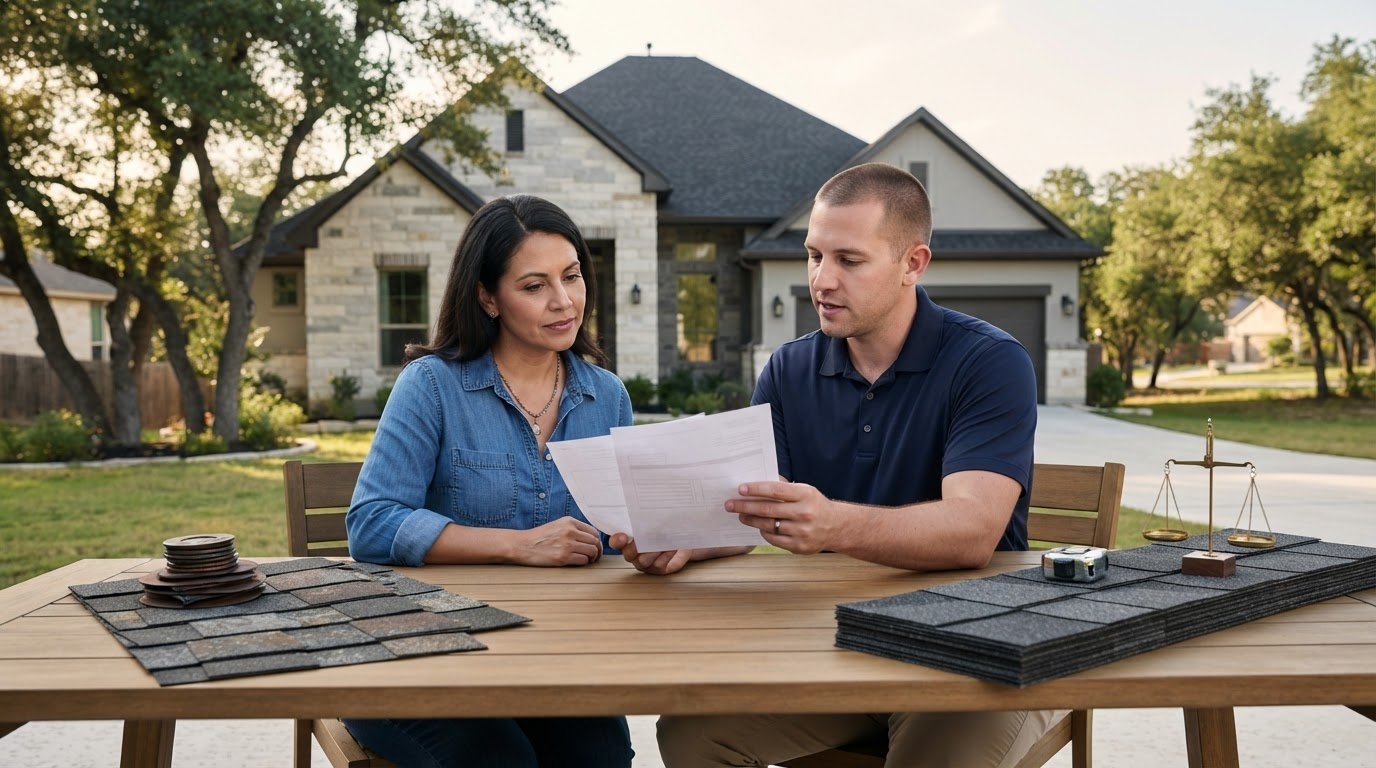
Could two homeowners with similar hail damage receive very different roof claim payments? Policy wording, depreciation, and claim conditions may help explain the difference. If you’re searching “actual cash value vs replacement cost roof texas,” you’re likely trying to understand what those terms could mean for your roof in Austin, Central Texas, Leander, Cedar Park, Georgetown, Round Rock, or Liberty Hill.
It’s easy to mix up the valuation method, the deductible, and a repair estimate, especially after a storm. Actual cash value generally accounts for depreciation, while replacement-cost coverage may handle depreciation differently. The exact terms and claim process depend on the policy.
This guide explains the basic difference, shows what policy language and conditions to check, and offers questions to ask before a storm. The Lewis Agency helps homeowners choose coverage limits and endorsements based on their dwelling and financial needs. The goal here is to help you read your policy with greater confidence, not predict a claim outcome.
Key Takeaways
- For “actual cash value vs replacement cost roof texas,” the key difference is how the policy treats depreciation when valuing roof damage.
- Check your declarations page and policy documents for roof valuation terms and endorsements that may affect coverage.
- Review the deductible separately from depreciation. They are distinct parts of a claim calculation.
- Look for payment conditions and claim requirements, and note what you want clarified before a storm.
- The Lewis Agency can help you understand homeowners coverage options, limits, and endorsements. The insurer makes claim decisions based on the policy and circumstances.
What ACV and Replacement Cost Mean for a Texas Roof
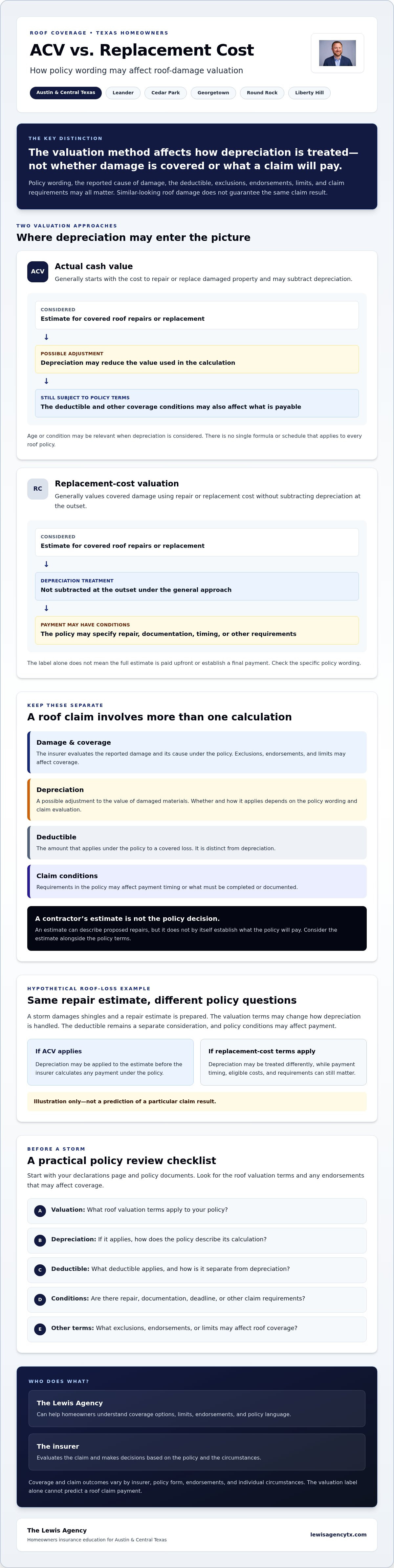
Actual cash value (ACV) and replacement cost are methods a policy may use to value covered roof damage. They describe how the insurer calculates a loss, not whether the damage is covered or exactly what a claim will pay. The question behind “actual cash value vs replacement cost roof texas” is how depreciation and other policy terms may affect the value assigned to roof damage.
In general, ACV starts with the cost to repair or replace damaged property and may subtract depreciation. Replacement-cost valuation generally does not subtract depreciation at the outset. For a neutral overview of the basic ACV concept, see Actual Cash Value (ACV). Your policy’s wording, endorsements, exclusions, deductible, and claim requirements still matter. Neither label alone guarantees that a roof will be replaced or establishes the final payment.
What does actual cash value mean for roof damage?
Depreciation is an adjustment that may reflect a roof’s age, condition, or wear, depending on the policy terms. It can reduce the value used to calculate a claim, but that estimated value is not necessarily the amount ultimately payable. Other terms, including the deductible and coverage conditions, may also affect the calculation.
Hypothetical example: A storm damages shingles, and an estimate is prepared for the covered repair. If the policy uses ACV, depreciation may be applied to that estimate before the insurer calculates any payment under the policy. The estimate, depreciation adjustment, and deductible are separate considerations. This example does not predict a particular claim result.
What does replacement cost mean for a roof?
Replacement cost generally values covered damage based on the cost to repair or replace it without subtracting depreciation at the outset. That does not necessarily mean the insurer pays the full estimate upfront or in every situation. The policy may set conditions for when or how replacement-cost benefits are paid, such as requirements to complete repairs or provide documentation. Check the specific wording rather than relying on the label alone.
For example, if a covered roof loss has a repair estimate, replacement-cost terms may treat depreciation differently from ACV terms. Payment timing, eligible costs, limits, and other requirements can still affect what is payable. Coverage and claim outcomes vary by insurer, policy form, endorsements, and individual circumstances.
How Depreciation and Policy Conditions Can Affect Roof Settlement
A roof claim involves more than choosing between ACV and replacement cost. The insurer evaluates the reported damage and its cause, applies the policy terms, and considers an estimate alongside those terms. Exclusions, endorsements, limits, and claim requirements may also affect the settlement. A contractor’s estimate can describe proposed repairs, but it does not by itself establish what the policy will pay.
The valuation method alone cannot predict a roof claim payment. Coverage, depreciation, the deductible, and policy conditions all matter.
Keep the deductible separate from depreciation. Depreciation is a possible adjustment to the value of damaged materials. A deductible is the amount that applies under the policy to a covered loss. They are different parts of a claim calculation, and the policy wording determines how they apply.
How is roof depreciation considered?
Age and condition may be relevant when depreciation is considered, but there is no single formula or schedule that applies to every roof policy. The policy wording and claim evaluation govern whether depreciation applies and how it is calculated. Do not assume that a particular roof age automatically produces a fixed reduction. Review the terms that apply to your policy and ask for clarification if the calculation is unclear.
Other coverage questions can matter just as much. The policy’s treatment of the reported cause of damage, any exclusions or endorsements, and applicable limits may affect a claim. A hail-damaged roof and a roof with deterioration may raise different coverage questions, depending on the policy and circumstances. Consider an estimate alongside the policy, not in isolation.
Why replacement-cost coverage may involve more than one payment
Some policies may initially withhold depreciation and make it available only after specified claim steps are completed. Conditions vary, so check your policy for deadlines, required documents, repair requirements, or other steps. Do not assume a particular reimbursement process or timeline applies to your roof.
Before authorizing repairs, understand what the insurer has evaluated, which estimate is being used, and whether any payment conditions remain. If the explanation is unclear, ask the insurer or your insurance professional to point out the relevant policy language. Homeowners can also review their homeowners coverage with The Lewis Agency and discuss policy options, limits, and endorsements. Claim decisions and payments are determined by the insurer.
ACV vs. Replacement Cost: What Texas Homeowners Should Compare
When comparing actual cash value vs replacement cost roof texas coverage, look beyond the label. Check how depreciation is handled, whether payment depends on completing repairs, and what the policy requires from you. Replacement-cost coverage does not automatically mean full reimbursement. The deductible, covered damage, limits, exclusions, and claim conditions may affect the final amount.
| What to compare | ACV | Replacement cost | What to verify |
|---|---|---|---|
| Depreciation | May be deducted based on policy terms and claim evaluation. | Generally is not deducted at the outset, but terms vary. | How does the policy define roof valuation and depreciation? |
| Payment conditions | Payment remains subject to coverage terms and the deductible. | Some policies may require certain steps before additional payment is available. | Are repairs, documents, or other claim steps required? |
| Potential out-of-pocket expense | Depreciation may affect the amount available for covered repairs. | Payment may still be affected by the deductible, limits, and policy conditions. | What expenses could remain your responsibility? |
Hypothetical comparison: Imagine the same covered roof damage and repair estimate under two different policy terms. Under ACV terms, depreciation may reduce the amount used to calculate payment. Under replacement-cost terms, depreciation may not be subtracted initially, though the policy could set conditions for receiving an additional amount. The estimate alone does not determine either outcome, and this example does not predict a claim result.
Which roof valuation method may fit your situation?
Consider your budget flexibility, the roof’s condition, and how you would handle a gap between repair costs and available claim funds. Compare the premium and roof coverage shown in your own policy documents. A lower premium by itself does not show whether coverage fits your needs, and neither valuation method is automatically right for every homeowner.
Does roof age decide whether coverage is ACV or replacement cost?
Roof age may affect underwriting or claim valuation, depending on the insurer and policy. But age alone does not establish which method applies or guarantee a change in coverage. Check the current declarations page and any endorsements for roof-specific terms, then ask what wording applies to your home. Do not rely on a general age cutoff instead of reviewing your policy.
How to Review Your Texas Roof Coverage Before a Storm
A policy review is easier before hail or wind damage creates time pressure. Use this sequence to find the roof terms that could shape a claim, then note anything you want clarified. Whether you own a home in Austin, Central Texas, Leander, Cedar Park, Georgetown, Round Rock, or Liberty Hill, confirm what your own policy says instead of relying on a general description of coverage.
- Start with the declarations page. Review the listed property coverage and deductible information. Note whether a separate deductible may apply to wind or hail, then check the policy wording to understand when it applies.
- Confirm the policy form. Find the form identified in your documents and remember that forms and coverage vary by insurer. Do not assume a familiar policy label tells the whole story about roof settlement.
- Look for roof valuation language and endorsements. Search the policy and attached endorsements for terms such as “actual cash value,” “replacement cost,” “roof,” or “depreciation.” Check whether an endorsement changes terms shown elsewhere.
- Review exclusions and claim conditions. Note language that may affect the reported cause of loss, required documentation, repair steps, or deadlines. Ask for clarification if you are unsure what a condition means.
- Keep a record of roof condition. Save relevant inspection, repair, and maintenance records, along with dated photos if available. These records can help describe the roof’s condition, but they do not guarantee coverage or a particular claim payment.
Which policy documents and terms should you check?
Read the declarations page together with the full policy and endorsements. The declarations page can point you to listed coverage and deductible details, while the policy wording explains terms, exclusions, and conditions. The Texas Department of Insurance offers consumer information about homeowners coverage. Check its current guidance and compare it with your policy language.
What should you ask after hail or storm damage?
Record what you observe and preserve relevant maintenance or repair documents. Before authorizing work, ask the insurer how the policy describes roof valuation and which claim steps apply. Do not assume damage is covered based on appearance alone. Coverage depends on the policy and circumstances, and the insurer makes claim determinations.
If you want help discussing your homeowners coverage options, limits, or endorsements, ask The Lewis Agency about your roof coverage. Bring your policy documents and questions so the discussion can focus on the wording that applies to your home.
How The Lewis Agency Can Help You Understand Roof Coverage
Roof valuation language can be difficult to interpret on your own. The Lewis Agency works directly with clients to identify risks and match them with appropriate policies. For homeowners in Austin, Central Texas, Leander, Cedar Park, Georgetown, Round Rock, and Liberty Hill, a conversation about homeowners coverage can help clarify which policy limits or endorsements may suit the dwelling and the homeowner’s needs.
Reviewing your coverage before a storm can help you identify questions while there is time to look up the relevant terms. This discussion does not determine whether damage is covered or how much a claim will pay. The insurer reviews the claim and makes coverage and payment decisions based on the policy and circumstances.
What an insurance agency can clarify about roof coverage
An agency can help you discuss homeowners policy options, limits, and endorsements. You might ask where your documents address roof valuation, which deductible information to review, or whether an endorsement changes the coverage terms. Having the declarations page, full policy, and endorsements available can make it easier to focus on the specific wording in your documents.
Those conversations are about understanding and choosing coverage. They do not replace the insurer’s evaluation of a particular loss or determine claim payments, underwriting, rates, or coverage decisions. If a question depends on how the insurer evaluates reported damage, the insurer is the source for a decision about that claim.
A practical next step for Austin and Central Texas homeowners
Before asking about actual cash value vs replacement cost roof texas, gather your declarations page, full policy, and any endorsements. Mark passages you have questions about and make a short list covering:
- How the policy describes roof valuation and depreciation
- Which deductible information applies to roof damage
- Any exclusions, endorsements, or conditions that may affect a claim
- What steps or documentation the policy requires during the claims process
Having these documents at hand makes it easier to discuss the language that applies to your home, rather than relying on general assumptions about Texas roof claims. Policy terms and coverage vary, so use your own documents as the starting point.
If you have a question about your homeowners policy, ask a question about your homeowners coverage. A conversation can help clarify your coverage options and which questions may need to be directed to the insurer.
Review Your Roof Coverage Before the Next Storm
Understanding actual cash value vs replacement cost roof texas coverage starts with knowing how your policy treats depreciation, which deductible applies, and whether payment depends on specific claim steps. The valuation label alone cannot tell you what a future claim will pay. Your policy wording, endorsements, and circumstances matter.
Review your declarations page and policy documents. Look for roof valuation language, exclusions, applicable deductibles, and claim conditions. If a term is unclear, write down your questions and ask for an explanation before you need to make decisions after a storm.
The Lewis Agency helps clients identify risks and choose appropriate coverage. Homeowners in Austin, Central Texas, Leander, Cedar Park, Georgetown, Round Rock, and Liberty Hill can discuss homeowners policy limits and endorsements with the agency. The insurer makes coverage and claim decisions.
Bring your questions and policy documents together for a clearer conversation. Ask a question about your homeowners coverage and take the next step toward understanding what your policy says.
Frequently Asked Questions
What is the difference between ACV and replacement cost for a roof?
ACV generally values covered roof damage after accounting for depreciation, which may reflect age, condition, or wear under the policy. Replacement-cost valuation generally uses repair or replacement cost without subtracting depreciation at the outset. The phrase “actual cash value vs replacement cost roof texas” refers to this basic distinction, but neither label promises a particular payment. Your policy wording, covered cause of loss, deductible, and claim conditions determine how the terms apply.
Does replacement-cost coverage pay to replace the entire roof?
Not necessarily. Replacement-cost coverage does not guarantee approval of a full roof replacement or full reimbursement of an estimate. The insurer evaluates the reported damage under the policy, and covered damage, deductibles, limits, exclusions, and required claim steps may affect payment. Review your own policy for the applicable terms. If the wording is unclear, ask your insurer or agent to explain it without assuming a particular claim outcome.
How is depreciation calculated on a Texas roof claim?
There is no single depreciation formula or rate that applies to every Texas roof claim. How depreciation is considered depends on the policy wording and the insurer’s evaluation of the claim. Ask how the roof’s age and condition were assessed and where the relevant valuation terms appear in your policy or endorsements. That can help you understand the calculation being used, but it does not establish the final claim payment.
Can an insurer settle a roof claim using ACV in Texas?
The applicable policy and the circumstances of the loss determine how a roof claim may be valued. There is no one answer for every Texas homeowner. Review your policy’s valuation provisions and any roof-related endorsements to see which terms apply. For Texas consumer guidance, consult current information from the Texas Department of Insurance. You can also ask your insurer or agent to explain relevant wording without assuming a specific claim result.
Does roof age affect actual cash value or replacement-cost coverage?
Roof age may affect underwriting or claim settlement, depending on the insurer and policy, but it does not create one universal outcome. Age alone may not tell you which valuation method applies or how a future claim would be handled. Check your policy and any roof-specific endorsements for the terms that apply to your home. Ask your insurer or agent to clarify the wording rather than relying on a general age cutoff.
What should I check in my policy before filing a roof claim?
Look for roof valuation language, applicable deductibles, exclusions, endorsements, documentation requirements, and claim conditions. Your declarations page may identify some coverage and deductible details, but it may not contain every relevant term. Read it alongside the full policy and endorsements. If a provision is unclear, ask your insurer or agent to explain what it says and which claim steps may apply. That explanation can help you understand the process, but it cannot promise a claim result.
Can The Lewis Agency decide whether my roof claim will be paid?
No. The insurer makes coverage and payment decisions based on the policy and circumstances of the loss. The Lewis Agency can help clients identify risks and discuss homeowners policy options, limits, and endorsements, but it cannot control a claim determination or guarantee an outcome. Homeowners in Austin, Central Texas, Leander, Cedar Park, Georgetown, Round Rock, and Liberty Hill can contact the agency with questions about their coverage.

Article by
Chris Lewis
Chris Lewis is the owner of The Lewis Agency, an Allstate insurance agency serving Austin and Central Texas. With more than 25 years of insurance experience, Chris focuses on helping Central Texas homeowners better understand their insurance coverage, including deductibles, roofs and hail, severe weather risks, water damage and other important coverage considerations. He created LewisAgencyTX.com to provide practical homeowners insurance education and help homeowners better understand their coverage before they need it.