Texas Roof Hail Damage Deductible Guide 2026
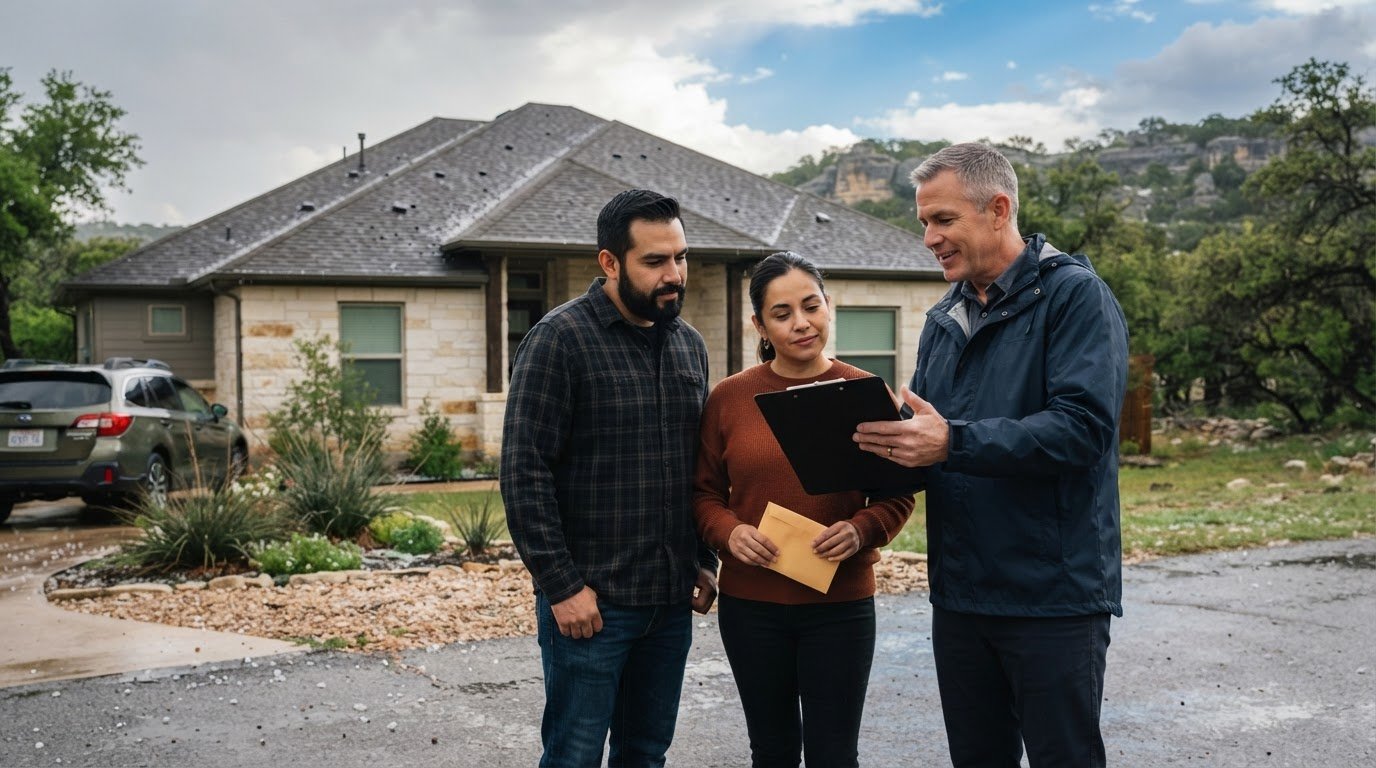
If severe spring weather damages your roof tomorrow, how much will you really pay out of pocket before your coverage kicks in? When examining a roof hail damage deductible insurance Texas homeowners often expect a simple flat fee or a small charge tied to the roofer's repair bill. In reality, wind and hail deductibles scale directly with your home's total dwelling reconstruction limit, which can mean thousands of dollars in sudden out-of-pocket expenses.
It is completely understandable to feel overwhelmed by confusing policy math, especially when you are also trying to interpret actual cash value schedules and strict state deductible payment laws. This guide explains how Texas wind and hail deductibles work so seasonal storm repairs never bring unexpected financial surprises to your household. You will discover how percentage deductibles are calculated against your dwelling limit, learn the critical difference between replacement cost and actual cash value roof coverage, and find out how to review your policy endorsements before severe spring storms arrive.
Key Takeaways
- Texas home policies frequently separate wind and hail damage from standard perils, creating distinct out-of-pocket rules for storm claims.
- When evaluating your roof hail damage deductible insurance Texas policies calculate that percentage against your total dwelling limit rather than the roofer's repair bill.
- The difference between Replacement Cost Value and Actual Cash Value determines whether your insurer pays full replacement costs or subtracts for roof age.
- Texas House Bill 2102 strictly prohibits contractors from paying, waiving, or rebating property insurance deductibles.
- Reviewing your policy declarations page before peak spring storms helps you budget effectively and avoid sudden financial surprises.
How Roof Hail Damage Deductibles Work in Texas Home Insurance
A property insurance deductible represents the specific out-of-pocket amount you agree to pay toward an approved claim before your insurer pays the rest. Understanding how insurance deductibles work as a foundational risk-sharing tool is especially vital in Texas, where severe convective storms routinely drop large hail across entire neighborhoods. In years past, homeowners often paid a simple flat fee like $1,000 for any covered loss. Today, coverage structures have shifted toward percentage-based thresholds that treat severe weather claims distinctly from routine property losses.
The Distinction Between All-Peril and Hail Deductibles
Reviewing your policy declarations page reveals an important layout: Texas carriers routinely separate property perils into distinct buckets. Rather than listing a single deductible, your policy typically outlines two separate amounts:
- All Other Perils (AOP): This applies to standard household losses, including kitchen fires, theft, or sudden pipe bursts. It often remains a manageable flat-dollar amount.
- Windstorm and Hail: This specific clause triggers only when wind, tornadic activity, or severe hail damages your exterior structure.
When evaluating a roof hail damage deductible insurance Texas policies apply this dedicated weather clause rather than your base property threshold. That means an interior water leak from an appliance triggers your standard AOP deductible, but shingles torn apart by spring hailstones trigger the separate wind and hail deductible.
Why Texas Insurers Require Separate Hail Deductibles
Why do carriers separate hail damage from other risks? Texas consistently leads the country in major hail events, creating massive property claim volumes each spring. According to the Insurance Information Institute, Texas recorded 902 major hail events in 2025 alone, more than double any other state. To manage this concentrated weather risk while keeping baseline homeowners insurance premiums accessible, insurers implement split deductible structures. Deductible structures vary across different policy forms and carrier guidelines, making it vital to understand your exact policy terms long before turbulent storm fronts develop.
Calculating Your Percentage Deductible: The Coverage A Equation
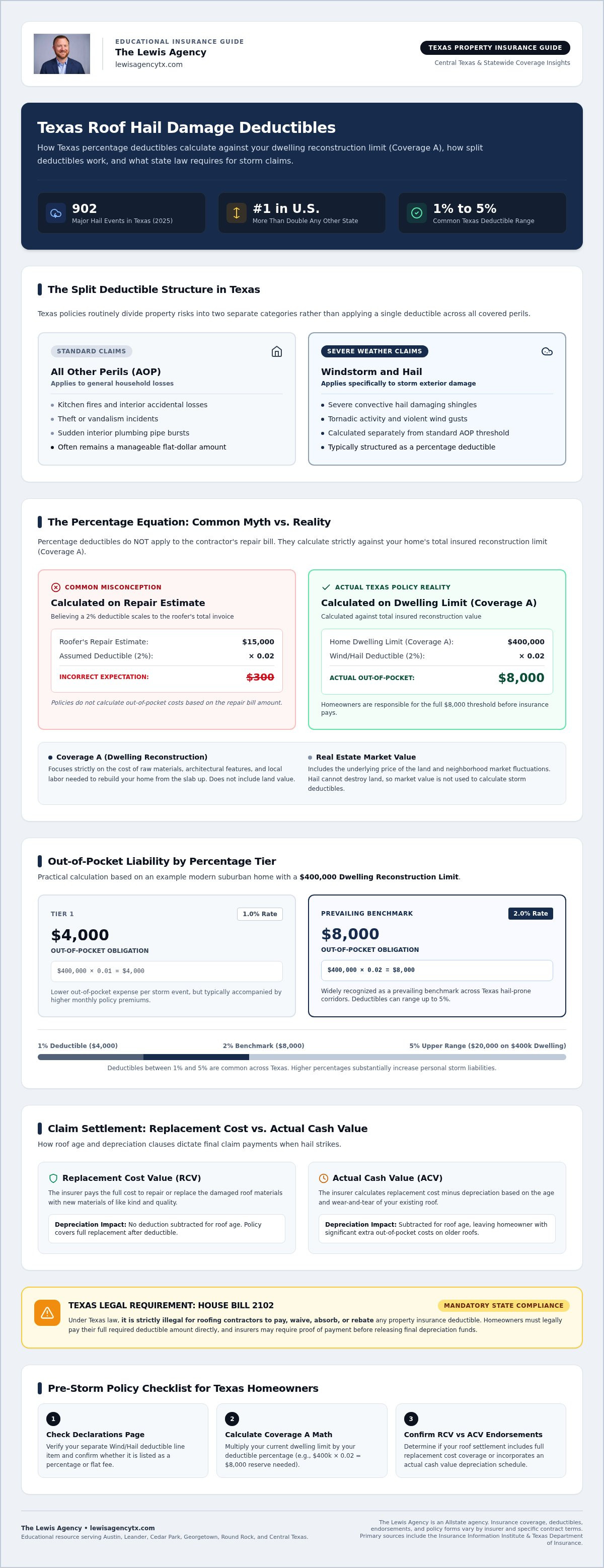
One common misconception among homeowners is assuming a two percent deductible means paying two percent of the roofer's total repair estimate. If an estimate comes out to $15,000, paying two percent would only be $300. That is not how property policies operate. In Texas, percentage deductibles calculate strictly against your policy's Coverage A limit, which represents the total insured reconstruction value of your home. If you want to clarify your policy endorsements and structural limits before storm season arrives, scheduling an educational review with The Lewis Agency can help you verify your numbers.
The Math Behind One Percent and Two Percent Tiers
Many older state consumer guides still rely on outdated home valuations of $150,000, giving families an inaccurate impression of what they might owe. In today's market, modern suburban replacement costs tell a different story. Consider a dwelling limit of $400,000 to see how the percentage equation works in practice:
- 1% Wind/Hail Deductible: $400,000 multiplied by 0.01 equals an out-of-pocket obligation of $4,000.
- 2% Wind/Hail Deductible: $400,000 multiplied by 0.02 equals an out-of-pocket obligation of $8,000.
Deductibles between 1% and 5% are common across the state, with 2% widely recognized as a prevailing benchmark in hail-prone corridors. When factoring your roof hail damage deductible insurance Texas carriers apply this formula directly. A higher percentage significantly increases your personal out-of-pocket liability whenever severe weather strikes.
Dwelling Coverage Versus Real Estate Market Value
Coverage A does not reflect what you paid for your home or what a buyer might offer tomorrow. Real estate market values include the price of the underlying land, which cannot be destroyed by a hailstorm. Instead, Coverage A focuses entirely on the cost of raw materials, architectural features, and local labor needed to rebuild your home from the slab up. Official Texas Department of Insurance roof guidance highlights how critical these policy limits are when settling claims.
Keep in mind that most homeowners insurance policies include an automatic inflation guard. This endorsement periodically adjusts your dwelling limit upward to keep pace with rising construction and material expenses. While this safeguards you against underinsurance, it also steadily increases your nominal dollar deductible over time, even if your deductible percentage stays exactly the same.
Replacement Cost Versus Actual Cash Value on Hail-Damaged Roofs
Even after calculating your exact deductible, your final out-of-pocket obligation hinges on how your policy values your roof structure. Settling storm losses involves more than just subtracting your deductible from contractor estimates. The structural settlement valuation method specified in your policy determines whether you only pay your deductible or absorb thousands of dollars in architectural depreciation on top of it.
How Depreciation Impacts Out-of-Pocket Roof Expenses
Settlement terms fall into two main valuation categories. Replacement Cost Value (RCV) pays to repair or replace damaged shingles with comparable modern materials without reductions for age, subject to policy limits. Insurers typically disburse RCV payouts in two stages: an initial payment reflecting actual cash value, followed by a second check for recoverable depreciation once you provide proof of completed repairs.
Actual Cash Value (ACV) functions differently. Under ACV terms, the insurer deducts accumulated wear and tear before issuing payment. That depreciation is non-recoverable. As the Insurance Information Institute's deductible breakdown notes, your deductible applies directly to the settled loss amount. When filing under a roof hail damage deductible insurance Texas homeowners holding ACV policies must fund both their full percentage deductible and the accrued roof depreciation entirely on their own.
Understanding Roof Schedules and Cosmetic Waivers
Insurers across Texas increasingly attach specific roof endorsements at policy renewal, particularly when shingles reach 10 to 15 years of age. Understanding these clauses prevents unpleasant surprises when adjusters inspect your property:
- Roof Surface Payment Schedules: These endorsements establish a sliding payout scale based on shingle age. As your roof gets older, the carrier pays a smaller percentage of replacement costs, requiring you to self-insure the remaining balance.
- Cosmetic Damage Waivers: Many policies covering metal or Class 4 impact-resistant roofs now exclude cosmetic damage. If severe hail leaves visible dents or dimples across metal panels but does not puncture the surface or compromise water-shedding performance, the carrier may deny the claim entirely.
Reviewing these endorsements early ensures you know exactly how age and cosmetic criteria affect your roof hail damage deductible insurance Texas coverage before severe thunderstorms roll in.
Texas Law and Hail Deductibles: Understanding House Bill 2102
Following intense hail storms, homeowners often encounter roofing vendors promising to handle the entire repair without any out-of-pocket expense. Texas law strictly prohibits these arrangements. Under Texas Insurance Code Chapter 707 and Texas Business and Commerce Code Section 27.02, codified by House Bill 2102, roofing contractors cannot lawfully pay, waive, absorb, rebate, or credit any portion of a property deductible. The statute ensures that policyholders take personal financial responsibility for their contracted share of storm restoration.
Why Free Roof Offers Create Legal Risks
Door-to-door sales pitches advertising a free roof might sound tempting, but agreeing to one carries genuine legal danger. To bypass your deductible, an unscrupulous contractor must typically submit inflated or altered invoices to your carrier, asserting that you paid costs you never actually covered. Concealing unpaid deductibles through deceptive billing constitutes criminal insurance fraud. Under Texas law, violations are classified as a Class B misdemeanor, punishable by fines up to $2,000, up to 180 days in county jail, or both. Any repair contract over $1,000 must include a mandatory consumer disclosure stating in bold type that the law requires you to pay your deductible.
Proof of Payment Requirements for Insurance Claims
Carriers actively verify compliance before releasing claim funds. Under state law, insurers issuing replacement cost coverage possess the explicit statutory authority to demand reasonable proof of deductible payment before disbursing withheld recoverable depreciation. Adjusters frequently ask for verified records, such as:
- Cleared bank checks or electronic transaction receipts
- Credit card billing statements showing the processed transaction
- Formal installment loan or financing contracts obligating you to full payment
Without acceptable proof, the carrier will simply withhold that second depreciation check. When handling a roof hail damage deductible insurance Texas property owners should always request itemized invoices matching the approved adjuster scope of loss. If you want to confirm your coverage limits and understand how state deductible mandates apply to your property, reach out to The Lewis Agency for a personalized policy checkup.
Preparing Your Roof Coverage Before Central Texas Hail Season
Peak hail activity across Central Texas typically hits hardest from March through June, when warm Gulf moisture collides with drylines and advancing cold fronts. Waiting until severe thunderstorm alerts sound across your neighborhood is the worst time to discover gaps in your coverage. Preparing ahead of time ensures that storm damage leads to a smooth recovery rather than unexpected out-of-pocket expenses.
Balancing Deductible Choices Against Premium Budgets
Selecting the right deductible requires balancing your ongoing premium costs against your household emergency savings. Choosing a higher percentage deductible can help reduce your regular homeowners insurance premium. However, it also demands substantial liquid cash if baseball-sized hail hammers your roof. When budgeting for your roof hail damage deductible insurance Texas guidelines emphasize matching your cash reserves to your actual dollar exposure rather than an abstract percentage.
Upgrading your roof materials can also make a meaningful financial difference. Many carriers offer policy discounts for homes protected by UL 2218 Class 4 impact-resistant shingles or qualified metal roofing systems. While discount options vary by carrier and policy contract, these durable products resist hail impact effectively, reducing the likelihood of minor claims while protecting your structure.
Reviewing Your Policy with The Lewis Agency
Before spring storms arrive, take a moment to audit your declarations page. You will want to verify whether your roof is covered under full replacement cost terms or a depreciated roof surface payment schedule. You should also check whether your Coverage A dwelling limit still accurately reflects current Central Texas construction costs. Additionally, scheduling a qualified roof inspection during calm weather creates a clear photo record of your pre-storm shingle condition, giving you documented proof should a disputed claim arise later.
Understanding your coverage details shouldn't feel like navigating a maze alone. As a dedicated Allstate agency serving Austin, Cedar Park, Leander, Round Rock, and neighboring communities, Chris Lewis at The Lewis Agency provides neighborly, educational guidance to help you examine your dwelling limits and understand your storm endorsements. Taking time to review your roof hail damage deductible insurance Texas coverage today gives you the clarity and confidence needed to weather whatever the Texas skies bring this season.
Take Control of Your Hail Coverage Before the Next Storm
Navigating seasonal storm repairs starts with clarity, not guesswork. When evaluating a roof hail damage deductible insurance Texas homeowners must remember that their out-of-pocket obligation scales with their total dwelling reconstruction limit rather than the roofer's repair estimate. Knowing whether your policy provides full replacement cost protection or enforces actual cash value depreciation schedules ensures you aren't blindsided by repair costs. Combined with state laws requiring policyholders to pay their full deductible, auditing your terms ahead of time is the best way to protect your household budget.
You don't have to decipher complex policy declarations on your own. As a dedicated Allstate agency serving Austin, Round Rock, Cedar Park, and surrounding Central Texas communities, The Lewis Agency is here to support you. Insurance professional Chris Lewis provides grounded, personal guidance to help you examine your dwelling limits, understand weather endorsements, and answer your storm deductible questions. Review your roof hail coverage with The Lewis Agency today so you can face severe weather season with confidence.
Frequently Asked Questions
What is a typical roof hail damage deductible for Texas homeowners?
Most Texas homeowners carry a wind and hail deductible between 1% and 2% of their home's Coverage A limit, though policies can range up to 5%. For a home insured for $400,000, a standard 2% deductible equals $8,000 in out-of-pocket costs. In Central Texas communities like Round Rock and Cedar Park, percentage deductibles have become the regional standard because severe spring thunderstorms produce frequent hail events across Travis and Williamson counties.
Can a Texas roofing contractor legally pay or waive my deductible?
No, it is illegal for any roofing contractor to pay, waive, rebate, or absorb your deductible under Texas law. House Bill 2102 established that policyholders must pay their full deductible directly. Contractors offering to cover your deductible commit a Class B misdemeanor, and homeowners who knowingly participate in these billing schemes can face criminal insurance fraud penalties. Legitimate contractors will always invoice you directly for the deductible amount required by your policy contract.
Is my hail deductible calculated from the repair estimate or dwelling limit?
Your deductible is calculated strictly from your total Coverage A dwelling limit, never from the contractor's repair estimate or the real estate market value of your property. For a roof hail damage deductible insurance Texas carriers apply your stated percentage directly against your insured structure limit. If your home has a $450,000 dwelling limit with a 1% deductible, your out-of-pocket obligation is $4,500, regardless of whether roof repairs cost $6,000 or $25,000.
What happens if storm damage repairs cost less than my deductible?
If the total cost to fix hail damage falls below your deductible amount, your insurance carrier pays zero dollars toward the repair. For instance, if an adjuster estimates roof repairs at $3,500 but your 1% deductible on a $500,000 home is $5,000, the expense rests entirely on you. Homeowners across Austin and Pflugerville should obtain an independent inspection before filing a claim for minor damage to avoid an unnecessary claim on their record.
How do replacement cost and actual cash value roof coverage differ?
Replacement Cost Value (RCV) pays to repair or replace your hail-damaged roof with new materials of similar quality without factoring in roof age, once repairs are completed. Actual Cash Value (ACV) subtracts depreciation based on how old your shingles are before calculating payment. With an ACV policy, you must pay both your deductible and the accumulated depreciation out of pocket, which can leave you covering a substantial portion of total roof replacement costs.
Why does my Texas insurance policy list two different deductibles?
Texas policies frequently separate standard perils from weather risks to manage extreme storm exposure. Your policy typically lists an All Other Perils (AOP) deductible for indoor risks like burst pipes or kitchen fires, alongside a separate wind and hail deductible. Evaluating your roof hail damage deductible insurance Texas documents will show that this split structure allows carriers to offer more manageable baseline premiums while accounting for the high volume of spring storms across Central Texas.
Can my insurer alter my roof deductible percentage upon renewal?
Yes, carriers can adjust deductible terms, raise percentage thresholds, or switch older roofs to actual cash value schedules when your policy renews. Insurers issue formal notice endorsements in renewal packets when these underwriting changes happen. Homeowners in growing areas like Leander and Buda should review their renewal declarations pages each year. Chris Lewis at The Lewis Agency helps local homeowners review their policy forms annually to ensure storm deductibles remain clear and manageable.

Article by
Chris Lewis
Chris Lewis is the owner of The Lewis Agency, an Allstate insurance agency serving Austin and Central Texas. With more than 25 years of insurance experience, Chris focuses on helping Central Texas homeowners better understand their insurance coverage, including deductibles, roofs and hail, severe weather risks, water damage and other important coverage considerations. He created LewisAgencyTX.com to provide practical homeowners insurance education and help homeowners better understand their coverage before they need it.